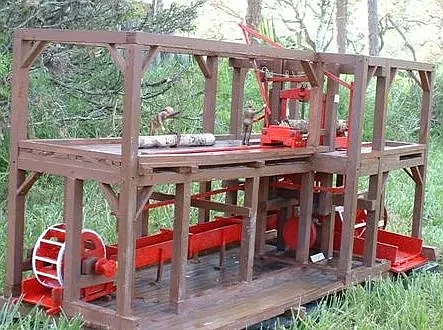
"A British Period Sawmill" model, created by archaeologist William M. Jones depicts how Hewitt's Sawmill may have appeared during Florida's British colonial period. Courtesy of the Flagler County Historical Society.
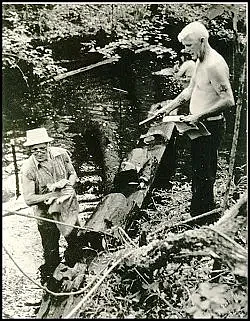
Archaeologist William M. Jones stands at the Hewitt's Sawmill site, where his 1977 investigations helped identify and document the remains of the colonial-era lumber operation along the original Kings Road corridor. Courtesy of the Flagler County Historical Society.
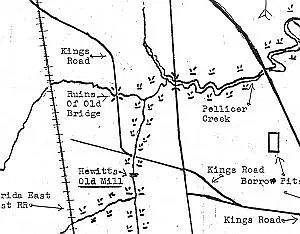
A map drawn by archaeologist William M. Jones identifies the location of Hewitt's Sawmill and related features along the original Kings Road corridor, helping document one of Flagler County's most significant colonial-era archaeological sites. Courtesy of the Flagler County Historical Society.
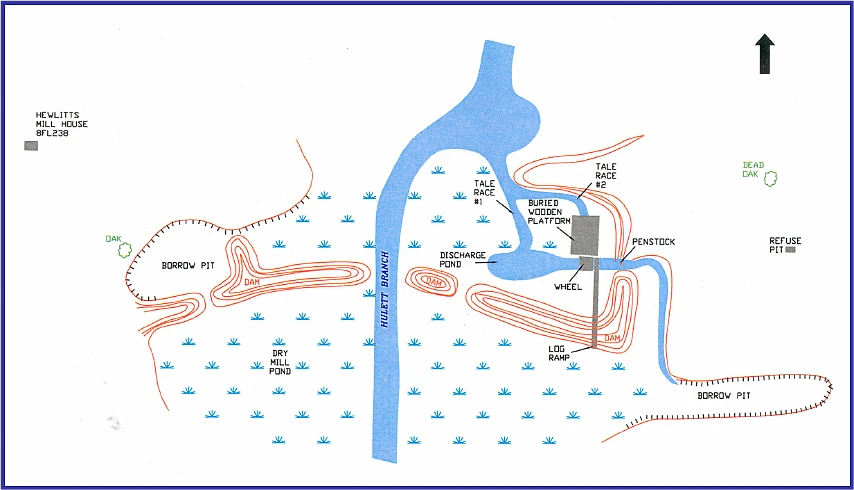
Collection ponds stored water brought south from Pellicer Creek through Hewitt Branch, supplying the hydraulic system that powered Hewitt's Sawmill in the late 1700s. The engineered waterworks helped drive one of colonial Florida's earliest industrial operations. Courtesy of the Flagler County Historical Society.
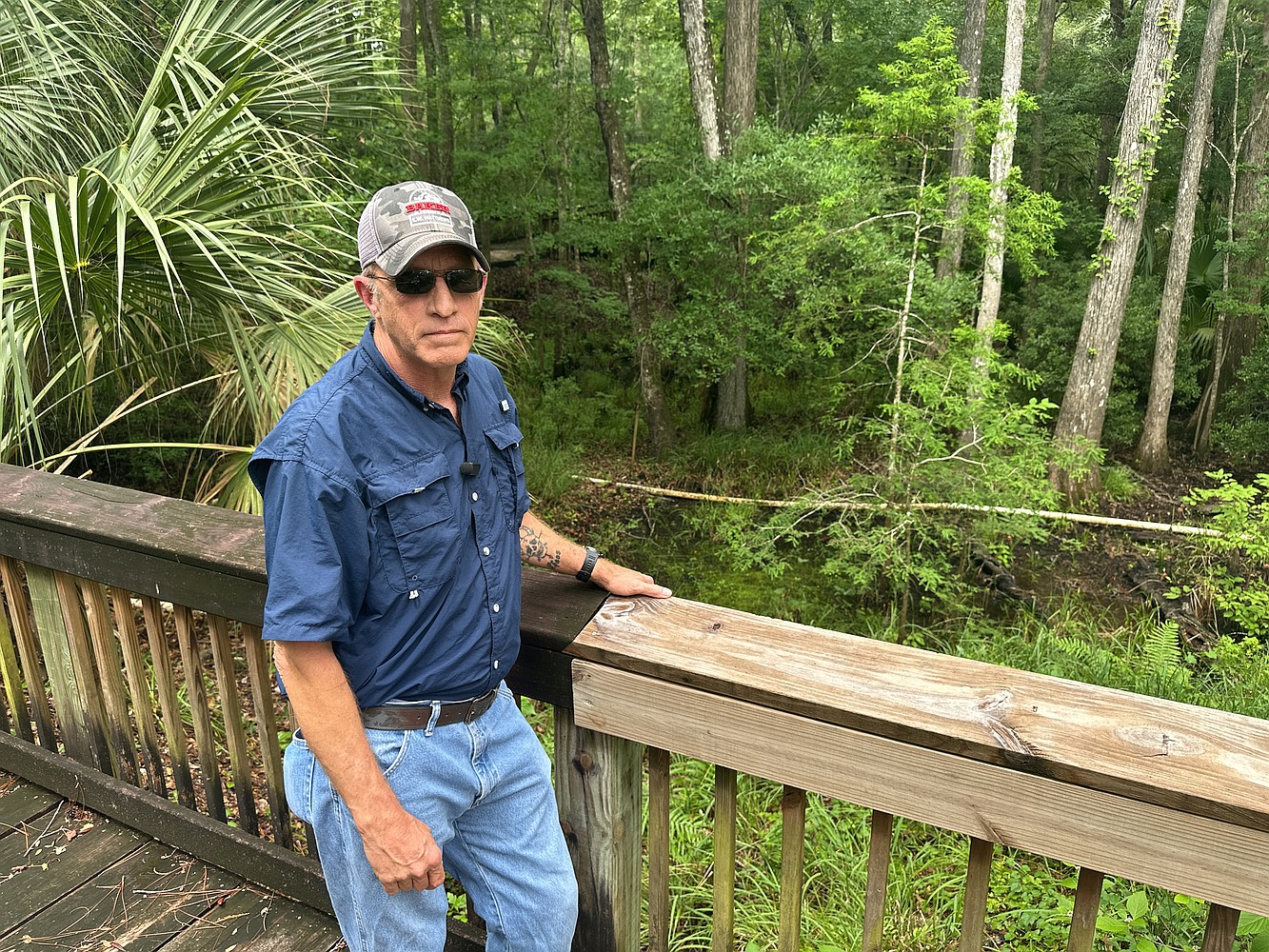
Palm Coast City Historian Preston Zepp stands near the site of Hewitt's Sawmill at Hewitt's Sawmill Park, where a British-era lumber operation helped supply St. Augustine during the colonial period. Archaeological evidence indicates the mill was built in 1770 along the original Kings Road corridor. Photo by Rich Carroll.
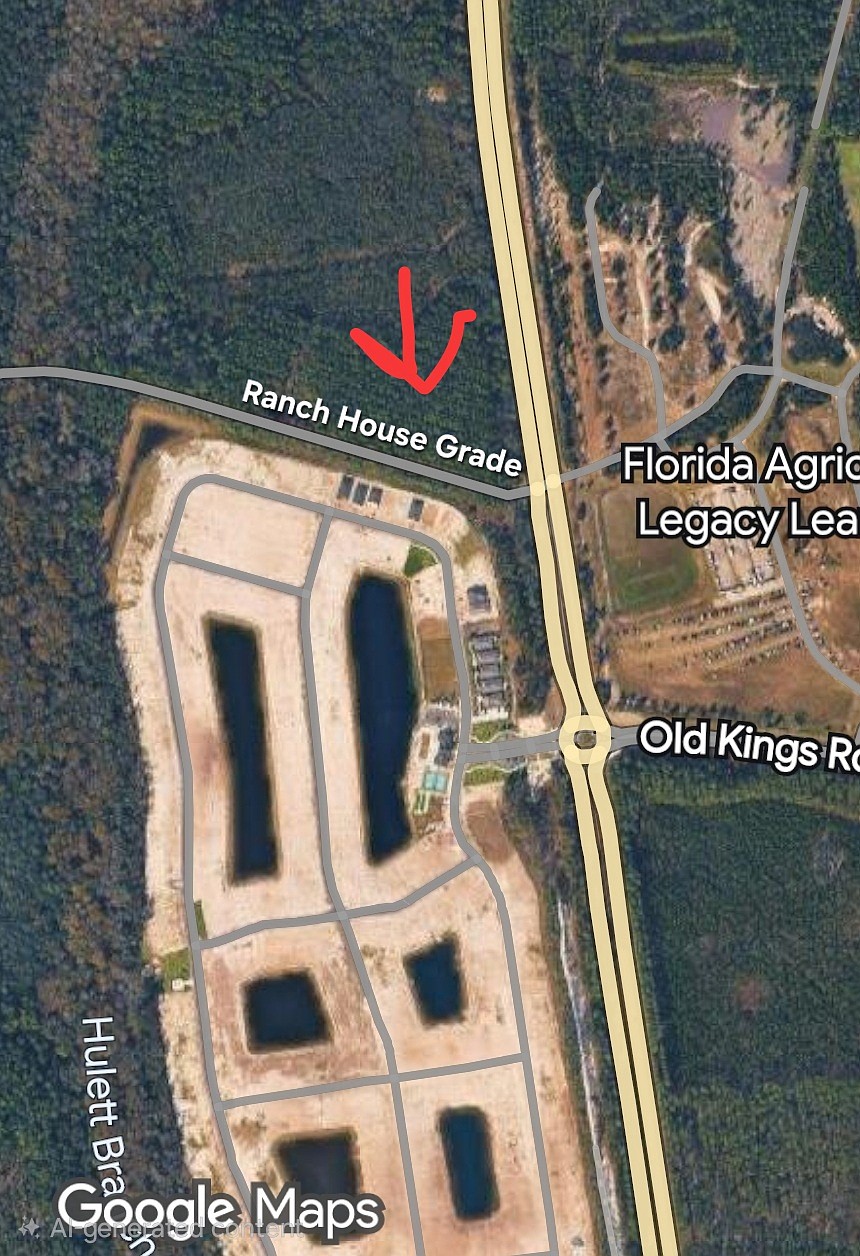
A modern map helps identify the location of Hewitt's Sawmill and portions of the original Kings Road corridor, highlighting the colonial-era transportation route and industrial site hidden within present-day Palm Coast. Courtesy image.
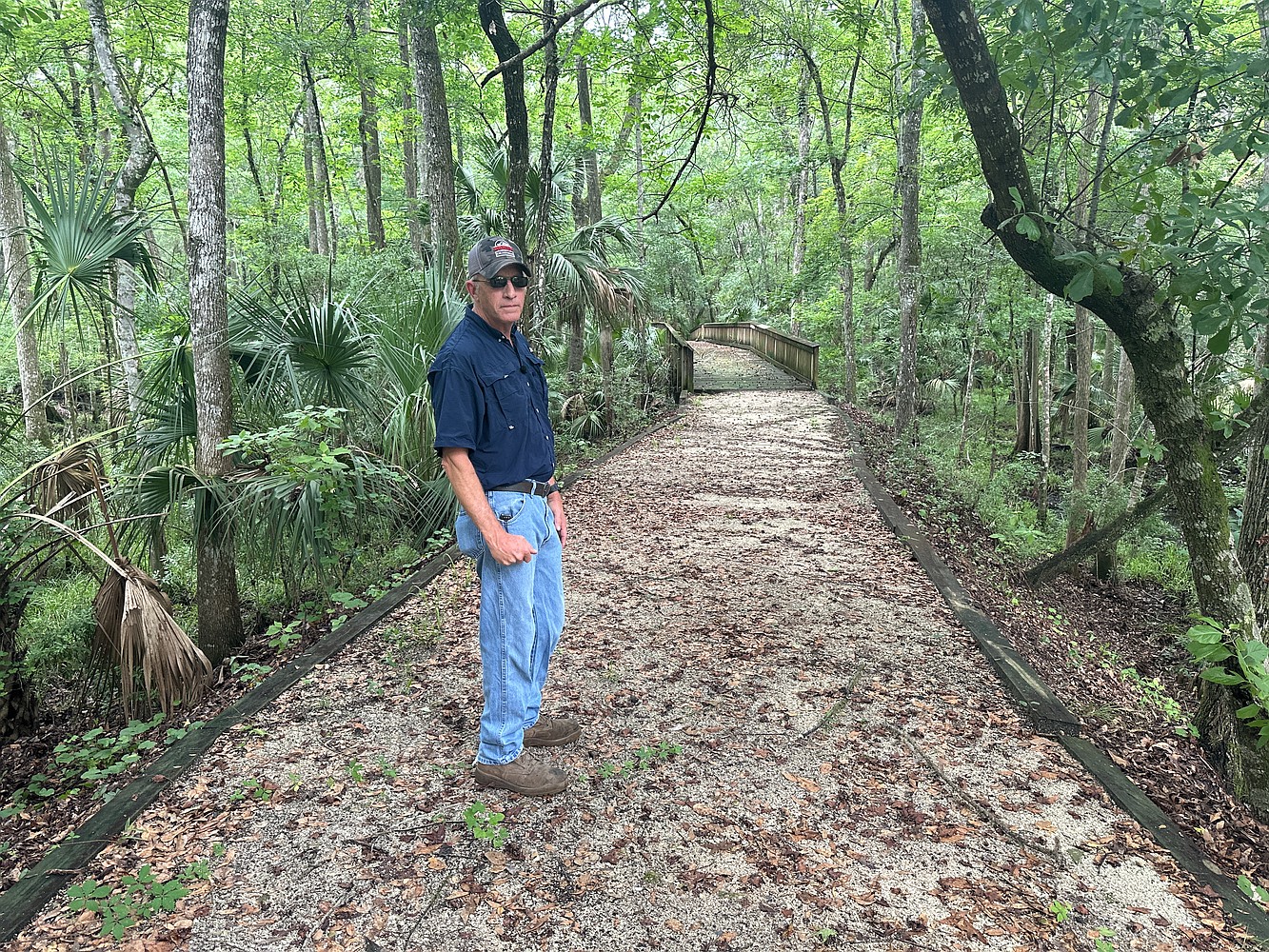
Palm Coast City Historian Preston Zepp stands near a preserved section of the original Kings Road at Hewitt's Sawmill Park, where remnants of the colonial-era transportation corridor remain visible more than 250 years after it was built by the British. Photo by Rich Carroll.
Thousands of motorists travel Old Kings Road every day, passing subdivisions, shopping centers and intersections that have become familiar landmarks of modern Palm Coast.
Few realize that hidden behind the development, beneath a canopy of oaks and cypress trees, portions of the original Kings Road still survive — a colonial transportation corridor that predates the United States itself.
On a recent tour of Hewitt's Sawmill Park, Palm Coast City Historian Preston Zepp led me along remnants of the historic route, explaining how the road helped shape East Florida more than 250 years ago and why preserving what's left has become increasingly important as Flagler County continues to grow.
"This was the first superhighway that was built through Florida," Zepp said. "Think of it like I-95 of its day."
The comparison may seem surprising to anyone familiar with today's Old Kings Road.
The modern roadway is paved, widened and lined with development. In some sections it features sidewalks, bike lanes and multiple travel lanes. It crosses modern infrastructure including Interstate 95 and Palm Coast Parkway and serves as a major local transportation corridor.
The original Kings Road was something entirely different.
Constructed by the British during the 1760s and extended southward as East Florida developed, the road connected St. Augustine to New Smyrna and settlements beyond. It followed portions of existing Native American trails, crossed swamps and waterways using bridges and causeways, and became the primary route for commerce, military movement and settlement throughout British East Florida.
Much of the original road has disappeared or been altered over time, but portions remain visible in and around Hewitt's Sawmill Park, where Zepp says visitors can still walk along the same route traveled by British settlers, soldiers, traders and laborers during the colonial era.
"This is an original stretch of Kings Road," Zepp said as we followed a narrow trail through the woods.
The route's significance extended far beyond transportation.
One of the most important industrial sites in colonial East Florida was built directly alongside it.
According to Zepp, builder and contractor John Hewitt established a water-powered sawmill at the site in 1770 to supply lumber to St. Augustine and British interests throughout the region.
"This is pre-American Revolution," Zepp said. "This is our revolutionary site here."
At the time, Florida remained loyal to Britain while revolution was unfolding in the American colonies to the north.
The operation supplied lumber harvested from the surrounding forests, including live oak, pine, cedar and cypress. Live oak was particularly valuable because of its strength and natural curvature, making it highly desirable for shipbuilding.
"The British loved live oak," Zepp said. "It creates a perfect bowsprit for ships."
Historians believe lumber produced at the site helped support construction projects in St. Augustine during a period of rapid growth. Following the American Revolution, thousands of Loyalists fled south to British Florida, creating a housing shortage and increasing demand for building materials.
"Everybody thinks of history around here as St. Augustine," Zepp said. "But we're 23 miles south and we're supplying the lumber to build what you see up there."
Today, little remains of the mill itself.
White markers outline the approximate footprint of the structure, which Zepp said measured roughly 53 feet long, 32 feet wide and 26 feet tall.
Much of what historians know about the site today stems from archaeological work conducted by William M. Jones in 1977. Zepp said Jones identified the remains of the colonial-era sawmill and recovered numerous artifacts from the property, helping establish its significance as one of Flagler County's most important historic sites.
Yet evidence of the sophisticated engineering that powered the operation remains visible throughout the property.
Unlike traditional northern sawmills that relied on falling water, Hewitt's mill used an undershot wheel powered by a complex hydraulic system. Workers constructed canals, ditches, dams and reservoirs that controlled water flow through the site.
Standing near the remnants of a colonial-era dam, Zepp pointed to the surrounding landscape.
"This was all man-made," he said. "This was all built up by slaves basically with wheelbarrows and bags of dirt."
Researchers believe the sawmill complex included far more than the mill itself. Historical evidence suggests there were likely slave quarters, a caretaker's residence, a blacksmith shop, kitchen facilities and possibly a cooperage where barrels were produced.
Scattered pieces of coquina stone can still be found throughout portions of the site.
The area also contains what may be one of Florida's earliest railroad beds.
Zepp pointed to a raised corridor crossing the property that historians believe may date back to the sawmill's operation.
"If we're correct, it makes it the oldest railroad bed in the state of Florida," he said.
The route was later reused in the late 1800s when the East Florida Land and Produce Company built railroad infrastructure through the area to move agricultural products.
The history preserved at Hewitt's Sawmill stretches far beyond the colonial period.
Long before the arrival of Europeans, Native Americans lived throughout what is now Flagler County.
"This is our oldest documented site in the county," Zepp said. "There are Native American areas going back 7,000 years."
Among the discoveries highlighting that history is a spear point found in the St. Johns Park-Hall Creek area that has been dated to approximately 7,000 years ago.
"We've got a spear point that was found over in the St. John's Park, Hall Creek area that has been dated to 7,000 years ago," Zepp said.
The artifact was later turned over to the Flagler County Historical Society.
The surrounding landscape would have provided ideal conditions for Native American communities, with access to freshwater creeks, wetlands, fish, game and transportation routes.
Zepp noted that nearby areas, including portions of Pringle Swamp, contain evidence of significant Native American activity.
The region's strategic importance continued long after the British period ended.
When Britain ceded Florida back to Spain in 1783 following the American Revolution, British settlers were given a choice: remain and swear loyalty to Spain or leave.
Hewitt chose to leave.
The site later became entangled in a series of conflicts that shaped Florida's early history.
During the Patriot War of 1812, Georgia militia forces invaded Spanish Florida in an unsuccessful attempt to seize the territory. According to local accounts, portions of the sawmill complex were damaged during those attacks.
The Second Seminole War also left its mark on the corridor.
Fort Fulton, a military outpost active between 1838 and 1840, stood nearby, and soldiers routinely traveled through the area.
"Osceola would have came up through here before he got captured up at Fort Peyton," Zepp said.
Archaeologists and historians have recovered railroad spikes, musket balls and other artifacts that may be connected to the Seminole Wars, Civil War-era activity or other chapters of the region's history.
The Civil War brought additional activity to the corridor as Florida supplied cattle to the Confederacy and military forces moved through portions of East Florida.
Walking through the property today, traces of those centuries remain hidden beneath the forest floor.
The woods preserve evidence of Native American occupation, British colonization, Spanish rule, military campaigns, industrial development and early transportation infrastructure.
At the same time, reminders of modern Palm Coast are never far away.
Subdivisions border portions of the site. Development has altered parts of the historic landscape. Recent storms have brought down trees and damaged trails.
Zepp and a small group of volunteers work to maintain the property and educate the public about its significance.
For him, the challenge is ensuring that future generations understand the importance of a place that helped shape the region long before Palm Coast existed.
"We're walking on a couple of centuries of history," Zepp said. "And nobody knows it sits back here."
As Palm Coast continues to grow, Hewitt's Sawmill Park offers a rare opportunity to step back in time.
A short walk off the modern roadway reveals the original Kings Road — a place where Native Americans hunted and fished thousands of years ago, where British engineers built Florida's first major transportation corridor, where enslaved laborers powered an industrial operation that supplied colonial St. Augustine, and where generations of Floridians left their mark on the landscape.
"This is history we're trying to save for future generations," Zepp said. "It's important for people to learn, and it's just constantly under threat from development right now."