- August 7, 2026

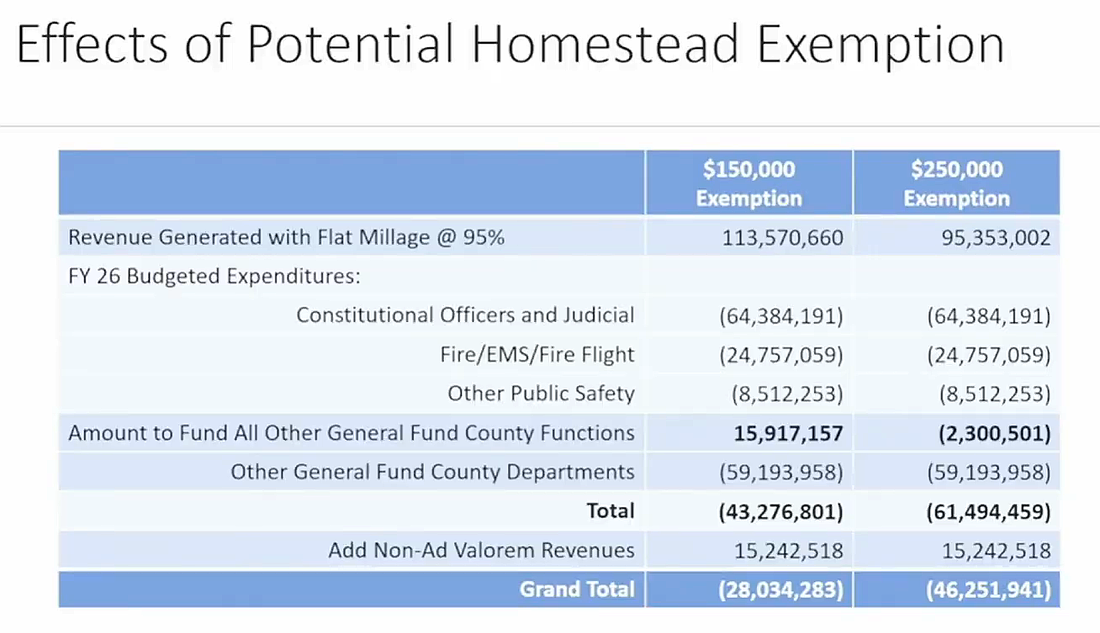
Flagler County officials are beginning to grapple with what a proposed expansion of Florida's homestead exemption could mean for local government budgets, with commissioners discussing potential revenue losses and the challenges local governments could face if voters approve the measure in November.
During a June 16 budget workshop, Financial Services Director Brian Eichinger presented an initial analysis of the proposed constitutional amendment, which would increase the homestead exemption to $150,000 in the first year and $250,000 in the second year if approved by at least 60% of Florida voters.
Eichinger stressed that the numbers presented were intended as a high-level exercise designed to help commissioners understand the potential effects on county finances.
"We plotted out these are all based on FY26 budgets," Eichinger said. "Just for big-picture discussion."
The presentation examined how reduced taxable values could affect county revenues and funding available for constitutional officers, public safety operations and other government services.
Vice Chair Kim Carney questioned how state leaders arrived at projections supporting the proposal, referencing comments made by state Rep. Sam Greco during a recent public appearance.
"The question on the table is how did they arrive at those numbers?" Carney asked.
Carney said local governments are being asked to evaluate a proposal that could significantly alter revenue streams without having access to the assumptions and data used to develop the state's projections.
The discussion highlighted concerns shared by many local governments across Florida as they attempt to determine how much revenue could be lost if the exemption is expanded.
Chair Leann Pennington said county leaders should prepare for the possibility that voters ultimately approve the amendment.
"No homestead exemption has never not passed," Pennington said. "So I go with the mindset that unfortunately — fortunate or unfortunate if you're sitting here in the seat of making decisions — this is probably going to pass."
Property Appraiser Jay Gardner offered a different perspective, noting that constitutional amendments now require 60% voter approval and that passage is far from guaranteed.
Gardner pointed out that Florida's Save Our Homes amendment, which limits annual increases in assessed value for homesteaded properties, originally passed with just 53% support.
"That wouldn't have passed this time," Gardner said.
Gardner said one of the most common questions he hears from residents concerns how local governments would replace lost revenue if the amendment is approved.
"I talk to a lot of people that go, 'Well, where's it going to come from?'" Gardner said.
The proposal has generated significant discussion throughout Florida because property taxes fund many local government functions, including law enforcement, fire protection, parks, road maintenance and other public services.
During the workshop, commissioners emphasized that the county's responsibility is to understand the potential impacts and begin planning for various scenarios before voters make their decision.
"Our job's to prepare," Pennington said. "Let's see what we need to do now to get ready."
County staff indicated additional analysis will likely be conducted as more information becomes available from state officials and the Property Appraiser's Office. For now, commissioners are treating the proposal as one of the largest financial uncertainties facing local governments as they continue work on the fiscal year 2027 budget.