- August 7, 2026

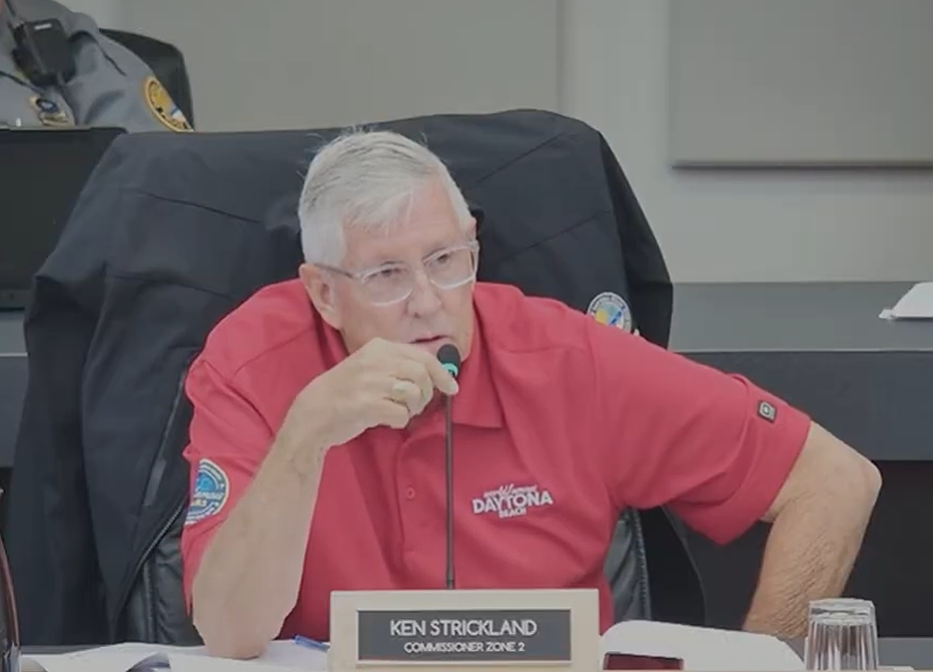
Daytona Beach commissioners discussed whether the city needs additional legal tools to address long-vacant properties and stalled redevelopment projects during Wednesday's City Commission meeting, with Commissioner Ken Strickland urging staff to find ways to prevent approved developments from remaining eyesores for years.
The discussion began after Strickland shared an email forwarded by Deputy City Manager James Morris regarding the status of 999 N. Atlantic Ave. The email, from Chief Building Official Mark Boyce, stated the contractor had submitted revised plans, the owners had secured financing and planned to install new windows, doors and stucco, with additional updates expected following a meeting with the owners.
While encouraged by the reported progress, Strickland questioned why movement came only after years of inactivity.
"It seems quite a coincidence that after all this time, 999 has been an eyesore, suddenly they're ready to improve it," Strickland said. "If they're serious, great. If it's just another strategic move to avoid demolition, I'll be disappointed."
Strickland said the issue extends beyond one property, arguing the city should strengthen its ability to ensure developers move forward after receiving permits and approvals.
"I'd like for us to figure out a way in the future that when we grant developers permits and approve their projects, that we tighten up our ability to get them to go to work properly," Strickland said. "I'd like for our legal department or whoever, permits and licensing, somebody to help us tighten this up so that we can encourage people that come in for permits and want to develop and improve properties rather than allowing them to sit there in disrepair and be an eyesore for not months, but years, lots of years."
City Attorney Ben Gross said staff would examine what legal options may be available.
"We'll work with staff to try to come up with some ways to incentivize people that are legal and defensible and effective," Gross said.
Commissioner Stacy Cantu looked for clarification, asking whether Strickland's concerns focused on abandoned buildings that have remained vacant for decades, rather than solely on inactive development projects.
"I thought he was talking about abandoned buildings just sitting there for decades," Cantu said. "Because we have a lot of motels..."
Strickland confirmed that was exactly his concern.
"You know, boarded up? Some of them are boarded up. Some of them are fenced off. Let's do something with them or knock them down," he said. "What can we do to move this along?"
Gross explained that Florida law limits what municipalities can do with privately owned vacant properties.
"Chapter 73 of the Florida Statutes does not allow local governments to condemn to eminent domain properties merely because of public nuisance or blight," Gross said. "We have to look at the enforcement tools that we have and see what other enforcement tools we can acquire."
Commissioner Quanita May then asked what options remain after the city has exhausted traditional code enforcement efforts.
"From a homeowner perspective, we have code enforcement, and our goal is compliance," May said. "But if we cannot get people to comply, we go to liens, and then those mount up... What else can we do when these situations arise? When we've maxed out liens, and we've maxed out asking, we've maxed out sending letters, what happens next?"
Gross indicated that the city may have the ability to foreclose on liens in certain cases or pursue nuisance abatement when permitted by state law. He also acknowledged that staff would investigate whether additional enforcement mechanisms exist for buildings that are not structurally unsafe.
The conversation later turned to several long-vacant beachfront properties. Strickland cited the Americana, La Playa and the Plaza as examples of buildings that have remained dormant for years despite their prominent locations.
"It's a sad state of affairs that a person who owns that type of property, especially in what we used to be. Those were really nice hotels," Strickland said.
He said addressing those long-standing eyesores is critical to improving Daytona Beach's image and attracting visitors.
"If we're ever going to improve our image and get headed back to being the tourist mecca that we once were, we've got to figure out a way to do something with these places that have been sitting there since right after the hurricanes of 2004," Strickland said.