- August 14, 2026

Daytona Beach officials are sounding the alarm over a proposed constitutional amendment headed to the November 2026 ballot that could reduce city revenues by millions of dollars annually while forcing difficult decisions about public safety, recreation programs and future growth.
During a June 17 presentation to the Daytona Beach City Commission, Government Relations Administrator Michael Chambliss outlined the potential impacts of a package of property tax reforms approved by state lawmakers and backed by Gov. Ron DeSantis. The proposal, which will be decided by Florida voters in the November 2026 General Election, would increase the state's homestead exemption, lower assessment caps on non-homestead properties and establish a pathway toward eliminating homestead property taxes altogether.
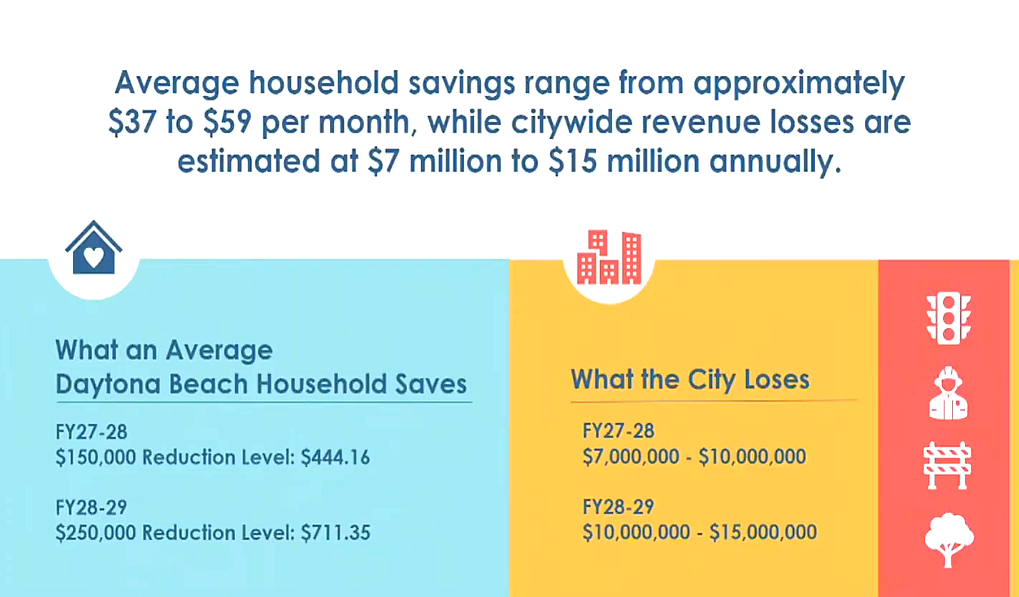
According to Chambliss, the changes could reduce Daytona Beach revenues by approximately $7 million annually beginning in fiscal year 2027-28, with losses potentially growing to between $10 million and $15 million per year after additional provisions take effect.
The proposal would increase the homestead exemption from $50,000 to $150,000 in 2027 before increasing it again to $250,000 in 2028. It would also reduce the annual assessment cap on non-homestead properties from 10% to 5% and direct the Florida Legislature to develop a plan for the eventual elimination of homestead property taxes. Chambliss noted that the proposal does not include a state reimbursement mechanism to offset revenue losses for local governments.
Chambliss warned that the financial consequences would likely force cities to reevaluate services residents have come to expect.
"One of the impacts more than likely will be shuttering some of our community centers, as the mayor mentioned earlier, and closing our programs," Chambliss said.
He pointed to youth recreation and educational programs as examples of services that could face cuts.
"We have a great summer program and year-round program for our students. Everything from gymnastics to swimming programs. Those will be impacted," Chambliss said.
Even routine services could come under review.
"Another thing that we enjoy here in Daytona Beach that not every municipality or county actually has is we have two-day garbage pickup. Does that move to save money to one-day garbage pickup?" Chambliss asked.
Mayor Derek Henry said the effects would extend well beyond City Hall budgets.
"The chief, the sheriff's office is going to lose $28 million. So, they're not going to. It's going to be tighter for them to operate as well," Henry said.
The discussion highlighted concerns that reductions in local government revenue could affect police, fire and emergency services throughout Volusia County. Earlier versions of the proposal included public safety funding protections, but those provisions were ultimately removed from the legislation, according to Chambliss.
Commissioner Monica Paris argued that Daytona Beach may be better positioned than some Florida communities because of its tourism economy and commercial tax base.
"Well, because we have this diversified tax base and you're asking how can we bring in more money? So since we have, it says, strong commercial and tourism tax base, so make sure that our tourism is the best it could be," Paris said.
She also suggested continued economic development could help offset some of the lost revenue.
"And how do we get more commercial projects into the city? I don't know if that's something. I know we're waiting for our new director, economic development director," Paris said.
Henry said the amendment could have broader implications for how cities approach future development.
"I think cities are going to be slower to do single family housing as a result of this because you can't. It can't pay for itself. It's not even possible," Henry said.
He questioned the financial incentive for municipalities to approve additional single-family subdivisions if those properties generate little or no tax revenue.
"There's always been an argument, does growth pay for itself? But what would be the benefit of adding single family housing when they're not going to pay any taxes?" he said.
Henry argued that Daytona Beach's past focus on commercial development may help cushion the blow compared to communities that rely more heavily on residential property taxes.
"One of the reasons that we are in far better position than other communities is because we have more apartments, we have more commercial development," Henry said.
He pointed to major commercial investments as examples.
"You think about Tanger and One Daytona and all the commercial developments that we've had over the last 10 or 15 years, they are really what's going to save us," Henry said.
While supporters of the amendment argue it would provide meaningful property tax relief for homeowners, city leaders said the proposal could force difficult decisions about public safety, parks, recreation programs and other municipal services that residents rely on every day.
The amendment will appear on the November 2026 General Election ballot, where voters will ultimately decide whether to approve the sweeping changes to Florida's property tax system.