- August 12, 2026

A major developer in Palm Coast’s Town Center has sued the city because it allegedly failed to guarantee water and sewer services.
Florida Landmark Companies LLC and Palm Coast Holdings Inc. are listed as the lawsuit’s plaintiffs and own land that is a part of a Development of Regional Impact created in the early 2000s in Town Center. Both companies are subsidiaries of Allete Properties, owned by Duluth, Minnesota-based Allete Inc.
The 370-page complaint, filed on Oct. 23, claims that in 2024, the plaintiff attempted to sell two of its properties in Town Center to unnamed clients. However, the lawsuit claims the purchasers cancelled the sale during the due diligence period because Palm Coast “was refusing to guarantee the potable water availability and wastewater capacity associated with the remaining entitlements in the Town Center DRI.”
“Without the guarantee of potable water available and wastewater capacity for the remaining buildout of the lands in the Town Center DRI, Plaintiffs are left with nearly worthless vacant land,” the lawsuit states.
The lawsuit is citing this failure to reserve its entitlements is a breach of contract.
The plaintiffs are asking the court to enforce the entitlements owed to them through the DRI agreement. If Palm Coast is unable to “immediately provide the necessary potable water availability and wastewater capacity” then the lawsuit is seeking an unspecified amount of damages.
The lawsuit was filed in Flagler County’s Circuit Court court with Judge Sandra Upchurch. Palm Coast’s attorneys do not comment on active litigations, but the city is required to respond to the lawsuit within 20 days, according to court documents.
Among the damages the companies list, they include lost profits, a decline in real property value and loss of sales, the complaint reads.
Florida Landmark Companies originally negotiated its DRI with Palm Coast in 2003. Building entitlements typically include certain infrastructure capacity guarantees on the part of the city.
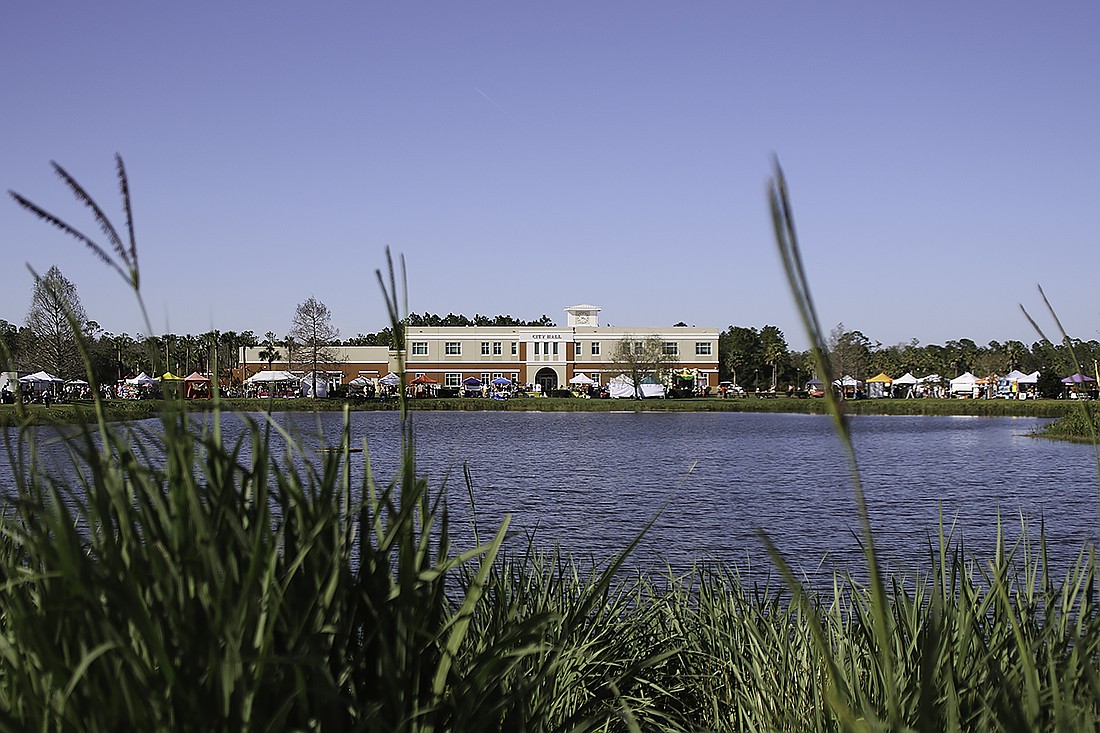
A search of the Flagler County Property Appraiser’s website shows that Palm Coast Holdings currently owns multiple parcels surrounding City Hall and Central Park. It held more, but as recently as 2024 has sold several parcels, including to two churches.
Palm Coast Holdings has been selling the land it owns surrounding City Hall for at least a decade.
Florida Landmark Communities, also named as a plaintiff in the lawsuit, outright owns at least one parcel of land near City Hall. Similar to Palm Coast Holdings, it has sold at least two other parcels of land in Town Center in recent years.
According to the lawsuit, Palm Coast Holdings owns 140 acres of land in Town Center while Florida Landmark Communities owns around 45 acres of land.
The complaint states Palm Coast approved the following entitlements for the Town Center DRI with Florida Landmark Communities, Inc., the predecessor of Florida Landmark Communities, LLC.: 2,500 residential units, 1.4 million square feet of office space, 2 million square feet of retail/commercial space, 1.4 million of square feet of non-retail/commercial space, 635,000 square feet of institutional space, a 2,400-seat movie theater, 480 rooms of lodging and a 240 bed nursing home, plus 714 acres of common area.
In 2022, the developers updated those entitlements with Palm Coast, which was approved by the then-Palm Coast City Council. During that update, Palm Coast “vested” the developer “for all of the entitlements associated with the Town Center DRI (in all phases) for, inter alia, potable water and wastewater.”
Vested, in this context of the lawsuit, means the developer’s right to the water and wastewater entitlements was legally protected.
In 2024, those entitlements were updated again after the company sold some of the properties. According to the lawsuit, the current entitlements on the property are: 3,575 residential units, 1.2 million square feet of office space, 1.9 million square feet of retail/commercial space, 1.1 million square feet of non-retail/commercial space, 625,000 square feet of institutional, a 2,400-seat movie theater, a 480-room hotel and 485-bed nursing home.
But since the DRI was instituted, Palm Coast has undergone a lot of growth, including more than doubling its population from 2003 to 2020. It has also annexed land into the city and extended its water and wastewater service outside of city limits into The Hammock through interlocal agreements with Flagler County.
In 2024, Palm Coast was cited by the Florida Department of Environmental Protections for exceeding its water and wastewater capacities. The city has until 2028 to upgrade its system to meet its needs.
This is the second major lawsuit filed against Palm Coast in the last two months. In early October, the Flagler Home Builders Association, in partnership with several local businesses, filed a lawsuit against Palm Coast for instituting impact fee increases greater than 50%, the cap set by Florida law.
Palm Coast argued over several months of meetings that it qualified for an “extraordinary circumstances” exception because of inflation, increased construction costs and extreme population growth.