- August 8, 2026

When Flagler Schools’ AI Taskforce began crafting School Board policy three years ago for artificial intelligence education, it didn’t take long for some of the policies to become obsolete. AI was changing that fast.
“Our policy wasn’t in place for three months, and already we were in violation of our own policy,” said Ryan Deising, the school district’s chief of technology and innovation.
But over time, Deising said, the district has developed great infrastructure to train teachers, teach AI literacy to students, use the evolving tools to aid teaching and learning, and, through all of that, making sure that students’ data is secure.
Deising compared AI’s rollout to the early days of the internet 30 years ago, but with light speed.
Everything's just moved so fast that now we're kind of learning together. Teachers are learning about it, and the students are learning at the same time, but we're keeping everything safe.
— TERESA PHILLIPS
“We get our teachers comfortable with it,” said Teresa Phillips, the district’s instructional technology coordinator, “And then we roll it out to students. But everything's just moved so fast that now we're kind of learning together. Teachers are learning about it, and the students are learning at the same time, but we're keeping everything safe.”
Phillips said the task force is making very intentional decisions about what tools are used.
“It's important that our students get those AI literacy skills to be ready for the future, because it doesn't matter what job you're doing, it’s going to involve AI,” she said. “So they have to learn not just how to use it, but what you have to be aware of while you’re using it, and how important that human is in the middle of all of it.”
Students in grades 6-12 use AI independently with platforms such as Google Gemini for Students and Khan Academy’s Khanmigo, an AI-powered teaching assistant and tutor.
Phillips said her daughter is able to get help with her calculus homework with Khanmigo.
“I couldn't help her at all,” Phillips said. “But she's able to go on there and ask questions. And it's not going to give you the answers, it's going to walk you through all of the steps, so it's like a tutor that's personalized and available for every one of our students in grades 6 through 12.”
Google’s Gemini and NotebookLM help students understand prompting, Deising said.
Notebook LM is like a study buddy, Phillips said, that will give you study sources, quiz you and help you make flash cards.
Elementary school students use MagicSchool and Canva in lessons driven by teachers, Deising said.
“We’re being careful what’s available for our students, what guard rails are to be put up for elementary students,” he said.
AI literacy is taught in all grades. Classes discuss how you can tell if an image is produced by AI. Phillips said students are actually more adept than teachers in knowing if images and material are AI generated.
At a School Board workshop presentation on April 28, Deising and Phillips said teachers and staff have had over 2,275 hours of professional learning opportunities in AI education this school year. They revealed surveys of faculty and staff from each of the last three years showing how knowledge and attitudes have changed.
In 2024, 72% of respondents had never used AI. In 2025, 44.7% said they used it weekly and 28.9% said they used it daily. This year, 44.3% said they use it daily and 36% said they use it weekly.
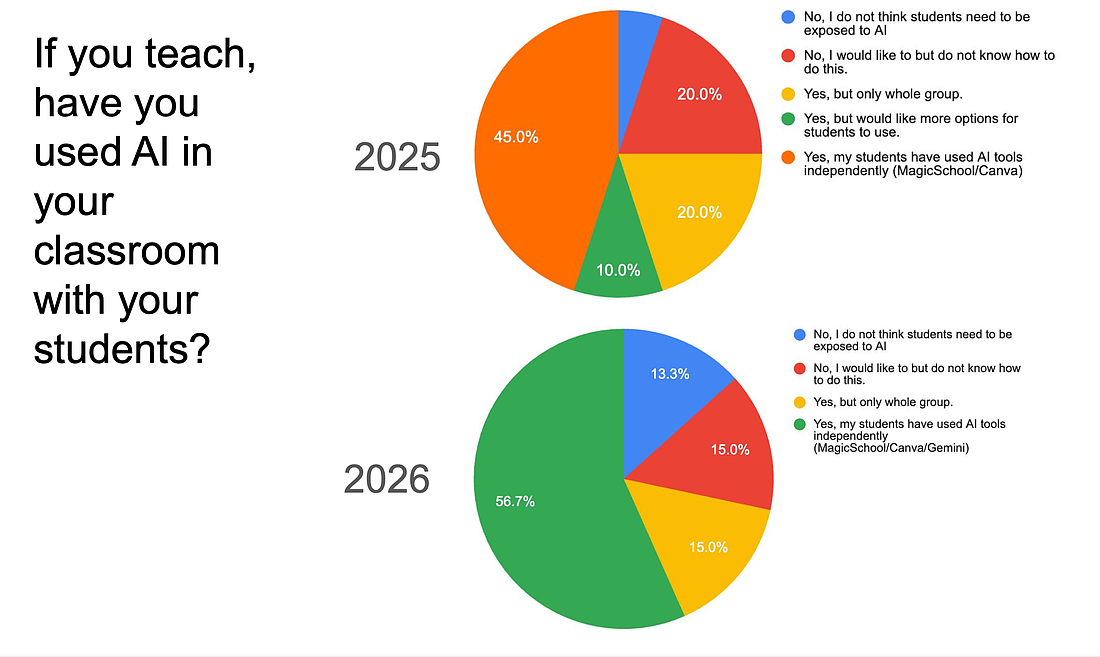
But when teachers were asked if they use AI in their classrooms, knowledge didn’t necessarily equate to comfort. While 56.7% this year said their students use AI tools independently, 13.3% said they did not think students should be exposed to AI. Last year, only 5% thought students should not be exposed to AI.
Kalista Chadwell, a graduating senior in Flagler Palm Coast’ High School’s International Baccalaureate program, said she had mixed feelings about AI in education.
“I think AI’s ruining creativity for a lot of students. A lot of people aren't thinking for themselves anymore, and they heavily rely on the use of AI,” she said. “But I've also seen it used in helpful ways, like making study guides or diving deeper into certain assignments that students don't understand. And teachers can use it in helpful ways, like making practice questions.”
She said she’s used it to make study guides and outlines for assignments.
“When I'm stuck trying to come up with ideas for, say, an English essay, it was pretty helpful because it started a thinking process where I was really able to explore and understand something on a deeper level than if I tried to do it all on my own,” she said.
At the workshop presentation, School Board member Janie Ruddy said she would like to see AI literacy become a diploma plus program.
Lauren Ramirez said she sees the advantage in AI being able to help students who learn in different ways.
“We don’t want to scare [students] away from AI,” Ruddy said. “There are real applications and benefits.”