- July 15, 2026

How many students are new developments projected to bring in to Flagler Schools in 2026? According to a new study, fewer students than in 2024.
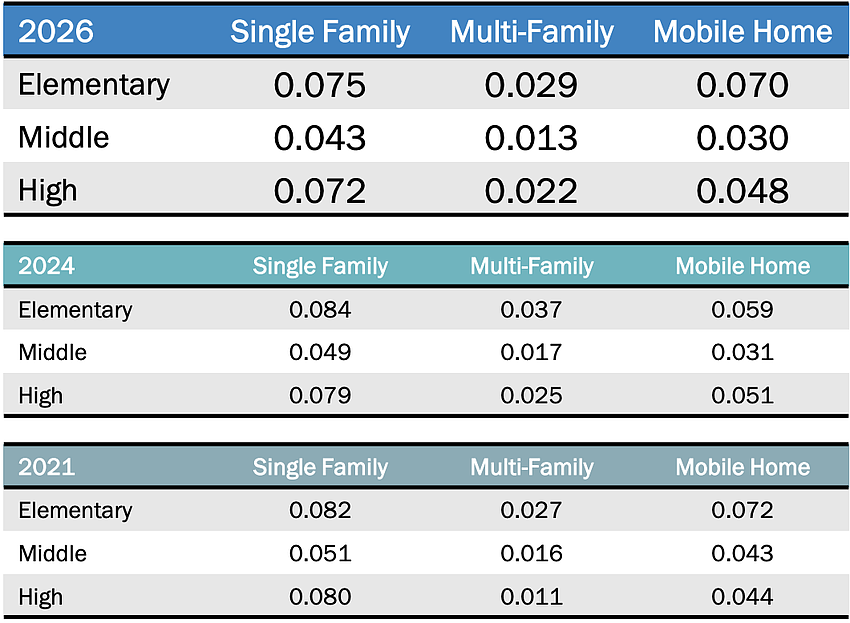
School Board members discussed the 2026 student generation rate at their workshop on Tuesday, July 14. This metric forecasts how many more children will attend Flagler Schools as a result of new developments and is reviewed every two years. The rate will be presented for approval at the School Board's meeting on July 28, and if OK'd, will be used by district staff when reviewing new housing projects and determining impacts to schools' capacity to determine concurrency.
"When a developer wants to build 500 new homes, the district needs to know how many kids will probably show up at their schools because of these homes," said Lisa Divina, coordinator of planning and intergovernmental relations for Flagler Schools. "We cannot guess. We have to have a number that we can count on."
According to the 2026 study, Flagler County has 14,855 students, including those who are homeschooled and enrolled in charter schools. A total of 132 students attend Flagler Schools from outside of the county, which were not included in the rate analysis.
Per the data presented, the majority of students enrolled in traditional schools in Flagler County — over 90% — reside in single family units, including duplexes and townhomes.
Still, the student generation rate has decreased in every school level and type of dwelling unit since 2024, except for one category: elementary students living in mobile homes.
John Gilreath, of JBrown Professional Group, said the numbers have lowered in 2026 because of recent significant development.
"Looking at it holistically, you've had 10,000 units built in the last three years in Flagler County," Gilreath said. "So you've had a large amount of development occurring compared to previous years, as well. We know in the future, with some of the things in the news, that development is planned to continue throughout the county. These numbers can shift depending on the amount of homes that have come online. There's usually a little bit of a lag with people moving into homes."
For example, the Brookhaven at Town Center applied for permits in 2012 and was granted a reserved capacity of seven students. In 2023, the subdivision generated 70 students, but the number fell to 50 new students in 2026.
Sawmill Creek, which applied in 2018, was given a reserve capacity of 55. In 2023, it generated 87 students. In 2026, 107 new students were generated.
The first two phases of Somerset at Palm Coast applied in 2021 and were granted a reserve capacity of 66 students. In 2026, the subdivisions generated 15 students.
"We expect that number to increase," Gilreath said. "So this is sort of a real-world application of that student generation rate with the number of units in a subdivision and estimated number of students versus actually what we're seeing."
School Board member Janie Ruddy asked why the district uses current data, rather than look at trends, to determine the rate.
"If we're short, we're essentially shortchanging ourselves if we have incorrect generation rates at the time that the buildings are going on, and so that's my concern," Ruddy said. "How are we ensuring that these numbers are valid for the time that we would actually need to build that school, or the community is actually having people start to arrive and buy those homes?"
It is a snapshot in time, Gilreath said, based on current housing stock.
"Attendance changes, and state policies change," he said. "I think that it's hard to go back and really say we could do a regression analysis for this because the data sets are different at every point in time."
Looking at future land uses is a way to determine what could happen, he explained, but could be a "shot in the dark" because allowable densities can be changed.
Ruddy was concerned that the board is being asked to approve a rate without certainty that this data has been effective in the past for planning.
"It's concerning because there is a lot of development going on right now," Ruddy said. "So if we approve this student generation rate and it's dropped, and we miss the potential impact revenue from what's being currently built in the next two years, that's significant."
School Board Vice Chair Will Furry, who led the workshop in the absence of Chair Christy Chong, said that because the rate is trending downward, then enrollment would also be less over time, supporting previous forecasts.
"In two more years, we'll see if this holds true, or it's gone up, or gone down more," he said.
School Board member Lauren Ramirez asked whether the district was also separately tracking the number of students who opt for homeschooling initially, and then later enroll in a traditional school, as the student generation rate didn't factor homeschooled or charter school students.
"I like that we have a formula, but to me, it just doesn't feel as accurate because we don't know what we don't know," Ramirez said.
Furry replied that the district has the capacity for those students, but when future planned developments are built out, that will be a "pain point."
Still, they won't happen overnight, Furry said.
Based on the board's feedback, Flagler Schools Superintendent LaShakia Moore said that the board wasn't saying the study was performed inaccurately — but that the student generation rate is lower than what is being experienced in the district.
"We may be generating more students into an area than we are being credited for on the district side, and I just think it's important to clear that up because we know that there's always language around proportionate share, impact fees and all of that," Moore said. "... We're saying as we move forward and we look at the data of what we have that's here as a snapshot, some of these places may be generating more students than we accounted for in the student generation [rate.]"