- July 14, 2026

Palm Coast city staff is recommending a slight property tax increase for fiscal year 2027, warning that inflation, rising public safety costs and growing operational expenses have made it increasingly difficult to balance the city's budget without additional revenue.
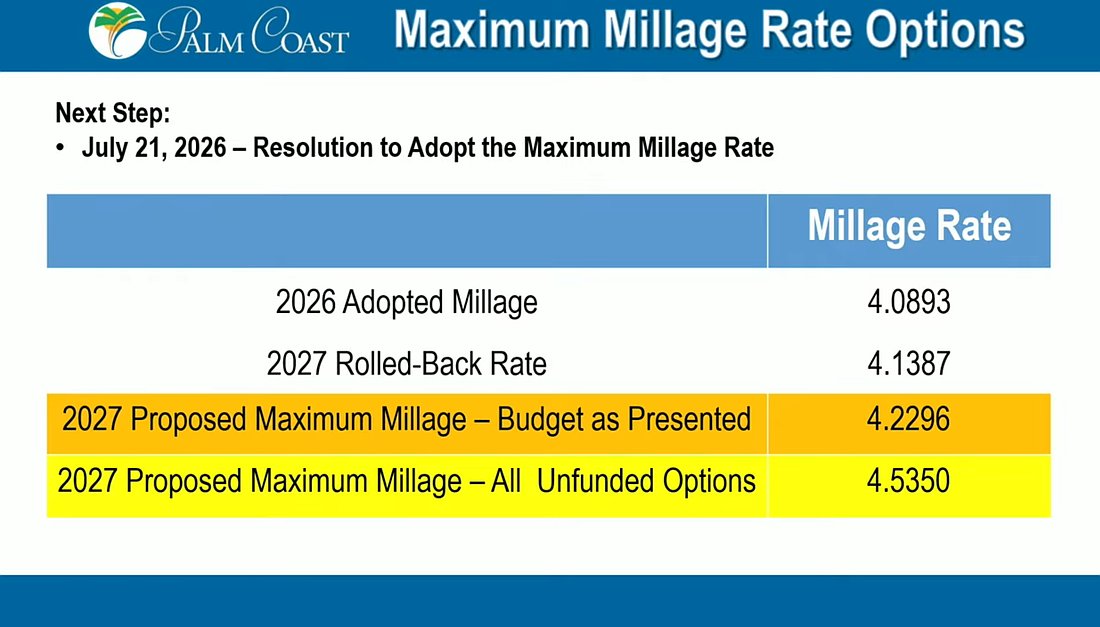
During a budget workshop on July 14, City Manager Mike McGlothlin recommended setting the city's maximum proposed millage rate at 4.2296 mills, up from the current 4.0893 mills. Staff said the recommendation would balance the proposed $72.2 million general fund budget while maintaining current service levels.
"This recommended millage increase will balance the budget regarding the approved Strategic Action Plans and communicated service level expectations," McGlothlin said.
He noted the proposal already includes several cost-saving measures, including freezing multiple general fund positions, adding no new general fund employees, eliminating cost-of-living raises for city employees while maintaining merit increases of up to 3%, and not funding the Flagler County Sheriff's Office request for nine additional deputies.
McGlothlin warned that lowering the proposed rate would require the council to reduce recently approved strategic priorities and city services.
Property taxes remain city's largest revenue source
Budget staff reported taxable property values increased 4.13% over the previous year, although nearly all of that growth came from new construction. Existing properties collectively experienced a slight decline in value.
The proposed millage rate would generate approximately $46.5 million in ad valorem tax revenue, the city's largest revenue source. Staff also projected relatively flat revenues from the state's half-cent sales tax, communications service taxes and state revenue sharing.
Public safety continues to drive spending
Public safety remains the largest component of the city's general fund budget.
Among the largest unfunded requests is nearly $1 million to add nine sheriff's deputies. The proposed fire department budget also reflects a 7.7% increase, driven primarily by overtime costs associated with staffing shortages and increasing emergency call volume.
Councilman Charles Gambaro noted that roughly 63% of the general fund is dedicated to public safety and public works.
"Those are the basic services that our residents expect," Gambaro said. "To be protected from fire, from bad guys ... and also the appeal of what brings us to Palm Coast, which is how it looks."
Recreation facilities continue operating at a loss
The Parks and Recreation Department is proposing a 4.2% budget increase, though several facilities continue to operate at a deficit.
Staff reported the Southern Recreation Center is projected to lose roughly $400,000 annually, while the Palm Coast Aquatics Center is expected to operate at approximately a $500,000 loss.
Council members requested staff develop a long-term strategy to increase revenue while maintaining recreational opportunities.
Technology investments offset by rising dispatch costs
The Information Technology Department proposed a $7.2 million budget, a 3.8% increase over the current fiscal year, while requesting no additional personnel.
Staff highlighted significant savings achieved through in-house technology projects, while noting the department's largest increase stems from Palm Coast's share of regional computer-aided dispatch (CAD) software. The city's annual allocation is expected to increase from about $16,000 to more than $87,000, reflecting higher emergency call volume and a revised cost-sharing formula with Flagler County.
Capital projects and policy changes
Council also reviewed several capital improvement projects.
Officials reported the Indian Trails Sports Complex improvements came in under budget, leaving approximately $960,000 available for additional parking and pedestrian safety improvements. Council members also reaffirmed their desire to build a new skate park, although funding has not yet been identified.
Staff also outlined several policy changes being considered to reduce future operating costs, including shifting code enforcement toward a complaint-based model, reducing economic development incentive funding and continuing the city's policy of using fund balance only for one-time expenditures.
Council weighs difficult choices
Much of the workshop centered on how much flexibility the council should preserve heading into the formal budget process.
Staff explained that 4.2296 mills represents only the maximum rate the city could adopt. Once advertised, the council may reduce the rate during budget hearings but cannot increase it.
"So you're asking us to set a maximum millage," Councilman Charles Gambaro said. "This is not what we're adopting."
Council Member Dave Sullivan cautioned against making last-minute changes after staff has spent months preparing the budget.
"In my experience in the 10 years I've been doing budgets here in the county and now in the city, the worst thing that ever happened was the day before the budget was going to get approved, the council voted to reduce the millage rate," Sullivan said. "That throws the staff into havoc because they've got to come forward with a budget. All of a sudden you do crazy things. You eliminate things just because you have to eliminate something."
Vice Mayor Theresa Pontieri said she would like staff to identify roughly $2.5 million in savings so the city can maintain its current millage rate while preserving funding for additional sheriff's deputies. She said the city had committed to a three-year plan to help the Flagler County Sheriff's Office keep pace with Palm Coast's growing population and wants to honor that commitment while minimizing the tax burden on residents.
"We made a commitment," Pontieri said. "I want us to find that money."
She added that maintaining the current millage rate rather than adopting the proposed increase would require the city to identify approximately $2.5 million in budget reductions elsewhere.
By the end of the workshop, the council reached consensus to move forward with a 4.2296-mill maximum proposed millage rate, preserving flexibility as staff continues refining the budget. The City Council is expected to formally adopt a resolution establishing the maximum millage rate at its July 21 meeting, allowing the rate to be advertised ahead of the required September budget hearings. Advertising the higher rate does not obligate the council to adopt it as the final millage rate, but it does allow members to lower the rate if additional savings are identified before the FY 2027 budget is approved in September.