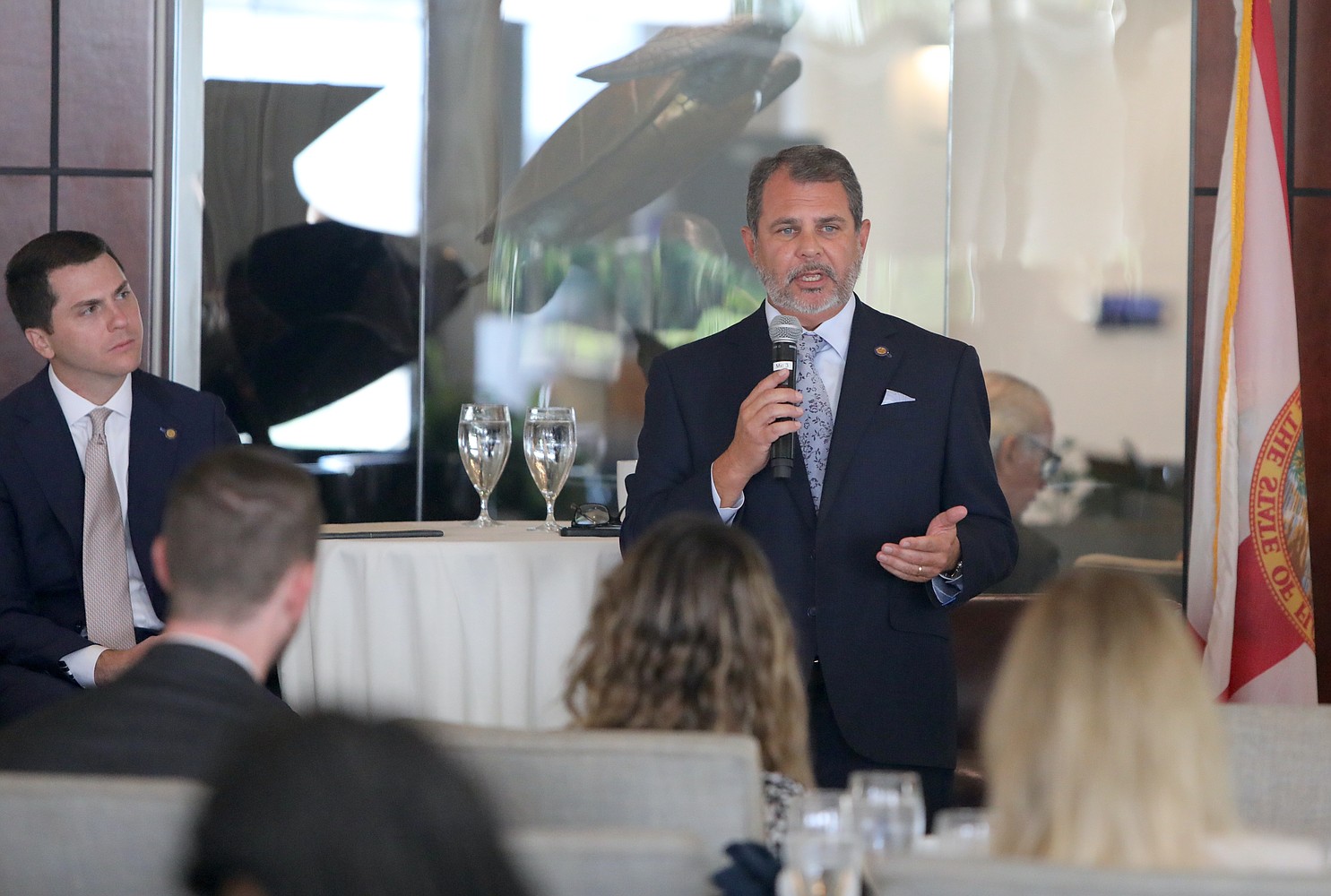
Rep. Sam Greco (left) listens as Sen. Tom Leek speaks at the Palm Coast-Flagler Regional Chamber of Commerce Legislative Update. Photo by Brent Woronoff
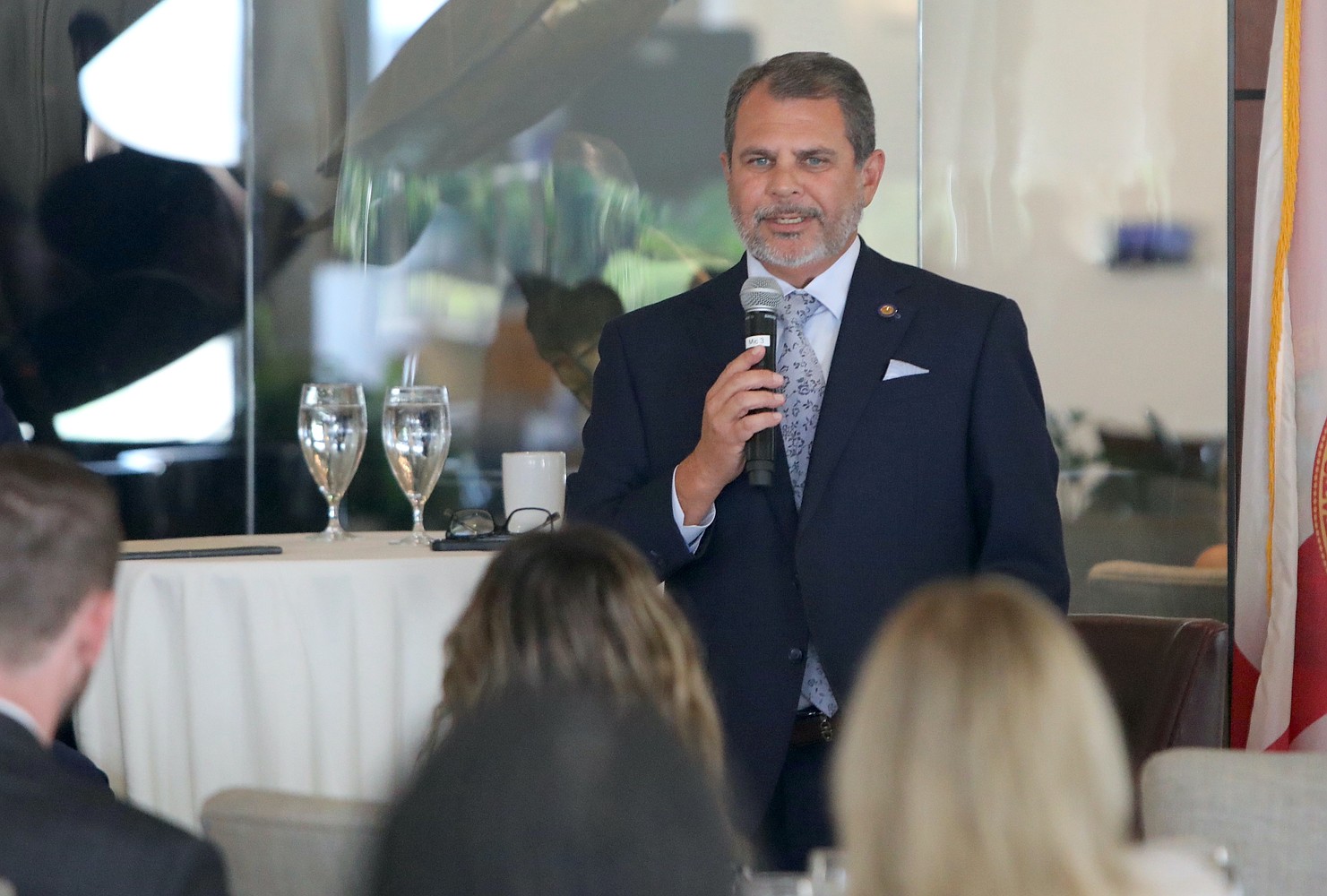
Sen. Tom Leek speaks at the Palm Coast-Flagler Regional Chamber of Commerce Legislative Update. Photo by Brent Woronoff
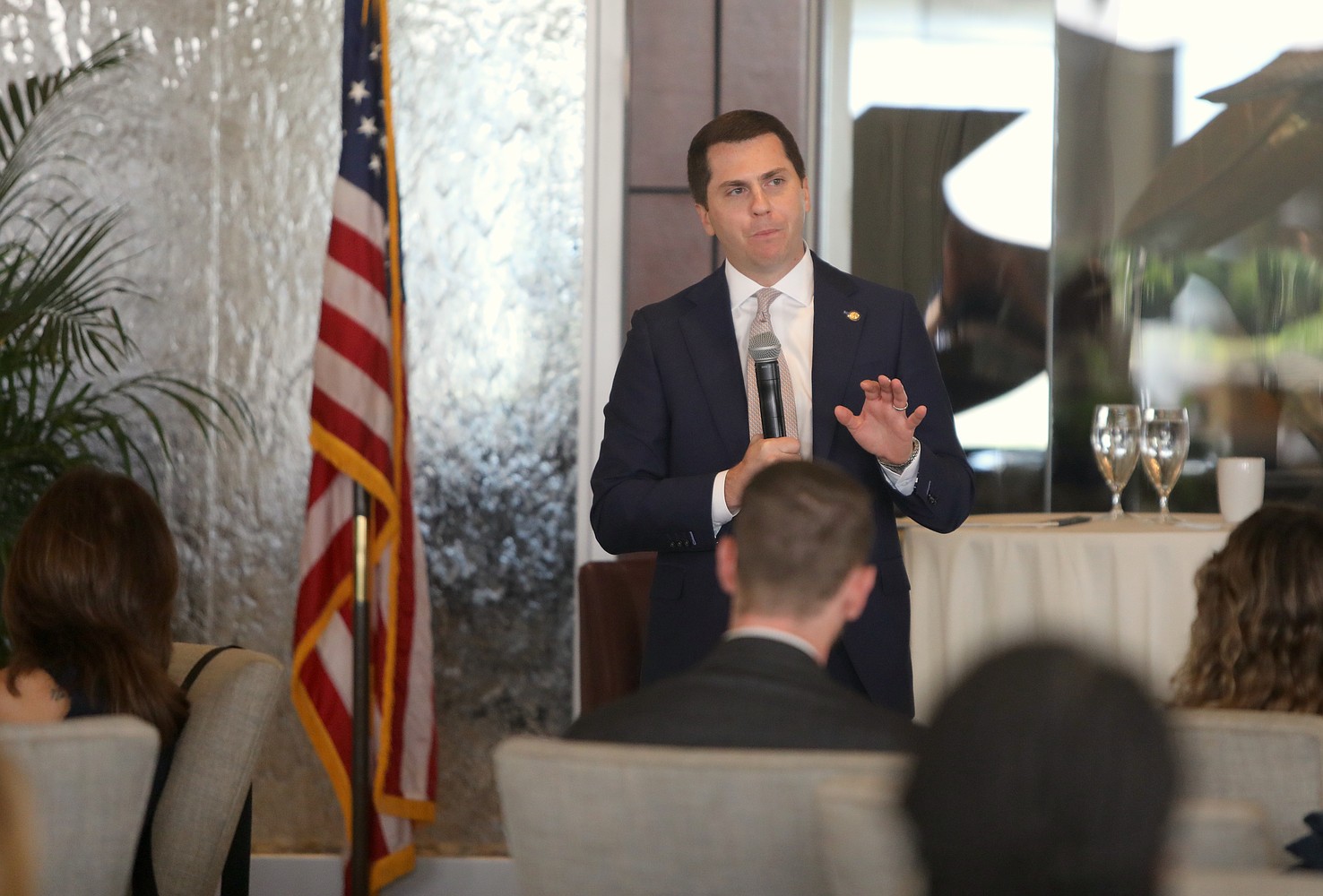
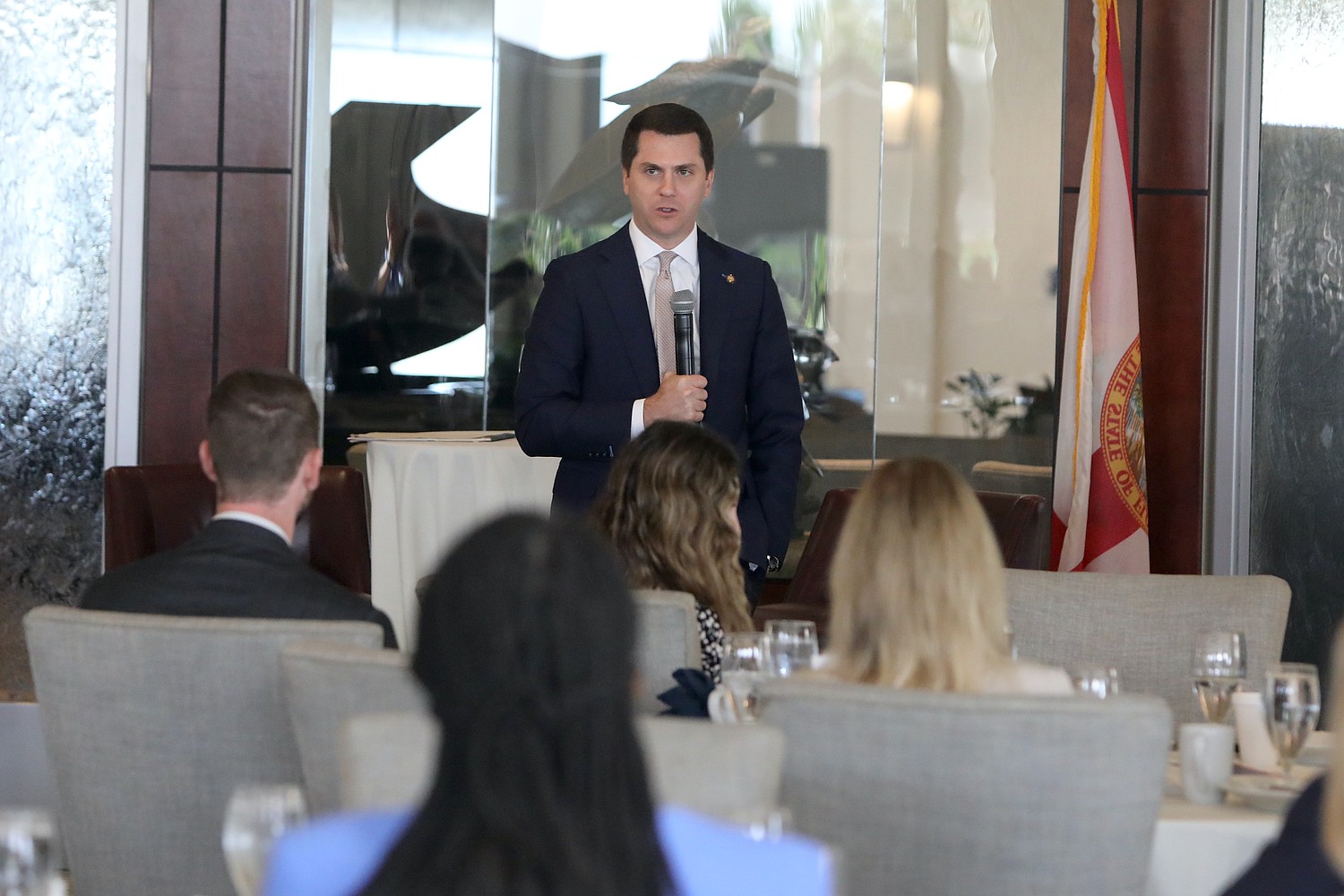
Rep. Sam Greco speaks at the Palm Coast-Flagler Regional Chamber of Commerce Legislative Update. Photo by Brent Woronoff
Rep. Sam Greco speaks at the Palm Coast-Flagler Regional Chamber of Commerce Legislative Update. Photo by Brent Woronoff
Elected officials and local community and business leaders attended the 2026 Legislative Update to hear reports from Flagler County’s local state legislators, Sen. Tom Leek and Rep. Sam Greco.
There were also a couple of elephants in the room — state issues that have taken center stage this election year — at the event, hosted by the Palm Coast-Flagler Regional Chamber on July 9 at the Hammock Dunes Club.
Leek, who spoke first before having to leave for another engagement, was asked about Florida Amendment 3, which will appear on the general election ballot in November. If it passes, with 60% of the vote, it will increase homestead tax exemptions to $250,000 over the next two years and limit how counties and municipalities can spend property tax revenue.
Greco was asked about school vouchers, which redirect public school tax dollars to families who choose private or home-school options
Leek said he is conflicted about the property tax amendment. He said there should have been a better product presented to voters. Property taxes have gotten out of control and growth in local government spending has become “insane,” he said. But rather than focusing on an increase in the homestead exemption, the focus should be on spending, Leek said.
“If you address a single revenue source, you’re going to be playing Whack-a-Mole,” Leek said. “We’ve got an entire budget for years built on this revenue source.”
If Amendment 3 passes, there will be spending cuts, Leek said, but not enough to make up the deficit. As a result, he said, there will be a fee shift.
Will it help folks that you’re trying to help? Absolutely. Will it shift the burden to properties that are higher valued? Absolutely. Will there be new fees, I don’t see how there won’t.
— SEN. TOM LEEK, on property tax amendment.
“Will it help folks that you’re trying to help? Absolutely. Will it shift the burden to properties that are higher valued? Absolutely. Will there be new fees, I don’t see how there won’t,” he said.
Leek’s proposal would limit local spending growth in accordance to a city or county’s population growth, adjusting for inflation, following the Colorado model.
Leek asked for a show of hands for who will vote for the amendment, who will vote against it and who has not decided yet. While there were more people in the room who indicated they will vote against it than for it, a key indicator, Leek said, is the number of people who are undecided. Most people who are undecided wind up voting no, he said.
“I don’t know if this gets 60%,” Leek said. “I think it struggles to get there.”
Unlike property taxes, the Florida Legislature took no action on accountability measures for the state’s $4 billion school voucher program. Despite a unanimous Senate vote to address oversight issues flagged by a state audit, the House allowed the legislation to die.
David Ayers, president of Flagler Broadcasting, asked Greco if he thought the school voucher system was working.
Greco said he is a supporter of school vouchers. Being a relatively new program, he said, he thinks it is approaching a stability point. The majority of vouchers are now going to families who are leaving public schools, rather than those that were never enrolled, making it easier to track, he said.
Brian McMillan, the Observer’s publisher, asked about educational accountability with the state setting standards for public school education that do not apply to private or home-school students who receive taxpayer-funded vouchers.
There are additional costs that we’re placing on our public schools that we don’t need to be. I’d rather cut those costs than to saddle private schools with costs.
— REP. SAM GRECO
“I look at it the other way,” Greco said. “I don’t think the answer to that is to regulate the private schools more. I think the answer is to decrease regulation where we can on public schools. There are additional costs that we’re placing on our public schools that we don’t need to be. I’d rather cut those costs than to saddle private schools with costs.”
Flagler Schools Superintendent LaShakia Moore said she wanted to comment as a taxpayer. She stressed that she is in favor of school choice with parents being allowed to educate their children where ever they want. But with $19 million of taxpayer money being distributed in Flagler County through the voucher program, taxpayers should be able to see what the return is on their investment, she said.
“What is important is the accountability to the dollar,” Moore said.
Every dollar the school district spends, it has to provide a record for, Moore said.
“As a taxpayer I just strongly believe that if $19 million is out in our community educating our children, we should be able to track those taxpayer dollars.”
Greco agreed that accountability “is incredibly important, and I want to make sure we can identify where every taxpayer dollar goes and make sure that it’s going where it’s supposed to go.”
Leek highlighted two bills that he prioritized during the legislative session. The Officer Jason Raynor Act succeeded. The AI Bill of Rights did not.
Raynor, a Daytona Beach police officer, was shot in the line of duty in 2021 and died of his injuries. The defendant was charged with first degree murder, but in 2023 a Clay County jury found him guilty of the lesser charge of manslaughter.
The Raynor Act, which Gov. Ron DeSantis signed into law, establishes a mandatory life sentence without the possibility of parole for defendants convicted of killing a law enforcement officer in Florida.
“We took care of that glitch. It took three years,” Leek said.
The AI Bill of Rights, which was in its first year in the legislative process, passed the Senate but did not pass in the House. The bill was in response to a teenage boy committing suicide after engaging with an AI chatbot.
“You can see the harm out there that some of these things are causing is so great, we just can’t afford to wait,” Leek said. “The Bill of Rights [provides] a lot of protections for children and vulnerable adults. The chatbot has to tell you it’s a computer, not only up front, but remind you periodically you’re talking to a machine.”
He said he believes the bill did not pass in the House because President Trump wants to see a national standard for AI regulation. But Leek doesn't think Congress will pass an AI bill in the very near future.
“This is a bill I love, I’m passionate about,” Leek said. “We’ll keep bringing that one back until it passes.”
Greco said Flagler County did very well during the legislative session.
“I had about $20 million in appropriations projects approved by the governor, and about $40 million in Florida’s budget is coming back to Flagler County,” he said.
Greco touched on a few bills that he sponsored which passed in this session: House Bill 679, which modernizes the state’s trademark registration process; HB 1293 which creates a third-degree felony for individuals who take possession of a rental property by using forged documents; and HB 1295, strengthening standards for memory care providers.
Another bill he sponsored was HB 445, Missy’s Law, that requires courts to immediately remand a defendant into custody without bond after they plead guilty or no contest, or are found guilty of a dangerous crime, keeping them detained while they await sentencing.
“This is a common-sense measure to make sure that communities are safe and make sure that people who are convicted are in custody.”
Greco, who was in his second year as a state representative, said he has been able to deliver quickly for his district because he’s had some “really great mentors including Sen. Leek, who helped me establish myself quickly.”
Flagler County School Board member Lauren Ramirez asked Greco if he had any opinions about Flagler Schools’ programs after he toured the district’s campuses this year.
Greco began by congratulating the school district for achieving an A grade earlier this month.
“That’s certainly something you all should be proud of,” he said, adding that he was impressed by his visit, particularly with the district’s classroom to careers programs.
“I hope you continue to grow that program,” he said. “I hope other districts can learn from the success that you’ve had here with those programs, and we can continue to create, obviously a strong education environment, but a workforce that is attractive to businesses who want to come here.”
Palm Coast Vice Mayor Theresa Pontieri asked Greco about getting dispatchers designated as first responders for benefit purposes and the lack of indemnity benefits for first responders with PTSD that is not necessarily connected to a physical injury.
Greco said he believes those bills will come back to the Legislature.
“Anything we can do to support our first responders is something that I’m in full support of,” he said. “I served in the military, and PTSD is a real problem and a real isssue we need to be addressing any time.”
APPROPRIATIONS
Rep. Sam Greco, District 19
Sen. Tom Leek, District 7
Rep Greco Legislative Achievements:
HB 679. Registration of Trademarks: Modernizes Florida’s trademark registration process.
HB 1293. Fraudulent Entry of Residential dwellings: Protects homeowners by making it a crime to fraudulently enter and take position of another person’s home. The Bill also allows landlords to immediately terminate a rental agreement when false information is used to obtain a lease.
SB 1404 (HB 1295). Memory Care: Strengthens standards for memory care providers, including requirements for resident contracts, facility conditions, and advertising.
Sen. Leek, Legislative Updates:
Protecting Law Enforcement Officers: SB 156, Officer Jason Raynor Act, prohibits a person from using or threatening to use force to resist any arrest or detention, or to resist an officer engaged in the performance of his or her official duties, if the officer was acting in good faith. (Passed)
Diversifying Florida’s Insurance Market: SB 990, seeks to create more capacity within the insurance market by allowing a business, or a designated protected cell captive insurance company, to insure specific and specialized types of risk. A pool of assets and liabilities are insured separate from other assets and liabilities, with the goal to drive down premiums. (Passed as HB 883)
Cementing School Board members’ Bill of Rights: SB 1620, clarifies School Board members’ oversight authority by allowing them to request information from the District CFO and other staff. It also expands what public records shall be kept with meeting minutes. Finally, school districts are prohibited from requiring or incentivizing district employees to sign an NDA. (Passed as HB 1073)
SB 436, Felony Battery: Fills a gap in the battery enhancement statute by adding “resisting an officer with violence” to the list of prior convictions that are eligible for enhancement as a repeat battery offense. This ensures that repeat violent offenders are treated as such. (Passed)
SB 398, Child Pornography Terminology: Removes all statutory references to “child pornography” and replaces it with “Child Sexual Abuse Material” (CSAM). This bill reinforces that any such material is a serious crime against a child. (Passed as HB 245)
SB 434, Windstorm Mitigation: Ensures that Floridians are not punished for home hardening by requiring that the increase in value attributable to improvements made to residences to increase the property’s resistance to wind damage may not be considered when determining the assessed value. (Passed Senate, died in the House)
Artificial Intelligence Bill of Rights: SB 482 sought to protect the most vulnerable when it comes to AI. In particular, it would have provided protections related to “companion chatbots.” These are not the bots you may run into to answer a routine question on a website, but instead they are created to sustain a relationship with a user that may seem real. The bill was narrowly drafted to provide protections for Floridians, while allowing AI to continue to be a valuable tool. (Passed Senate, died in the House)