- July 5, 2026

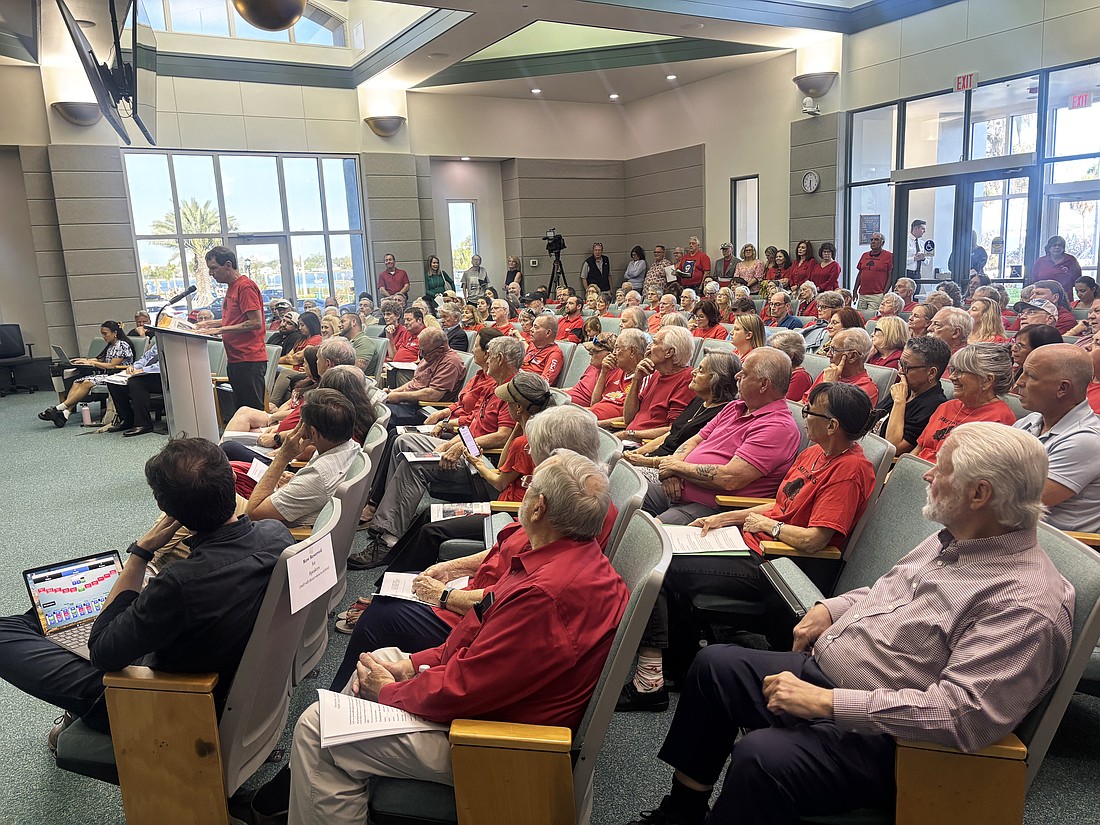
The Tomoka Oaks Homeowners Association, along with 14 individual residents, have filed an appeal of the Ormond Beach City Commission’s recent approval for a 254-home development on their former golf course.
The appeal, filed on April 23, seeks to reverse the commission’s 3-2 vote on March 24, that OK’d a development order to Triumph Oaks of Ormond Beach for the proposed Tomoka Reserve subdivision. The main argument? The threat of a multimillion lawsuit strong-armed the City Commission into approving the development. In an op-ed to the Observer,Deputy Mayor Lori Tolland, who approved the project, wrote that she felt they were making the decision as a commission “with a virtual gun to our heads.”
“You should not be under that much duress when you are trying to make decisions about whether or not they are meeting the land development code,” said Michelle Zirkelbach, a Tomoka Oaks resident and volunteer HOA president. “And the land development code is very clear that we, as existing residents, are also offered protections.”
Zirkelbach, a local teacher and real estate agent, is one of the individual residents named in the appeal.
The project has been a contentious one from the start. Developers Carl Velie, Ray Barshay and Sheldon and Emily Rubin purchased the former 147-acre golf course in 2018. They held preliminary neighborhood meetings and approached the city in 2021. For the next five years, several meetings to discuss the project were held, including three public hearings at the Planning Board level, which ultimately resulted in a recommendation to deny the project in 2023.
Then at a City Commission public hearing that year, the project was remanded back as officials asked the developers to decrease density.
The developers then filed an application to rezone the property from a Planned Residential Development to its original residential zoning of R-2, “Single-Family Low Density.” The commission denied the rezoning in 2024 and the developers filed an appeal with the Seventh Judicial Circuit later that year.
In December 2024, the developers also filed a federal lawsuit, alleging that the city had violated the developers’ property rights by declaring that the golf course has no allowed zoning uses by right and refusing to issue a new development order.
The HOA’s appeal states the federal lawsuit “tainted” the development’s approval.
“Without the approval, the City Commission was told that they would face monetary damages, attorneys’ fees and damages amounting to millions of dollars for which they would have to assess residents, including Petitioners as citizens of the City of Ormond Beach,” attorney Ralf Brookes writes in the appeal.
Due to the matter being a pending litigation, City Attorney Randy Hayes declined to comment.
The appeal further argues that the application’s approval ignores land development code standards as well as bypassed the city’s own policies by skipping a Planning Board hearing. At the recent hearings, Hayes stated a Planning Board hearing was not necessary because the commission was reviewing an existing application that had already come before them for approval in the past.
The Tomoka Oaks HOA argues otherwise; the first proposal consisted of 276 lots, which was later reduced to 272 lots.
The approved development order was for 254 lots and included other provisions, such as a different type of buffer to the one originally proposed.
In the initial application, the city wanted a “type six” buffer — seven trees, 70 shrubs and 70 ground cover plants per 100 linear feet. The developers’ new plan is for a “type four” buffer —five trees, 50 shrubs and 50 ground cover plants per 100 linear feet.
“The plan wasn’t the same,” Tomoka Oaks resident Missy Herrero said. “And if it was a continuation of the same plan, that plan was recommended for denial by city staff and the Planning Board.”
Herrero also is named in the 63-page appeal, which cites concerns with site access, the traffic study, lot sizes and neighborhood conformity, stormwater and environmental impacts.
More residents wanted to join the appeal as individuals, Zirkelbach said, but were unable to because they hadn’t spoken at the public hearings. (It should be noted that the March 24 meeting had over 50 people participating in public comment.)
“We wanted to see the process,” Zirkelbach said. “This thing was so rushed, the city commissioners asked, ‘Can we table this? Can we read? Can we come back? Can we get answers to some of these questions?’ And they were shut down by the city attorney. ... That’s a really heavy-handed stance for a city employee to take in regards to the commissioners who are supposed to be the ultimate decision-makers, and it’s frustrating.”
Herrero said that it was clear from the tone in the chambers that commissioners felt pressured to approve the project, not based on its merit, but on the litigation.
“What changed?” she asked. “Did the plan change to meet what city staff recommended the last time they looked at this project? Not, it didn’t. It actually came back at a lesser plan. That’s what’s so hard.”
The homeowners aren’t saying “no” to all development of the golf course, Zirkelbach said.
“We’re not asking to turn back the hands of time,” she said. “We’re not asking that nothing be built. We’re asking that the land development code be followed.”
Editor’s note: The Observer reached out to the developer’s attorney Karl Sanders for comment, but he did not respond in time for publication.