- July 26, 2026

A two-year study by the U.S. Army Corps of Engineers showed that fixing the chronic flooding problems in Daytona Beach’s Midtown area will be an expensive fix with no easy solution.
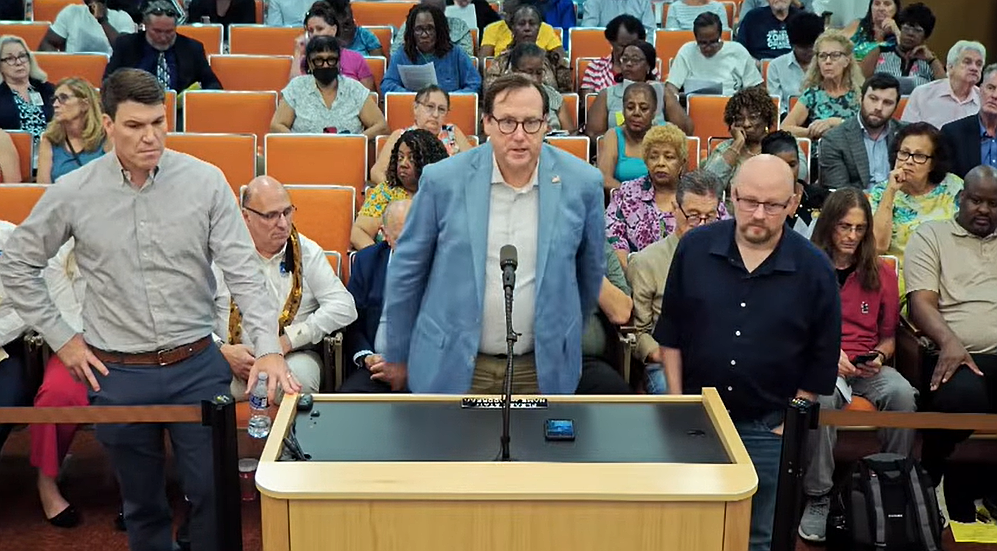
The results of the study were presented to the Daytona Beach City Commission at its May 6 meeting, just weeks ahead of the 2026 hurricane season. The study encompassed the area within Orange Avenue, Beville Road, Nova Road and Ridgewood Avenue.
The issue facing Daytona Beach is multi-faceted. Not only does Daytona Beach’s Midtown area have little green space to promote water absorption, but Midtown sits in a lowlying area that collects stormwater that is mostly flat.
“In layman's terms,” said Jason Levecchia, a USACE engineering technical lead, “there's not enough slope, topography wise, to force the water to drain quickly back to the Halifax River and essentially back to the ocean.”
Two major canals — the Nova and Navy canals — also meet along the west side of the area, and spillover from those canals impact the area, too. Additionally, those canals were not designed for the amount of stormwater runoff the receive now, according to the Army Corps study.
Not only does water drain slowly into the Halifax River, but during high tides, the water can get pushed back into the streets.
“You have brought to us the worst news,” Mayor Derrick Henry told the Army Corps representatives. “Our biggest dream was we'd have a solution. If I said I was anything less than heartbroken now, I'd be lying.”
Despite the chronic flooding problems, funding is likely to be in short supply. The USACE team told the City Commissioners Daytona Beach would likely be at the “bottom of the list” for project funding, and compete against other more justifiable projects.
Despite the engineering team's best efforts — “We have tried every step of the way to get around it,” USACE project manager James Lagrone said — they could not find a good solution for Midtown’s flooding.
USACE engineer Tom Gesture said they looked at multiple options, many of which were not feasible or effective or were cost prohibitive to the amount of help it would offer.
The best they had to offer was to direct excess stormwater to the golf course using sluice gates, using the course as a retention pond and then pumping the stormwater out.
“That is a very robust plan. The one that is most likely to be able to actually address all flooding in the city,” Gesture said. “It is a very expensive plan.”
That plan would cost an estimated $200 million, and would be unlikely to reserve federal funding. The project would require updating the city's stormwater system to direct he flow of the water to the golf course.
Levecchia said that the team looked into whether the existing underground pipes needed to be upgraded to larger sizes to accommodate the water flow, but their analysis showed that wasn’t the case.
“I think you need a way to get the canals themselves, Nova [and] Navy and all the outlets, to get the water out a lot faster than it is currently,” he said. “I think they're under sized from width and from depth.”
Depth would be the more difficult problem to fix, he said, as the groundwater table is very high because it is near the beach.
Lagrone said they have one more course of action the Army Corps would like to try.
TOM said their last resort is for the city to request for the Army Corps to conduct a larger study due to the complex nature of the problem. That study would cost additional money, but if a solution is found through it, Army Corps policy would allow USACE to potentially cost-share the project.
But, he said, he doesn’t think that would be the case. The additional study would cost $1.2 million and a result would not be available until summer 2027.