- July 5, 2026

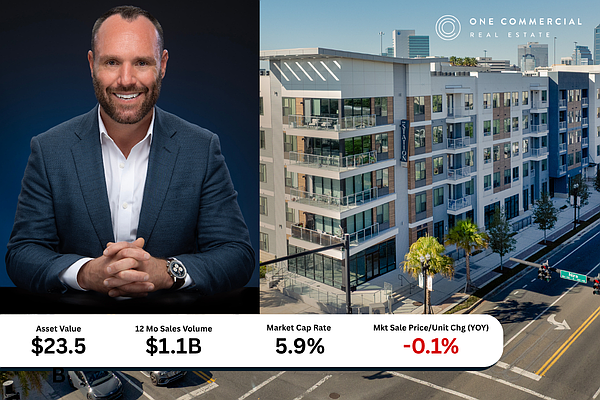
Investor sentiment in Jacksonville’s multifamily market has shifted from cautious to constructively selective. Over the past year, operating fundamentals have begun to stabilize, and that stabilization is showing up in buyer behavior: capital is re-entering the market, but it is concentrating in deals where underwriting is clear and financing can be executed with confidence.
As of second quarter 2026, trailing 12-month multifamily sales volume reached $1.1 billion—up nearly 40% year over year. The rebound is meaningful, yet Jacksonville still trails Florida’s other major multifamily metros in overall transaction volume, reflecting the market’s continued “quality-first” posture and the ongoing bid-ask work that defines today’s pricing environment.
In our day-to-day conversations with buyers, sellers, and lenders, the pattern is consistent: stabilized assets in established submarkets are drawing the deepest demand. Lease-up and non-stabilized opportunities can trade, but typically only when pricing offers a discount—or when going-in yields are widened enough to compensate for near-term operational and execution risk.
That selectivity is visible in what is actually trading. Roughly 65% of recent volume has been tied to 4- and 5-Star properties, with another 20% attributed to 3-Star trades. Lower-tier assets account for the remainder, and they often require more creativity around business plans, reserves, and (critically) insurance and capital expenditures.
Cap rates have remained relatively stable, generally pricing 30 to 40 basis points below the national average. Still, price discovery is not “done.” Many buyers are underwriting to second-year performance rather than relying solely on in-place income—an approach that acknowledges lagging rent growth, higher expense loads, and the reality that operational improvements take time to translate into durable net operating income.
One tailwind is beginning to materially influence deal economics: declining insurance costs. Insurance has been one of the most volatile—and consequential—operating expenses for Florida multifamily assets, often constraining leverage and eroding cash flow. Recently, increased competition among carriers and new market entrants have improved pricing and underwriting flexibility, including for assets that were previously difficult to place.
For a typical Florida multifamily portfolio, year-over-year insurance cost reductions of 30% to 40% are increasingly achievable. Practically speaking, a top-tier asset that may have carried insurance near $1,000 per unit a year ago can now be insured closer to $700 per unit—or less—depending on loss history, construction, wind mitigation, and deductible structure. While risk remains uneven (particularly for older vintage properties, frame construction, and coastal affordable housing), this premium relief is improving net operating income, supporting loan proceeds, and strengthening bid competitiveness.
Timing, however, still matters. With hurricane season beginning in June, active storms can delay or restrict policy binding, which adds yet another reason investors are prioritizing certainty and clean execution.
Within the metro, Southside continues to command the greatest share of investor interest, supported by strong population and employment growth and the highest median incomes in the region. Over the past year, Southside led the market in sales volume and ranked among the top 10 submarkets statewide. Across 66 trades recorded over the trailing 12 months, the average sale price approached $19 million, with typical marketing periods ranging from four to five months and some compression in bid-ask spreads.
The year’s headline transaction underscored the point. In December 2025, Waterton acquired the 555-unit Country Club Lakes community in Southside for $94.4 million—about $170,090 per unit—at a reported 5.3% cap rate.
For owners considering a sale and investors evaluating acquisitions, the takeaway is straightforward: Jacksonville’s multifamily market is improving, but today’s buyer is paying for durability. In this cycle, the highest liquidity remains with stabilized assets, verifiable expense structures, and a clear path to insurable—and financeable—cash flow.
Strategize Your Next Smart Move.
Thinking of buying, selling, or repositioning a multifamily asset?
Contact me, Jamie Cuzzocreo at ONE Commercial Real Estate for insight-driven guidance backed by real market data. Get the same information today’s top investors are using to make smarter moves.
386.415.3577