- August 12, 2026

Palm Coast officials are warning that without a major new funding source, the city’s roadway system will continue to deteriorate and quickly.
During a lengthy workshop presentation Tuesday, Stormwater and Engineering Director Carl Cote outlined what city leaders described as a growing infrastructure crisis tied to rising paving costs, declining revenues and years of deferred maintenance following the expiration of a half cent infrastructure sales tax in 2012.
“Providing adequate funding for maintenance of infrastructure is critical,” Cote told council members while presenting the city’s updated Pavement and Roadway Asset Management Program.
According to the presentation, Palm Coast maintained roughly 950 lane miles of roads between 2000 and 2012, largely funded through the half cent infrastructure surtax approved by voters in 2002. Since the surtax expired, resurfacing activity has dramatically declined, with only about 350 lane miles maintained between 2013 and 2026.
At the same time, the cost of milling and resurfacing roads has skyrocketed by roughly 300% since 2005, while roadway maintenance revenues have actually declined about 9% over the last two decades.
The result, according to city staff, is a rapidly aging roadway network now valued at approximately $850 million. Residential roads are showing the steepest decline.
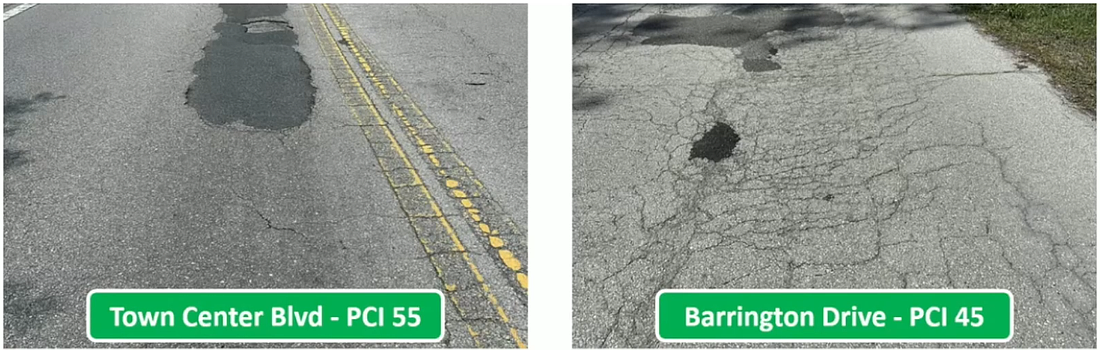
Cote said Palm Coast’s residential road pavement condition index, or PCI, has dropped from 78 in 2017 to 69 in 2026. The citywide roadway average now sits at 72, below Florida’s statewide municipal average of 76.
“We’re towards the top of the list early on in 2017 and now we’re almost at the bottom of the list in comparison to other cities,” Cote said.
The city has increasingly relied on micro surfacing, a less expensive treatment that seals and refreshes residential roads, but staff acknowledged it is only a temporary solution.
“It’s definitely a very short term fix,” Cote said. “It makes things look good for a little bit, buys you a little bit of time.”
Officials said Palm Coast is now running out of roads that qualify for micro surfacing because too many streets have deteriorated beyond acceptable thresholds. Staff is also exploring alternatives including cape sealing and a thin structural asphalt mix used in New York.
Councilman Ty Miller described the city’s current approach as unsustainable.
“The moral of the story is that even with the efforts that we’ve done, we’re still losing the battle,” Miller said. “We’re sticking our finger in the dam and more holes are popping up.”
Miller repeatedly stressed that the city is effectively choosing between “two losing solutions” unless a new dedicated funding source is identified.
“Right now we don’t have the money to fix things properly and because of that things are getting worse,” Miller said. “They’re only going to cost us more money in the long run.”
Staff presented multiple five year funding scenarios to council.
Under the city’s current approach, dedicating $2.5 million annually primarily toward arterial roads, residential collector roads would decline from a PCI of 67 to 57 within five years. Residential local roads would fall from 68 to 61.
A second option would split the funding, using $1.5 million annually for arterial roads and $1 million for residential collector roads. While that would slow residential deterioration, arterial roads would also decline significantly.
Vice Mayor Theresa Pontieri argued that allowing residential collectors to fall into the 50s was unacceptable and pushed for continued general fund support for neighborhood roads.
“I don’t think that’s acceptable,” Pontieri said. “I don’t know how we function at 57 on collector roads. That’s crazy.”
Pontieri also pointed specifically to Town Center Boulevard as a roadway requiring urgent attention because of its role in the city’s economic development efforts.
“Who’s going to want to invest in the CRA when you can’t drive on the road?” she said.
According to Cote, the city would need just under $3 million for arterial roads and about $9.4 million for residential roads to maintain recommended service levels. He said the actual funding shortfall is about $500,000 for arterials and $9.4 million for residential roads, leaving Palm Coast just under $10 million short overall.
Council members discussed several possible future funding sources, including dedicated millage, gas taxes, reserve funding, franchise fees and a potential countywide sales tax model.
The council ultimately reached consensus directing staff to return with additional funding scenarios and recommendations during upcoming budget workshops in June.