- July 16, 2026

The Palm Coast Planning and Land Development Regulation Board voted unanimously Wednesday night to recommend denying two key requests that would have paved the way for the city's proposed westward expansion, saying members did not have enough information about how roads, utilities, schools and other public infrastructure would be funded before approving the project.
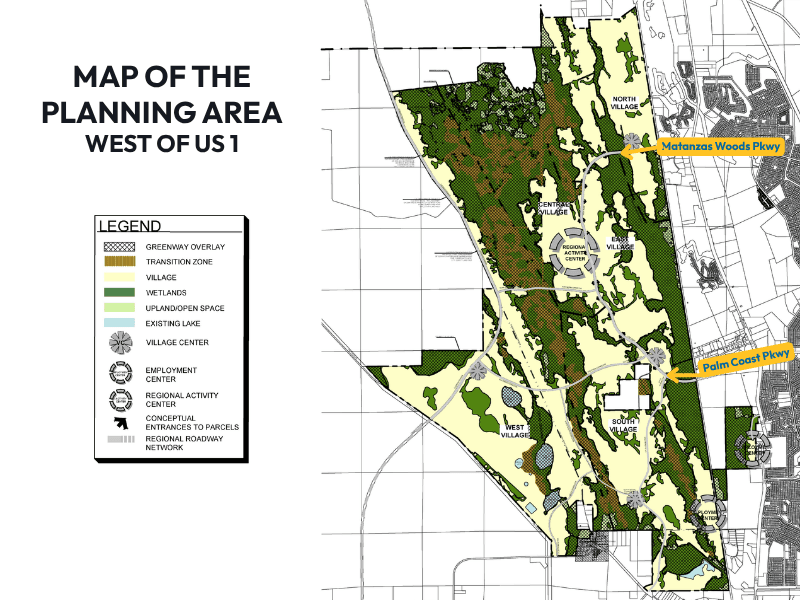
In two separate 5-0 votes, the board recommended denial of a Future Land Use Map amendment and a companion zoning map amendment affecting approximately 20,144 acres owned by Radiant Palm Coast LLC. The proposal would establish a Master Plan Mixed Use designation and Master Plan Development zoning for what city officials have described as Palm Coast's long-term growth area west of the Florida East Coast Railway. Approximately 7,041 acres of the property currently lie in unincorporated Flagler County and would require separate annexation into Palm Coast before the project could move forward. The annexation itself was not before the Planning Board and will require separate action by the Palm Coast City Council.
The recommendations now move to the Palm Coast City Council, which will make the final decision on the applications.
Planning staff recommended approval of both requests, emphasizing that Wednesday's action was intended to establish the planning framework rather than authorize construction. Staff repeatedly stressed that no development could move forward until future development agreements addressing roads, utilities, schools, parks and other public infrastructure are negotiated and approved by the City Council.
According to city staff, the proposal would allow up to 21,920 residential units and approximately 6.6 million square feet of nonresidential development while preserving more than 40% of the property through a greenway overlay designed to protect wetlands, wildlife corridors and environmentally sensitive lands. Staff estimated the project could ultimately add about 54,800 residents and require additional investments in transportation, water, sewer, parks and schools.
Senior Planner Jose Papa told the board the approvals under consideration would not eliminate future infrastructure requirements.
"We cannot approve a technical site plan for development unless we have that development agreement," Papa said, explaining that developers would have to demonstrate adequate roads, water, sewer and other public facilities before construction could begin.
Applicant representatives described the hearing as only the first step in a lengthy process.
Mike Hahaj, representing Radiant Palm Coast, said the current applications establish the planning framework, while future negotiations would determine how public facilities are funded and constructed before development occurs.
Ray Spofford, vice president of planning with England-Thims & Miller, said the concept is intended to create a master-planned community emphasizing environmental preservation, employment opportunities and long-term financial sustainability.
The proposal includes a regional activity center, employment centers, village centers, interconnected roadways and a greenway system linking existing conservation lands. Spofford said preliminary fiscal analysis estimates the project could generate a positive net fiscal benefit over 30 years while creating more than 10,000 jobs at buildout.
Despite those projections, board members expressed repeated concerns that residential development could outpace commercial and industrial growth.
Vice Chair James Albano questioned whether the proposal devoted enough land to employment uses, arguing Palm Coast should prioritize jobs before additional housing. "It seems like we should front load the industrial and commercial," Albano said. Later in the discussion, he added, "The last thing we need at this point in Palm Coast are more residential homes... We need industrial jobs. We need bigger companies with a lot of employees," saying that expanding the city's employment base should be a higher priority if Palm Coast hopes to diversify its tax base.
Staff responded that the proposed development agreement contains phasing provisions requiring land to be reserved for workplace uses, although officials acknowledged actual construction of commercial buildings would ultimately depend on market demand. They also noted that many retailers and employers require a certain population threshold before locating in a community.
Transportation was another major topic.
Board members questioned whether roads should be built to their ultimate capacity from the outset rather than expanded later as traffic increases. Planning Manager Phong Nguyen said those details would be addressed during the next phase of negotiations, which will determine roadway improvements, utility infrastructure and funding responsibilities based on the project's impacts.
Spofford added that the goal would be to construct major roadways, including the Loop Road extension, as four-lane divided facilities initially because doing so is more cost-effective than widening roads later. He also noted that funding already committed for Loop Road comes through state appropriations rather than city funds.
Historic preservation also emerged as a significant issue during the meeting.
Palm Coast City Historian Preston Zepp urged board members to give greater consideration to the area's historic resources before moving forward. Zepp said the proposed alignment of County Road 2209 appears to overlap portions of the historic Dixie Highway and warned that changes to the corridor could jeopardize its National Register status. He also argued that several historic sites identified within the project area, including the Old Brick Road, lack meaningful protections despite the project's environmental focus. Referring to a recent Palm Coast Observer feature on the Old Brick Road, Zepp noted that the roadway remains a tangible link to the area's early history and deserves stronger preservation measures as westward expansion plans move forward.
The Flagler County School Board also voiced concerns through Chris Wilson, attorney representing the Flagler County School Board, who said the district supports growth but remains concerned about how school impacts would be addressed.
Wilson said the district estimates the project could generate roughly 4,400 students and create approximately $188 million in school impacts while impact fees would cover only about $111 million, leaving what he described as a $77 million gap. He argued those issues should be resolved before granting the requested land use and zoning approvals.
Flagler County officials also requested a larger role in future negotiations. Assistant County Attorney Sarah Spector said the county wants to remain involved throughout the project's next phases, while Interim Growth Management Director Chuck Miranda asked that future development agreements specifically address impacts to County Roads 13 and 205 before development proceeds.
Before the board voted, Chair Sandra Shank said members were not trying to prevent development but wanted to ensure the city addressed unresolved issues before granting the requested approvals. She noted that the property owner has development rights but emphasized the city's responsibility in shaping the project, telling the applicant, "You have land rights, you have entitlements. How it's going to be developed, we have a part in that." Shank also said she wants greater attention given to preserving the area's historic and cultural resources as planning for westward expansion continues.
After nearly two and a half hours of presentations, public comment and board discussion, the Planning Board voted unanimously to recommend denying both the Future Land Use Map amendment and the zoning map amendment, with members citing unresolved questions surrounding infrastructure, mitigation and long-term planning.
The applications are scheduled to continue through the city's review process, with the first City Council hearing tentatively planned for Aug. 4 before state review and a potential second reading later this year.