- July 29, 2026

Flagler Beach, with a mind to reimagine itself as a multi-modal city, has approved a new mobility impact fee for new development.
The Commission voted 5-0 at its April 9 to implement these mobility impact fees for new development with a vision to redesign Flagler Beach into a more multi-modal-friendly city.
The April 9 meeting started with an update to the Flagler Beach City Commission from the Volusia-Flagler Transportation Planning Organization’s Bicycle/Pedestrian Advisory Committee. The committee is made up of representatives from Volusia and Flagler Counties and is responsible for reviewing plans relating to bicycle and pedestrian safety.
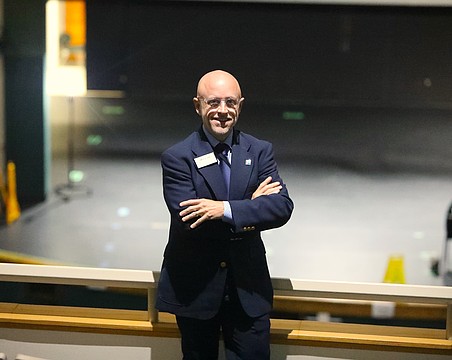
Flagler Beach’s representative Ed Fendley said the Commission needs to continue implementing and encouraging safe and walkability designs and initiatives. While Flagler Beach has done a great job doing so in recent years, he said, there is still more work to be done.
“Flagler Beach is a historic, traditionally designed, walkable small town. That is gold,” Fendley said. “Slowing down traffic, making our streets more walkable as they were designed to be, and increasing golf cart access. That plays to our history. It plays to our strengths.”
Reducing the speed limit on State Road A1A has also been a key initiative, as well as on State Road 100. S.R. 100, he said, is the biggest remaining threat to pedestrian safety and the biggest area for improvement.
“The design should say and tell drivers, slow down, stop for a while, have some fun, spend some money,” Fendley said. “And right now, the design and operation of State Route 100, Moody Boulevard from Colbert Lane to the [S.R. A1A], it says the opposite. It says go fast.”
With that in mind, the Commission approved a new mobility impact fee later in the meeting. Impact fees are only charged to new development and can only be used to address infrastructure demands created by new development.
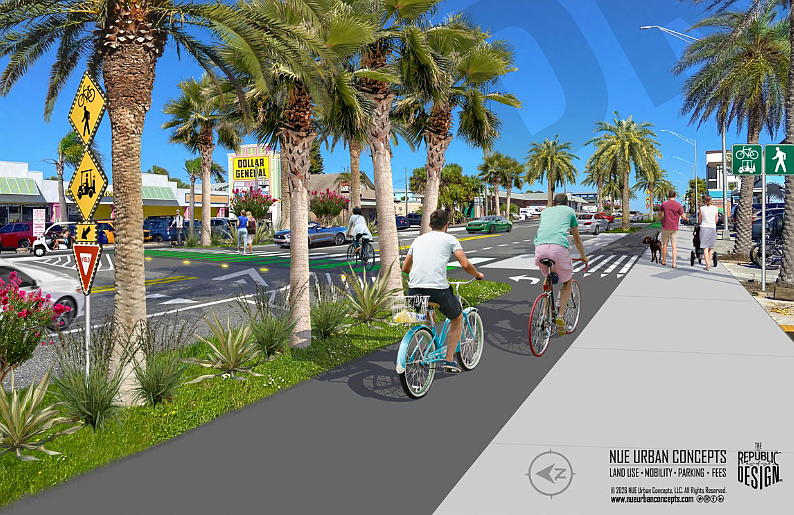
A “multi-modal” design would make the roadways of Flagler Beach more accessible and safe for pedestrians, cyclists, golf carts and drivers. Jonathan Paul with the urban planning firm NueUrban Concepts presented a multi-modal reimagining of Flagler Beach to the Commission, showing ways the city could prioritize and encourage slower driving or multi-modal lanes.
“The idea is as you come into Flagler Beach, there are different changes to the geometry of the roadway to the point where you ultimately get to slower speeds when you're in the downtown core near the pier,” Paul said.
The mobility plan Paul presented was just to give the commissioners an idea of ways the mobility fee could be used. That included redesign options for State Road 100, narrowing streets through roadway striping, medians or even expanding sidewalks.
“The big part of it is we provided money for funding, design, and upgrades to the corridor,” Paul said. “Ultimately, what those [upgrades] are, that's going to be a lot of community discussion.”
Commissioner James Sherman said these designs show the city can find alternative ways for people to get around safely without using cars.
“We don’t have a people problem, we have a car problem,” he said. “Putting these fees into place will help move people throughout the city.”
The impact fees are charged based on building size, per 1,000 square feet: For residential homes, $2,981, hotels and short-term rentals would cost $3,843, while retail would vary from $10,621 to $29,931, depending on the type of business.
If a building were to be demolished and built back bigger, the assessed impact fees would only be for the additional square footage: a building that was 1,000 square feet and built to be 3,000 would only have an impact fee based on the 2,000 square foot difference.
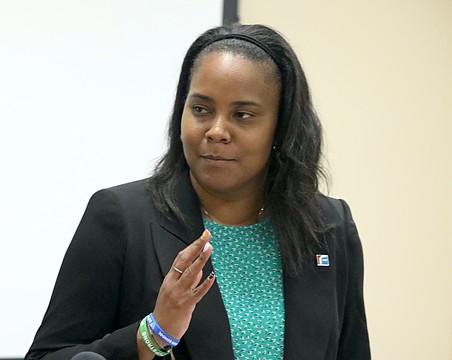
Commissioners Eric Cooley and R.J. Santore and Mayor Patti King did have concerns about how these additional fees would affect new small businesses wanting to come to the area.
But King pointed out that the fees would provide a real benefit to the community.
“We're about walkable and bicycles and golf carting. And we want everybody to travel together safely,” she said. “And if we all have to pay for it in this fashion, that makes the most sense.”
Cooley did suggest the commission lower the business impact fees but increase those for residential, but the other commissioners agreed to keep them as proposed.
“Maximizing the mobility — I look at the need,” Cooley said. “If anyone needs massive amounts of money put into improving mobility, it's this city.”