- July 29, 2026

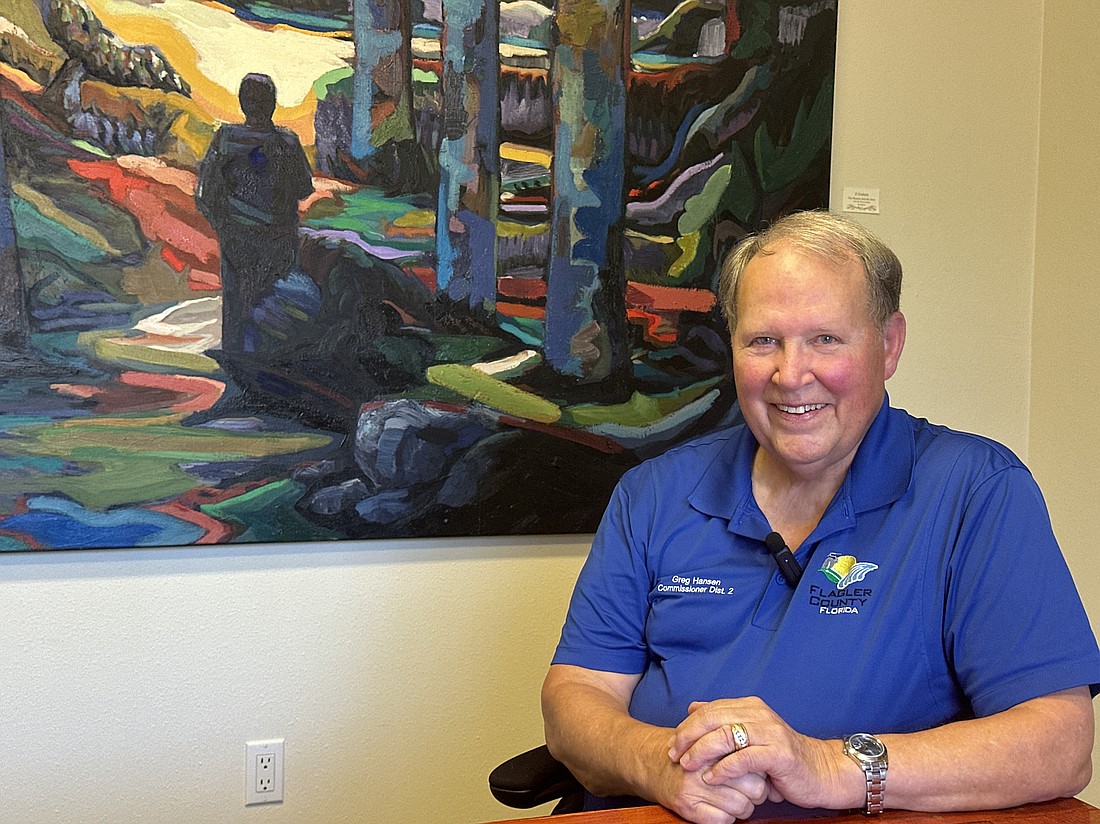
As Flagler County Commissioner Greg Hansen prepares to conclude nearly a decade representing District 2, he sat down with Palm Coast Observer Publisher Brian McMillan for an interview on Observer Now to discuss the issues that have defined his time in office. Hansen, whose district includes The Hammock and much of eastern Flagler County, spoke about preserving the Hammock's character, the county's data center moratorium, the uncertainty surrounding Florida's proposed property tax amendment, county budget challenges and what he considers his biggest accomplishments in public service.
What follows is a transcript edited for length and clarity.
You've represented District 2 for nearly 10 years, and much of The Hammock falls within your district. You've joked before that you're almost like the "mayor of the Hammock." Why is that?
The Barrier Island and the Hammock are unincorporated, so they don't have their own city government like Palm Coast does. Because of that, when residents have an issue, they come to me.
I joke that I'm the mayor of the Hammock, but there is some truth to it. If somebody has a concern about roads, drainage, development or anything county-related, I'm usually the first person they call. That's always been something I've tried to embrace. I want people to know they can reach me.
The Hammock Overlay has become a major topic recently. Why is that overlay so important to residents?
If you think about the Hammock, it's really unique. As I understand it, it's the only true remaining hammock left in Florida. It's known for its beautiful tree canopy, its natural environment and its scenic character.
The county owns a significant amount of environmentally protected land there, and organizations like the Hammock Community Association have worked very hard to preserve that character.
People recognize State Road A1A as one of America's scenic highways. There are very few traffic lights, very little commercial development and an Old Florida feel that residents want to protect.
The Scenic A1A designation focuses primarily on the roadway itself, but the Hammock Community Association is concerned with preserving the entire community. They want to make sure future development doesn't change what makes the area special.
Property values in the Hammock are among the highest in the county. How do you think Florida's proposed property tax amendment could affect the area?
I think homeowners — particularly owners of higher-value homes — would benefit if Amendment 3 passes because their property taxes would likely go down.
But that's only part of the story.
My biggest concern isn't whether taxes go up or down. It's that the amendment doesn't actually explain how local governments are supposed to function afterward.
If voters approve it, the Legislature will then decide how everything works. They'll determine how local governments can raise money and what restrictions they'll face.
To me, that's the scary part.
I don't believe informed voters will support something without knowing how it will actually work.
You've also expressed concern that renters and businesses could actually be hurt by the proposal. Why?
Businesses don't receive the same homestead protections homeowners receive. If you're a small business owner, you're still paying property taxes.
Those costs don't just disappear.
Most landlords will eventually pass increased costs along, through higher rent.
So while homeowners may receive some relief, renters could ultimately end up paying more, and businesses won't receive the same benefit.
That's why I think it's much more complicated than simply saying we're cutting property taxes.
The Hammock Community Association challenged the county over a boat storage project, before eventually dropping its lawsuit. Do you feel that issue has finally been resolved?
It's resolved from a legal standpoint.
The Hammock Community Association withdrew its lawsuit, and the county reached a settlement with the developer. Construction has already started.
Whether everyone is happy with the outcome is another question. I don't think anybody walked away completely satisfied. The developer spent a lot of money getting to this point. The Hammock Community Association clearly wasn't thrilled with how things unfolded.
But sometimes that's what compromise looks like. The jury is still out. Maybe it turns into a great project. People need places to store boats. If the restaurant portion succeeds, that could be something the community enjoys. We'll have to wait and see.
Do Hammock residents feel they're being heard by county government?
I think they feel heard by me.
The challenge is that I'm only one commissioner.
Many residents would like an opportunity to speak directly with all five commissioners instead of relying on me to represent every concern they have.
Sometimes I find myself on the losing end of a 4-1 vote.
I've encouraged them to wait until after the upcoming election before holding another workshop with the full board because there's a chance we'll have new commissioners.
That could change the conversation.
Residents often pack commission meetings wearing matching green shirts in support of Hammock issues. What does that tell you?
It tells me they're passionate. They show up. They speak during public comment. They care deeply about protecting their community. Even when they don't win, they're engaged in the process. That's healthy government.
One of the commission's biggest recent actions was approving a one-year moratorium on new data centers. Why did you support that pause?
Quite honestly, my wife has probably become one of the biggest researchers on data centers I've ever met. She constantly sends me information from around the country about communities dealing with these facilities. The more I learned, the more concerned I became.
There are questions about noise. Questions about enormous electrical demand. Questions about backup diesel generators. Questions about water consumption. Some facilities recycle water; others use tremendous amounts of it.
The technology is changing so quickly that I don't think enough is known yet about their long-term impacts. Some people say data centers are the future. Maybe they are. But my feeling has been that Flagler County doesn't need to rush into becoming part of that future until we understand the consequences.
The county is in the middle of another difficult budget cycle. How do you decide when to approve funding requests and when to say no?
That's exactly what we're working through right now.
The Board of County Commissioners controls its own budget, and this year we reduced our departmental budget by 5%. We hoped that would set the example for everyone else.
Some constitutional officers came in within reason, but others requested much larger increases. So now we're back at the table having those conversations again.
The reality is, we're already seeing the effects of reducing spending, and those effects aren't always pleasant.
People often hear about budget cuts, but they don't necessarily see what that means. What kinds of services are already being affected?
One example is out in Marineland Acres.
At the end of each beach access road, we had installed trash cans and dog waste stations. We recently removed those and instead placed dumpsters at the parks. That alone saves roughly $200,000 a year because we no longer have crews driving around constantly emptying individual trash cans.
Those are the kinds of decisions people don't always notice until they happen. Unfortunately, I think there will be more.
One area that concerns me is western Flagler County. The drainage swales out there aren't like Palm Coast's swales. They're massive drainage ditches. For years they weren't maintained properly, but over the last six or seven years we've developed a really good maintenance program. We've made tremendous progress clearing those canals and improving drainage.
If revenues continue shrinking, that's the kind of work that could slow down or stop, and that concerns me.
Public safety is another major part of the county budget. Are there concerns about maintaining those services?
Absolutely. Fire Rescue falls directly under county government, unlike the Sheriff's Office.
We're already discussing whether Fire Rescue and EMS should eventually be funded through a countywide Municipal Services Benefit Unit, or MSBU, to create a dedicated funding source.
The challenge is that an MSBU works differently than property taxes. Someone who currently doesn't pay property taxes because they're a disabled veteran or qualify for another exemption could still end up paying an MSBU assessment.
That's something people need to understand. It's another example of how complicated these funding discussions really are.
Do you see any benefit in creating dedicated funding sources for services like public safety?
There's certainly transparency.
We've talked about whether the Sheriff's Office should eventually have its own dedicated funding source.
One advantage would be that residents could clearly see exactly how much money is being allocated to law enforcement. Right now, it's all part of the county's overall budget.
Having a separate funding mechanism would make that spending much more visible. Whether that ultimately happens is another question.
Do you think there's any appetite among county leaders to reduce spending on public safety?
No. Public safety is my No. 1 priority. Sheriff Rick Staly has done an outstanding job. Crime is down. People feel safe. The community recognizes that. I don't think anyone wants to move backward.
At the same time, if the county eventually loses tens of millions of dollars because of property tax changes, everybody will have to share some of that burden.
That doesn't mean defunding law enforcement. It simply means every annual increase has to be carefully evaluated. The Sheriff's Office has grown every year, and the results have been positive. But every department will likely face closer scrutiny moving forward.
If budget reductions continue, what other services could residents begin noticing?
The quality-of-life services. People like having roadsides mowed. They like seeing trees trimmed. They appreciate clean parks.
Those are often the first things that get reduced because they're easier to delay than emergency services.
But eventually residents notice.
The proposed Westward Expansion has largely been debated at Palm Coast City Hall. Does it affect the county?
Our biggest concern is protecting County Road 205 — what many people call the Brick Road.
We're committed to preserving that road.
If the development eventually happens, Palm Coast will be responsible for providing water, sewer and fire protection.
The county will still provide EMS services, so at some point decades down the road we may need another ambulance and another EMS crew.
But we're talking about something that could take 30 years to fully build out. So from the county's perspective, there really isn't an immediate impact.
Earlier this year, Chief Financial Officer Blaise Ingoglia visited Flagler County and claimed local governments had overtaxed residents by roughly $59 million. Did anything positive come from that discussion?
One positive outcome was that it encouraged more conversation about government spending.
But I strongly disagree with the way those numbers were presented. We reduced our budget by 5%. We've lowered the millage rate almost every year I've served on the commission.
The challenge is that even when you lower the millage rate slightly, property values often increase. So governments may still collect more overall revenue.
That doesn't necessarily mean taxes were increased. It reflects higher property values.
As for the $59 million figure, we've repeatedly asked for the data supporting that number. We've submitted public records requests. We've asked where those savings came from. We've never received documentation showing where that number originated. That's why I remain skeptical.
As you prepare to leave office after nearly a decade, what are you most proud of?
I love Flagler County. My wife and I came here simply to look around. We liked it so much that we bought a house the very same afternoon.
This community has been wonderful to us.
What I'm most proud of is how accessible I've tried to be. I've always wanted residents to know they could call me.
For years, if someone invited me to their home to discuss a problem, I'd go sit at their kitchen table and talk with them. I return phone calls. I answer emails. If someone has a concern, I want them to know somebody is listening.
I genuinely enjoy helping people. That's why I accepted the appointment when Gov. Rick Scott was looking for someone to fill the commission seat years ago. I told my wife I thought I could help people. She told me to go for it. And that's what I've tried to do every day since.
Are there accomplishments that stand out when you look back on your time in office?
There are quite a few.
One that always comes to mind is Bay Drive Park. That was a difficult project. There was a very vocal group that opposed it. We kept meeting. We kept listening. We kept explaining why the project was important.
Eventually it moved forward. Today people love that park.
Sometimes leadership means sticking with something long enough for people to see the finished product.
Those are the kinds of accomplishments I'm proud of.
Finally, what do you hope residents remember about your time on the County Commission?
I hope they remember that I genuinely cared.
Whether someone agreed with every vote I made isn't really the point.
I hope people know every decision I made was based on what I believed was best for Flagler County.
I tried to be available. I tried to listen. I tried to help. At the end of the day, that's what public service should be about.