- March 3, 2026

A Bunnell resident has filed a case in court against the City of Bunnell over its approval of a 1,200-acre industrial park rezoning.
Bunnell resident Chelsea Herbert, represented by attorney David A. Theriaque has filed a petition asking the Flagler County Circuit Court to review the rezoning approval of the development known as US 1 Park. Herbert and her attorney, who could not be reached in time for the publication of this article, filed the case on Jan. 7.
The lawsuit alleges that Bunnell’s decision “departed from the essential requirements of law” and “is not supported by competent substantial evidence.” Herbert and her attorney are requesting the court void the rezoning.
The petition states the city’s approval departed from essential requirements because “the approval constitutes impermissible conditional zoning,” the approval does not comply with Bunnell’s land use regulations and is not supported by “competent substantial evidence.”
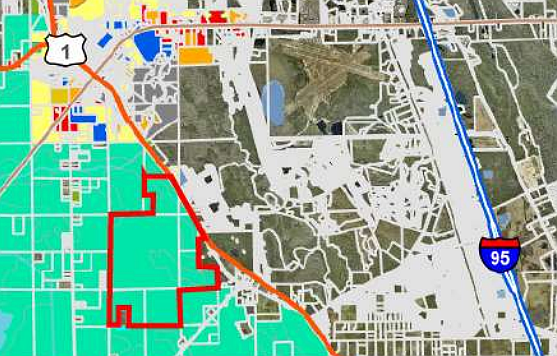
The property is 1,259 acres of undeveloped land east of Old Haw Creek Road and west of Highway U.S. 1. The applicant received approval from Bunnell to rezone the land to both Light and Heavy Industrial.
That Light Industrial allows for a mixture of businesses from cold storage, retail and wholesale businesses to include industrial equipment, electronic equipment assembly, auto detailing and adult entertainment businesses according to Bunnell’s land development code.
Approved Heavy Industrial uses include solid waste management facilities, junk yards, large-scale manufacturing businesses, chemical production plants, boat building, truck and freight terminals and truck scales, and more.
On Dec. 8, the Bunnell City Commission voted 3-2 to approve the developer’s future land use and rezoning application. The application did not include any specific uses for the 1,200 acres.
The current application is a reduction from the originally proposed 1,842 acres and the developer has agreed to self-imposed conditions of approval, according to the city’s website. Those conditions include “including limited use of processing and large quantity bulk storage of certain chemicals, prohibition of landfills and fuel farms from within the project area.”
City Manager Alvin Jackson declined to comment on the lawsuit because it is in active litigation. But in a phone interview with the Observer, Bunnell City Planner Adrian Calderin and Community Development Director Joseph Parsons described the review process Bunnell undertakes with large-scale applications.
Bunnell does not have any specific criteria listed in its Land Development Code to analyze large-scale applications against, Calderin said, and when that happens staff defaults to the city's comprehensive plan.
"All zoning map requests have to align with our adopted comprehensive plan," he said. "What that looks like is that we look at various policies, goals, objectives that are applicable to the request, and that is what we review to make sure that it aligns with those policies, objectives and goals."
It application must also be compatible with the surrounding area and have no adverse impact on the public facilities and services.
Calderin said an "adverse impact" on services would be if the, based on the maximum potential capacity of the site, the rezoning would exceed the city's capacity for services. US 1 Park, he said as an example, was showing it would exceed the public facility analysis, but because Bunnell is in the midst of upgrading its current infrastructure, the analysis shows
By the time anything is developed on the site, the city's infrastructure would be able to accommodate the growth.
"And if there's if that wasn't the case, then we would probably have some type of condition saying a development agreement will be needed to ensure that there's adequate public facilities in place," he said, "...to ensure that if there is an adverse effect, it's covered by set agreements."
According to a city document for US 1 Park titled “Rezoning Narrative Justification Statement,” the zoning was suitable for the land because “there are existing properties in the City with an Industrial FLU which are adjacent to County and City properties that have future land use designations of residential (in some instances, very dense residential) and ag [agriculture].”
Herbert’s petition claims her property will “be substantially affected” by the city’s decision, as her property is one of the residential properties located near the US 1 Park property.
Calderin said the city analyzes public facilities, fire services, preliminary traffic counts. The rezoning stage of applications is for a "30,000-foot-level" overview.
"Once things are getting close to developing the land, then you get to more like the 5,000-foot, 10,000-foot-level, where they have to have traffic counts and mitigation requirements," he said.
Parsons said more specific site-specific requirements are reviewed with development applications, not straight rezonings as in the case so far on US 1 Park.
But, Parsons said, the US 1 Park developer has exceeded the city's requirement for buffers around the perimeter. Instead of the minimum 30 feet, he said, the developer has committed to 100-foot buffer from neighboring properties, with a six-foot high vegetative berm.
It's also important to note, Parsons said, the areas of US 1 Park that are heavy industrial also have a decrease in intensity.
"That was intentional on the developer's part," he said. "And encouraged by the city."
There's a lot of moving parts with large-scale applications, Parsons said. Calderin said while staff provides the analysis, the commissioners' jobs are to weight the overall impact.
"I would believe that what their duty is whether or not this is in line with the long-range planning efforts with the city," Calderin said.