- February 18, 2026

A 500-home development on Seminole Woods Boulevard has been approved by the Flagler County Planning Board.
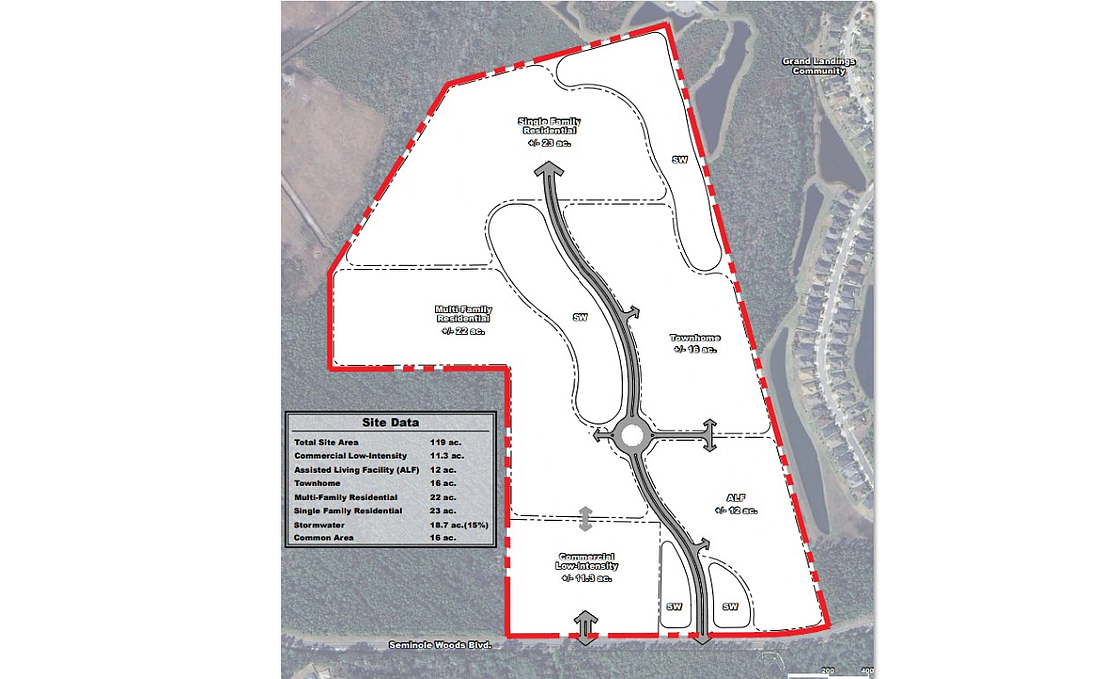
The board recommended 6-0 approval for the development application at its Feb. 10 meeting, and the Flagler County Commission will review it at an upcoming meeting. The development, owned by MPC Lots LLC, is a 119-acre property near the Grand Landings neighborhood.
Flagler County’s staff analyzed the application based on the “worst-case” scenario, or the maximum the development would be able to build under the mixed use-high intensity zoning and planned unit development land use.
That worst-case scenario would include 71.4 acres of residential and 47.6 acres of commercial, with a minimum requirement of 30 acres of stormwater and common areas as open space. The applicant has self-imposed an overall density cap of seven units per acre on the development.
With that cap, the development is approved for a maximum 502 residential units, a mix of single family homes, townhomes and apartments. The minimum lot size for a single family home would be 4,000 square feet, with the smallest allowable living space at 700 square feet.
The analyzed scenario would allow for almost 830,000 of commercial space, including an assisted living facility.
Though the county is required to analyze by that “worst-case” scenario, the application’s master plan apportions the property differently. Instead of 71 acres of residential land, they’re planning for 61 acres of residential.
The plan also outlines only 23.3 acres of commercial land, instead of 47 acres, with 16 acres of common area and 18.7 of stormwater.
Planning board member Timothy Connor asked attorney Michael Chiumento explicitly if that development would “go anywhere near” the 830,000 square feet of commercial space.
“That is a cartoon,” Chiumento said. “That is the process the county and state require us to do.”
“You’re not proposing anywhere near that floor area?” Connor asked.
“No,” Chiumento said.
Connor asked staff if those statements were binding for when the developer returns for site plan and final plat approval, which is where the developer maps out the land in specific lots.
County planner Simone Kenny said the developer is beholden to the conceptual master plan and the PUD development agreement.
“If they did anything that was substantially inconsistent with that master plan, they would have to come back for a new public hearing,” she said.
Many residents in the surrounding area, including from the Grand Landings neighborhood attended to ask the planning board to deny the application. Most were concerned about the size of the development, including the 830,000 square feet of commercial space.
“We don’t need to become Volusia County,” resident James Carlin said.
Chiumento said he could appreciate the residents’ feeling about the concern that their "sleepy community" is going away, but, he said, this was always the plan for Flagler County and Palm Coast.
Chiumento referenced the Flagler County’s comprehensive plan, approved in the 1970s, and Palm Coast’s 2004 comprehensive plan, both of which, he said, called for development of this size.
“This plan has been in place for over 50 years,” Chiumento said. Later, he added: “This concept has always been a part of the community.”
The October 2025 traffic study conducted for this application found the development would add 1,416 additional traffic trips during peak hours in the evening, which, according to county and Palm Coast analyses, does not exceed the capacity of Seminole Woods Boulevard.
But where would these new homes and businesses get their water and sewer from? From Palm Coast.
The planning board had asked at a previous meeting to hear from the city if it had capacity to supply the water for this development. The city said it did.
“We don’t have any issues of water, sewer or reuse in that area,” Chiumento said.
Typically, a property that is using the city’s water would then need to be annexed into Palm Coast, per the city’s policy. But an early 2000s settlement between Flagler County, Palm Coast and Flagler Beach known as the Water Wars agreement states that the annexation would not apply to this development.