- March 24, 2026

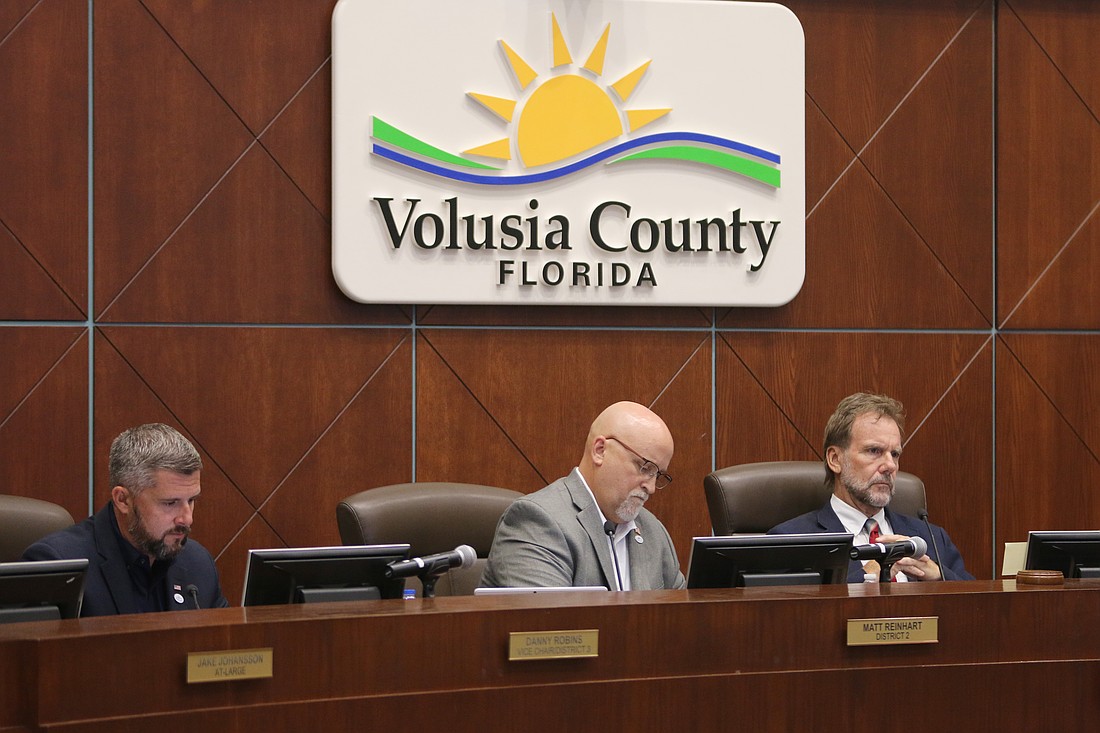
The County Council is on board: Citizens should have a say in whether they want "toilet to tap" or not — at least within the county's utility service area.
The council directed staff on Tuesday, Feb. 3, to draft a charter amendment and county ordinance for the 2026 ballot that would prohibit the use of blackwater (wastewater from toilets) from potable water reuse and from being injected into the aquifer in the county's jurisdiction, unless voters were in favor of such an initiative.
A grassroots effort was led by political committee Let Volusia Vote, with Daytona Beach resident Greg Gimbert at the helm. Gimbert previously approached the Volusia County Council with a proposal for a charter amendment at its meeting on Jan. 20, where the council asked staff to bring back more information on "toilet to tap," as well as a legal analysis on the topic.
Gimbert said he wanted the council to take a "bare bones minimum step" to protect Volusia residents against blackwater reuse.
"We had a lot of problems in Volusia County before poopy water came along, and we're going to have a lot of them after this is resolved, but none of them are any excuse not to reserve this important protection for our residents," Gimbert said.
But is a charter amendment the answer?
People are not lining up to support a "toilet to tap" initiative, Dream Green Volusia Founder Suzanne Scheiber said, but the deeper issue is water conservation and protection of natural resources.
"Everyone in the chamber can sign [a petition] right now," she said. "That does not address the water shortage, water pollution policy deficiency, or support funding for land conservation, which we already voted for. It is contradictory to support a 'toilet to tap' ban and not support land conservation."
Paolo Soria, senior assistant county attorney, told the council that partial preemptions exist concerning regulation of potable reuse. The county can pass an ordinance prohibiting blackwater reuse within its utility service area, but not within the municipalities' or private utility service areas. The county is responsible for 7% of the total service area.
"When you start to regulate cities' water utility service areas, that becomes problematic because there's certain statutes that grant the authority to the municipalities," Soria said. "Essentially, there's a requirement that says potable reuse may not be disallowed from being part of your regional water planning activity when you get to the state level."
There have been a few potable reuse pilot projects in the state, Soria explained. In 2020, the Department of Environmental Protection formulated rules about potable reuse, which went into effect in February 2025. One of those rules requires a 12-month pilot project.
The City of Deltona previously pulled two permits for potable reuse: one for Aquifer Storage and Recovery and another for an injection well.
"ASR allows you to inject either surface water, treated stormwater or treated wastewater to a drinking water standard into the aquifer," County Public Works Director Ben Bartlett said. "Essentially, it stays down there. You use it as a storage tank and you can pull that back up and use it for supplementing irrigation, or potentially, if you were permitted for using it for drinking water. They have a permit to do an exploratory well for that, however, they have not chosen to move forward with that."
The permit for an injection well to recharge the aquifer is the newest one, Bartlett said.
"They're just basically pumping surface water treated to a drinking water standard into the aquifer, and it's just for recharging the aquifer," he said.
The only city in Volusia County, Bartlett said, that has ever considered a "toilet to tap" pilot program has been Daytona Beach. That has since been shut down.
Four ASR wells are permitted in Volusia, but none have been placed into operation.
The state wants all utilities and water users to pursue alternative water sources to supplement or reduce the water being used from the aquifers, Bartlett said.
County Councilman David Santiago asked: Does the state think this is dangerous?
"I can't speak for the state," Bartlett said. "Obviously, they view it as a viable method of alternative water supply. I would anticipate that's why they're giving grants to utilities to pursue such methods."
With no "toilet to tap" projects planned in the county, Councilman Jake Johansson said he didn't see a reason to be proactive and possibly trigger a state preemption on the matter.
"I just think we're a little early on this," he said. "I think it's a 'watch.' It comes up every election year as an issue that's imminent — like tomorrow we're going to be drinking [wastewater.] You look at social media; it's bottles of water that are brown, which is far from the truth."
Chair Jeff Brower argued that's what he was told the last time he brought it to the council as a discussion. This happened in 2022, and Brower wanted a county ordinance to prohibit "toilet to tap." Instead, the council voted 4-1 to never discuss the issue again until a new council was sworn into office.
"You are incorrect," Brower said, raising his voice as he spoke about the Deltona project. "It is here. It's being done right now."
The county can take a "simple step" to address the issue, he argued.
"Do we need conservation? Granted we do," Brower said. "Are septic systems putting pollution into the water? Yeah, they probably are, but we have an opportunity to stop putting this into hyper-speed and making it far worse for our county."
Brower has found staunch support against "toilet to tap" in Councilman Don Dempsey this time around. Dempsey, who said he doesn't trust government science, comparing it that of the Titanic and the COVID-19 vaccine.
"I don't want my family to be the guinea pigs for their science because I don't want them to turn out like these people that were victimized by the vaccine, that were victimized by the Titanic or whatever — I don't want to be the guinea pig," he said.
If the council does proceed with placing a "toilet to tap" ban on the ballot, it would need a two-thirds vote to pass.