
Staying the course: Volusia County Council's 2040 vision for ECHO is to maintain status quo

The Volusia County Council examined the 2040 strategic plan for the county's ECHO program on Tuesday, Feb. 3, largely voting against implementing new recommendations.


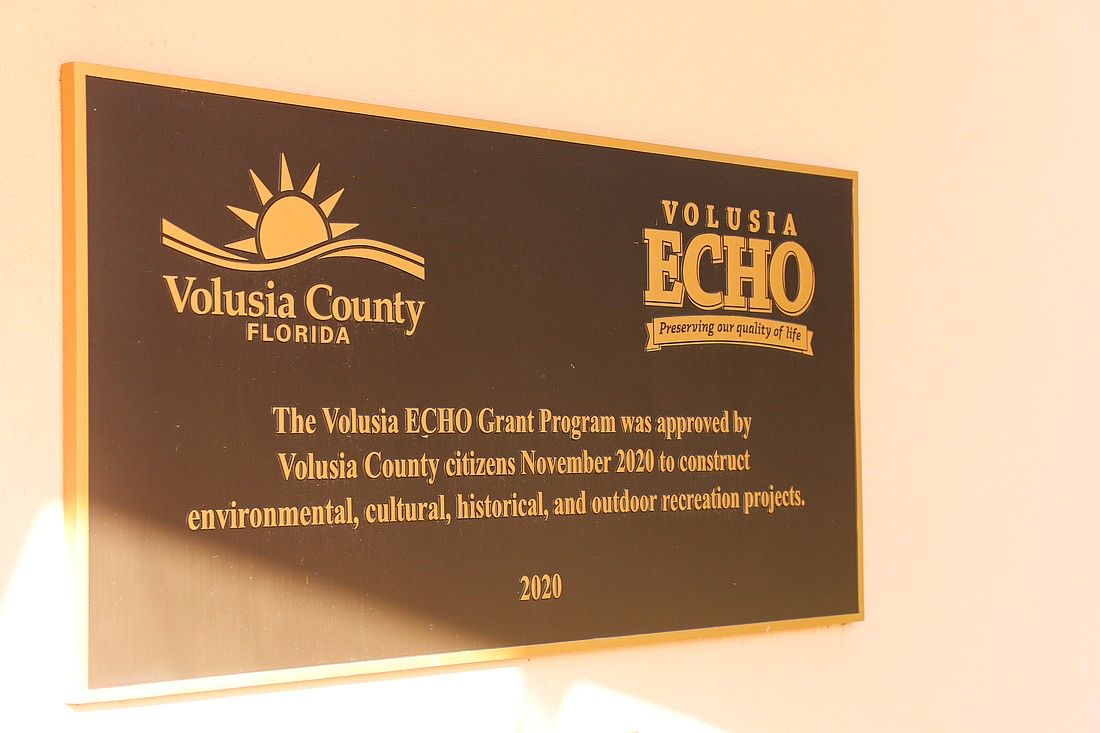
A plaque outside the Ormond Memorial Art Museum and Gardens recognizing it as an ECHO grant recipient. Photo by Jarleene Almenas
  • Ormond Beach Observer
  • News
  • Share

Eleven policy decisions. A 26-year voter-approved program. Seven Volusia County Councilmen largely defaulting to the way the program operates today, despite recommendations by their advisory committee.

Revisiting a previously tabled discussion, the Volusia County Council examined the 2040 strategic plan for the county's ECHO program on Tuesday, Feb. 3. The strategic plan was designated to identify future projects and partnerships, enhance grant processes and develop marketing strategies, according to county staff. A total of 30 recommendations were formed by the ECHO Advisory Committee, 11 of which were considered policy decisions that required action by the County Council.

These policy decisions, said Community Services Director Brad Burbaugh, would create new categories within the program, require more funding and would, typically, be out of an operational control. Ultimately, the council chose to leave the program as is.

Councilman Don Dempsey questioned why changes for ECHO were brought to the council.

"It's funny that when I want to readdress Volusia Forever to talk about some potential things that need discussing in Volusia Forever, I get inundated with, 'Leave it alone. They voted for it, as is." Dempsey said. "... But yet, the same thing voted on the same referendum, now we're doing a deep dive and gutting it, and nobody says boo about it."

In the strategic plan, community input outlined "lack of political leaders' understanding" of the ECHO program as a weakness. Dempsey took issue with this, as well as some stakeholders expressing concern about the County Council spending ECHO funds on "pet projects" or as a slush fund. (Residents have recently criticized the county, and Dempsey specifically, for a proposal to construct a motocross facility at 356-acre site in New Smyrna Beach. Council has set aside $3.5 million of ECHO funds for the project, which county staff states falls under the "Outdoor Recreation" category of the program.)

Dempsey didn't specifically mention the motocross project, but Councilman David Santiago did. 

"There's an orchestrated effort to try to stop the ... motocross, and I'm supportive of it, of that project, for the valid reason that it's good for the community," Santiago said, adding that the comments made to the plan's consultant were trying to undermine that.

The people voted for ECHO, he said, for the core principles of what the program does. 

"We still govern the process on how we implement that, and that's what we're discussing here today," Santiago said.


Policies 1 and 2

The two policy presented to the County Council involved establish a pre-construction grant category and expanding pre-award match credit for grant writing expenses.

The council could choose to:

  • Increase the allowable match credit to $10,000, remove the $200,000 organizational budget cap and extend eligibility to all nonprofit applicants, regardless of size.
  • Increase the allowable match credit to $10,000 while retaining the $200,000 organizational budget cap and continuing to limit eligibility to smaller nonprofits.
  • Increase the allowable match credit to $10,000, remove the $200,000 organizational budget cap and extend eligibility to all applicants — including municipalities and other units of local government.
  • Maintain the current $7,500 limit and existing eligibility restrictions.

The council opted to maintain the current limit and eligibility restrictions for both policies.


Policy 3

The advisory committee recommended dedicating ECHO investment income to a capital reinvestment fund, protecting prior such investments for small and medium-sized nonprofits.

The council could choose to:

  • Create an Emergency Capital Repair Grant for critical building systems that have failed or will fail within 90 days, threatening operations or covenant compliance. This would be available year-round.
  • Create an annual Planned Capital Replacement Grant for building systems within two years of expected end-of-life based on industry standards.
  • Defer implementation of a new fund and direct staff to return with more program details at a future date.
  • Maintain current policy with no capital repair support mechanism.

The council chose to maintain current policy.


Policy 4

The advisory committee recommended that the county offer zero match bonus funding to incentivize low-impact development elements across all ECHO project categories.

The council could choose:

  • A percentage-based bonus, where the county could offer up to 20% of total project cost in additional match-free funding for projects incorporating significant environmental elements.
  • A fixed cap bonus, where the county could offer up to $100,000 in additional match-free funding for projects incorporating significant environmental elements, regardless of total project cost.
  • Defer implementation of any new incentives and direct staff to return with more program details at a future date.
  • Maintain current policy with no incentive program.

The council opted to maintain current policy.


Policy 5

The advisory committee reccomended a grant award cap adjustment and phase-out of the exceptional grant category.

The council could choose:

  • A moderate increase by raising the grant cap to $750,000, retain the exceptional category at $2.5 million, and establish a $5 million cumulative funding cap per project.
  • Increase the standard grant cap by $250,000 each year, starting at $1.25 million in 2026 and reaching $2.5 million by 2032. Once complete, the county would eliminate the exceptional grant category and establish a $5 million cumulative funding cap per project.
  • Immediately raise the standard grant cap to $2.5 million and eliminate the exceptional grant category, as well as establish a $5 million cumulative funding cap per project.
  • Maintain the current $600,000 standard grant cap and $2.5 million exceptional grant category and cap.

Councilman Danny Robins made a motion to immediately raise the cap to $2.5 million and eliminate the exceptional grant category. The motion passed in a 4-3 vote, with Dempsey, Councilman Troy Kent and Chair Jeff Brower voting no.


Policy 6

The committee recommended the county require a streamlined application for direct county expenditures projects to increase transparency and accountability.

The council could choose to:

  •  Formalize the process by developing a handbook and standardized application. The advisory committee review would continue prior to council action.
  •  Continue requiring the advisory committee review these projects without implementing a handbook or formal application process.
  • Enhance public reporting by expanding visibility of these projects on the transparency and accountability dashboard, website and annual reports.
  • Maintain the current process.

The council chose to maintain the current process.


Policy 7

The advisory committee recommended the county launch a library-based admission pass program. 

The council could choose to:

  • Partner with Volusia County Public Libraries to implement a comprehensive admission pass program in FY 2027-2028.
  • Launch a one-year pilot program with three to five participating facilities to evaluate demand and operational requirements before full implementation.
  • Direct staff to conduct a feasibility study and return with a detailed proposal including cost estimates and facility participation commitments.
  • Require or allow future grant applicants with admission-based facilities to include library passes as part of their grant proposal. Pass costs would be funded through the grant award.
  • No action.

The council chose to take no action.


Policy 8

The advisory committee recommended the council allow staff approval on non-scope budget changes.

The council could choose to:

  • Delegate these amendments to staff.
  • Maintain the current process.

The council chose to maintain the current process in a 4-3 vote, with Dempsey, Kent and Brower voting no.


Policy 9

The advisory committee recommended the council allow the ECHO program to support public art and placemaking initiatives.

The council could choose to:

  • Direct staff to develop a proposal with the Cultural Council.
  •  Establish public art as eligible under Cultural category.
  • Integrate with the county's Art in Public Places Policy.
  • Prohibit ECHO funding for public art installations and placemaking initiatives.

The council chose to prohibit using ECHO funds for public art.


Policy 10

The advisory committee recommended the county develop an advisory committee selection guide.

The council could choose to:

  •  Prepare a revised resolution and adopt a selection guide with geographic and expertise criteria for advisory committee members.
  • Prepare a revised resolution and adopt mandatory selection requirements.
  • Maintain the current process.

The council chose to maintain the current process.


Policy 11

The advisory committee recommended implementing term limits for advisory committee members.

The council could choose to:

  • Enact four-year terms with two consecutive term limits, for a maximum of eight years.
  • Enact three-year terms with two consecutive term limits, for a maximum of six years.
  • Enact four-year terms with three consecutive term limits, for a maximum of 12 years.
  • No change.

The council chose to proceed with a resolution to enact four-year terms with two consecutive term limits, for a maximum of eight years.
 

Latest News

×

Your free article limit has been reached this month.
Subscribe now for unlimited digital access to our award-winning local news.