- April 2, 2026

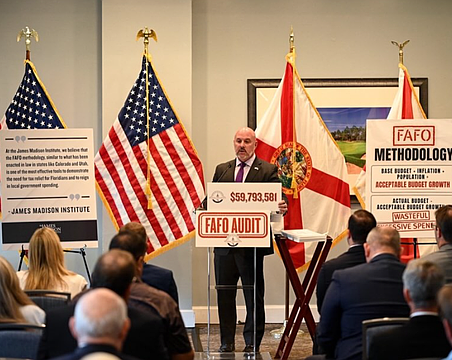
Florida Chief Financial Officer Blaise Ingoglia claims that Flagler County, since 2019–2020, has seen one of the largest percentage increases in local government spending in the state. According to his calculations, roughly $59 million was collected and spent wastefully from taxpayer-supported funds, mainly the property tax paid by property owners.
I’m no politician’s apologist but in Flagler County all our elected leaders are very accessible to the citizens. The same goes for appointed officials like fire chiefs and city managers. CFO Ingoglia’s faulty narrative relies on a simplified assumption which is that local government’s obligated spending should track with household inflation and population growth. That assumption is divorced from operational reality.
Local government is not buying groceries. The cost of flour and eggs is not compatible with the replacement cost of a firehouse which serves as a great example. Consider the modern firehouse: what used to be a basic structure recently is now a hardened public safety facility. It must meet hurricane standards, environmental regulations, ADA compliance, advanced communications requirements, and redundancy for power and operations.
The firehouses of yesterday had zero accommodations for female firefighters. These aren’t enhancements, they are mandates. Many of the added expenses are unfunded federal mandates or unfunded State of Florida statutory directives, the entity that CFO Ingoglia represents.
This same reality applies to procurement. The idea that government can simply “buy cheaper or shop better” no longer reflects the marketplace. Basic is gone. Safety systems, emissions standards, integrated electronics and supply chain pressures have fundamentally changed what is available. You can’t buy an F-150 with roll-up windows and a radio delete except at extra cost.
Public agencies are not choosing luxury. In another example, many grants obligate local general fund commitments into purchases of alternative fuel vehicles. Half succeed famously and the other half fail spectacularly, spending an inordinate amount of time out of service on wreckers and in repair bays.
There is also a deception by the CFO regarding capital projects. Roads, stations and infrastructure do not exist outside the taxpayer equation. They are funded directly or indirectly by the same revenue streams. Calling something a capital investment does not make the cost disappear.
Fiscal scrutiny must be grounded in operational reality, not a simplified formula. The very essence of wise leadership is planning ahead. It understands the fundamental truth, that it is cheaper to invest in tomorrow with today’s dollars before they depreciate further and prices rise. The principle is ancient and biblical: In Genesis, Joseph stored grain in the seven years of plenty to survive the seven years of famine. Responsible leadership plans, foreseeing a time of need before the crisis arrives.
Fixing a longstanding deficit of firefighters and law enforcement officers when property values rise is prudent and sound leadership. Delayed infrastructure becomes emergency spending. Deferred public safety brings the worst community cost. Growth without preparation is failure.
Flagler County and the municipalities are not exempt from criticism. They are navigating a complex environment where safety, compliance and growth intersect. It is necessary to mention that CFO Ingoglia, the attacker of our local politicians and appointed officials, is himself both a politician and appointed, not elected, official. The CFO is too experienced and too intelligent to misunderstand these realities, which shows that what is being presented is not incomplete by accident, but selectively framed.
Roland Clee
Flagler Beach
A Flagler Beach resident, Roland Clee served a major Florida police department as a community service officer for more than 26 years. He writes the American Peace Officer newsletter.