- April 1, 2026

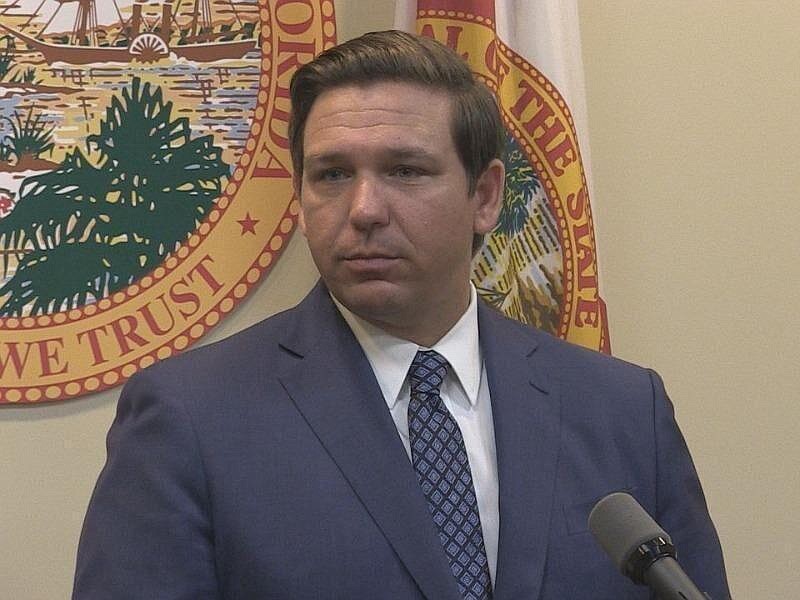
Bills allowing the state to designate groups as “domestic terrorist organizations” and to require Florida voters after the 2026 election to prove their citizenship at the ballot box were sent to Gov. Ron DeSantis’ desk Tuesday.
DeSantis has already indicated he will sign the elections measure (HB 991), and Democratic elections lawyer Marc Elias has pledged to file a legal challenge.
The bill is Florida’s version of the Safeguard American Voter Eligibility (SAVE) America Act, a federal proposal that requires voters to provide proof of citizenship when they register to vote and present a photo ID when casting their vote. The Republican-controlled Legislature voted 27-12 in the Senate and 77-26 in the House on the proposal.
DeSantis posted support for the legislation on March 16.
“Florida has led on election integrity for years --- banning ballot harvesting, eliminating Zuckerbucks, creating a state office to prosecute voter fraud, among other initiatives --- and now we will be enacting the Florida SAVE Act to further bolster our nation-leading efforts,” DeSantis posted on X.
But while the federal bill restricts mail-in ballots, Florida’s measure does not. Limiting mail-in ballots is a priority of President Donald Trump.
As the federal SAVE Act has stalled in the U.S. Senate, Trump on Tuesday evening signed an executive order requiring the states to deliver a list of voters receiving mail ballots to the administration, and ordering the U.S. Postal Service not to deliver any ballot to anyone not on the list.
The order also requires tracking mechanisms for all mail ballots.
In the state legislation DeSantis received, it also requires candidates to disclose whether they are dual citizens of another country.
The bill also requires the state’s Office of Election Crimes and Security to provide any violations or irregularities relating to the involvement of foreign nationals in state elections in its annual report.
Candidates for federal offices will also be required to disclose whether they intend to trade stocks while in office.
The proposal involving the naming of “domestic terrorist organizations,” approved 80-25 by the House and 25-11 by the Senate, backs up an executive order by DeSantis from December that named two Islamic groups as terrorist organizations.
The overall measure (HB 1471) bars a court from enforcing any provision of a religious or foreign law, an attempt to prevent the use of the Islamic code of law known as Sharia law in Florida courts
Another provision allows the state’s Chief of Domestic Security --- currently Florida Department of Law Enforcement Commissioner Mark Glass --- to designate a domestic or foreign terrorist organization. The Governor and the Cabinet would still have to approve the designation.
Democrats raised concerns that under the bill and a linked public records exemption (HB 1473) regarding how a “terrorist” designation is reached, the groups wouldn’t be provided due process to respond to the charge.
Other parts of the bill bar schools affiliated with such designated organizations from receiving state K-12 scholarship program money, and public universities and colleges from spending state or federal funds to support programs or campus activities that promote a designated terrorist organization.
The bill progressed in the Legislature even as U.S. District Judge Mark Walker issued a preliminary injunction against DeSantis’ order, which classified the Council on American-Islamic Relations, or CAIR, and the Muslim Brotherhood as terrorist organizations.
In his March 5 ruling, Walker wrote that DeSantis violated the organization’s rights by targeting CAIR and threatening those providing the organization with material support.
The proposals were among 13 bills from the 2026 legislative session sent to DeSantis on Tuesday.
DeSantis has until April 15 to act on the proposals.