- March 17, 2026

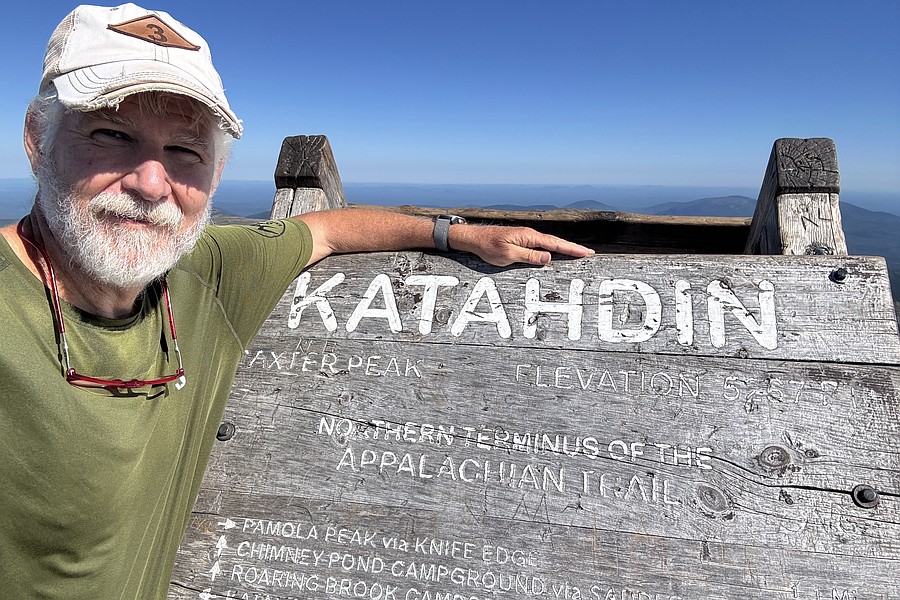
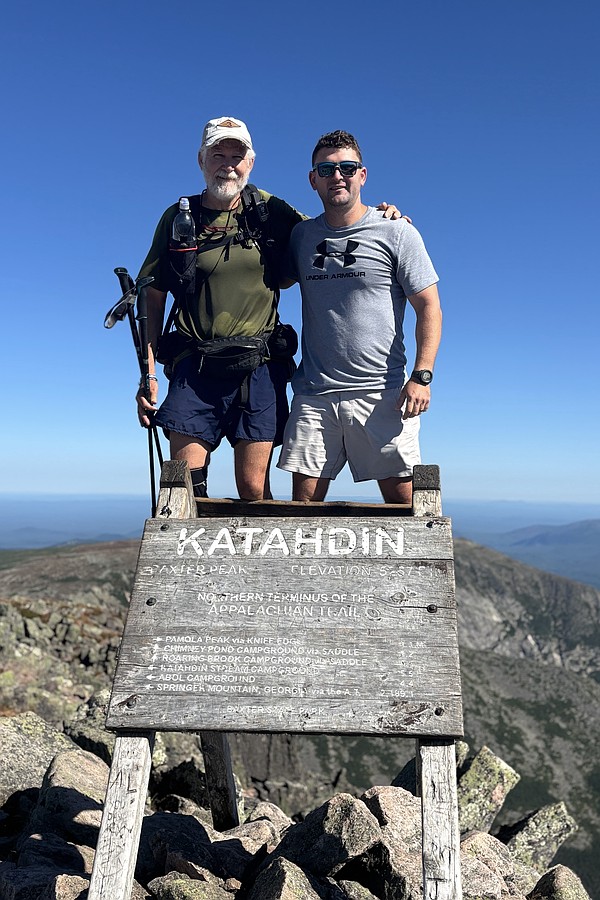
Dave Freeman at the summit of Mount Katahdin, the northern end of the Appalachian Trail. Courtesy photo
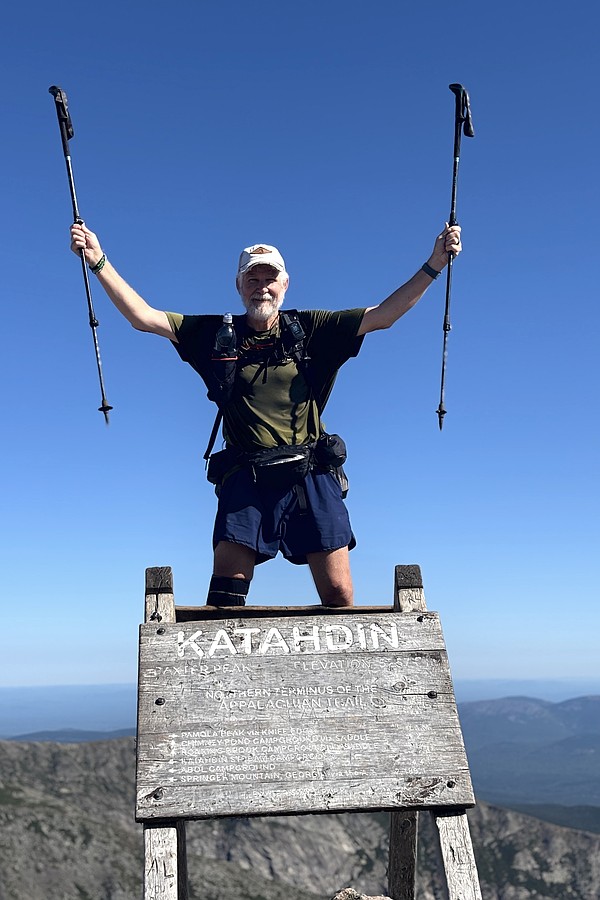
Dave Freeman completes the thru-hike of the nearly 2,200-mile Appalachian Trail with a climb to the summit of Mount Katahdin in Maine. Courtesy photo
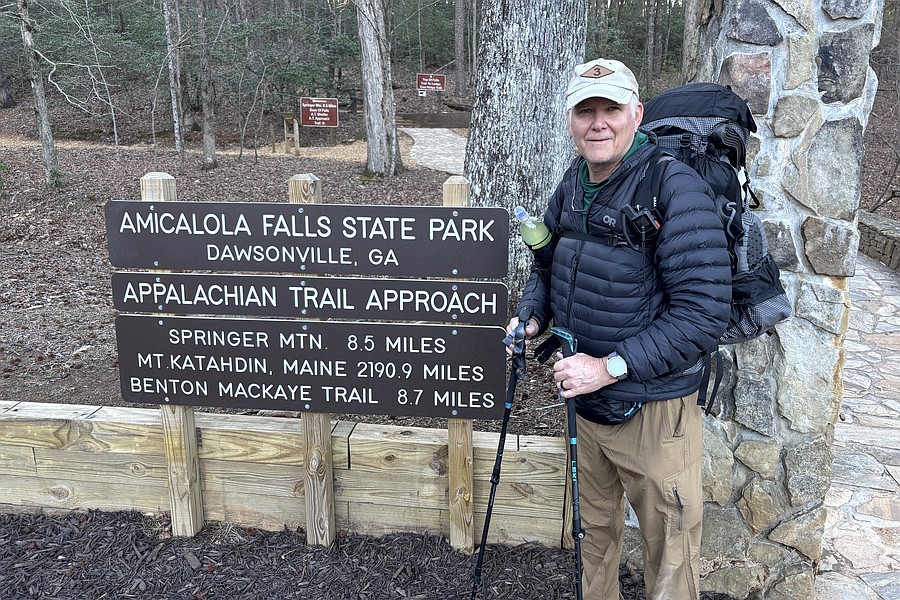
Dave Freeman begins his hike in March at the Appalachian Trail Approach at Amicalola Falls State Park in Georgia. Courtesy photo
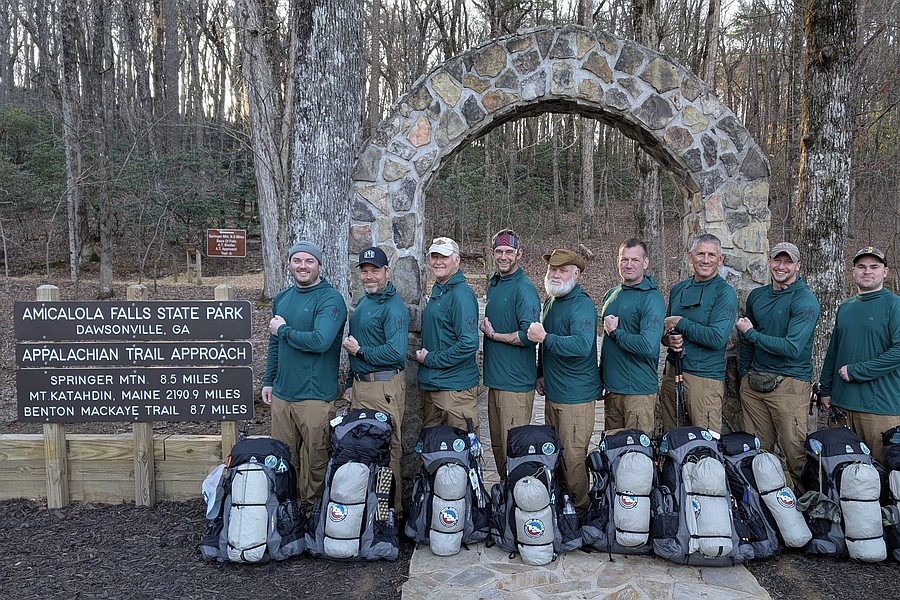
Dave Freeman's Warrior Expedition group begins the hike in March. Seven out of the nine finished. Freeman is third from the left. Courtesy photo
Dave Freeman with his son, David, who summited Mount Katahdin with his dad. Courtesy photo
Since 1936, only about 750 people over the age of 60 have completed the nearly 2,200-mile thru-hike of the Appalachian Trail. They are known as “2,000 milers.”
Dave Freeman, Flagler Schools’ chief of operations, is one of the most recent. Freeman, who turned 65 during the hike, began his trek on March 18 at the Appalachian Trail Approach in Amicalola Falls State Park in Georgia and finished five months later on Aug. 22 with a climb to the summit of Mount Katahdin in Maine.
He completed the hike in 158 days carrying ultralight equipment and minimal supplies. Sixteen of those days, were “zero days,” when he took the day off in a nearby town to resupply, take a shower and sleep in a bed. He lost 25 pounds during his hike, which was sponsored by Warrior Expeditions, an organization that supports veterans.
Freeman said he had a lot of fun meeting people on the trail, including a couple of high school classmates. He was happy to complete an adventure that was long on his bucket list, but he doesn’t plan to be doing anymore trail thru-hikes in the near future. He thanked Superintendent LaShakia Moore and the Flagler County School Board for giving him the opportunity to take five months of leave to complete his quest.
He spoke to the Observer on Tuesday, Sept. 2, his first official day back at work.
WHAT DID YOU LEARN FROM THE EXPERIENCE?
I learned that there are a lot of people out there who want you to succeed. Through the organization I hiked with, the Warrior Expeditions, they had supporters that about every 70 miles or so who we could call and say, “Hey, I'm passing through your area. I'd like to be able to do a home stay and a resupply.” And people that I have never met had signed up to help the veterans. They would come and pick you up off the trail, take you back to your house. You'd get a shower, you'd sleep in a nice bed, do some laundry. They'd take you to do a resupply. So, there were trail angels like that that really supported us.
And then just the for the regular hikers, the supporters that were out there, people that had benefited from trail angels in previous years would come out to pay back what somebody did for them. They would set up “trail magic,” is what they call it. They would be at a road junction. They would have cold drinks, maybe a cold beer. We had some that had chips and food and others that would go all out.”
WHAT WAS YOUR DIET LIKE ON THE TRAIL?
I was burning up about 4,000 calories a day. Towards the end I was hiking about 20 to 25 miles a day, so you can imagine you're burning a lot of calories. I started out eating honey buns and donuts for breakfast, because I was trying to get my calorie intake up. But that got tiring pretty quick. And so I switched to oatmeal and a sleeve of donuts, whateve. For lunch, I was eating a lot of tortillas, chicken salad and tuna salad. For a snack, I ate a lot of protein bars. I always carried a bag of Cheetos with me, because I would eat Cheetos for lunch and dinner. And I think I probably ate more Cheetos in five months than I've eaten my entire life. For dinner, I had the freeze dried meals, or noodles and throw some protein in it. Sometimes I would hitchhike to the town to get something to eat, and then hitchhike back to the trail to keep going. I did that a couple times with buddies and friends.
HOW OFTEN WERE YOU WALKING WITH OTHER HIKERS?
I started with the Warrior Expeditions. There were two groups of 10, and we started on two different dates. The first four days, we had to hike together. And we had mentors who did the hike last year, that hiked with us those first four days. But after the four days, we were all on our own, because everybody hikes at different speeds. But our group kind of stayed together for probably three weeks. We weren't all hiking the same speed, but we'd all end up at the same place that night. You tried to end up at a shelter or lean-to, because that usually had water that you could filter. You'd filter your water from a stream or a lake. Most of the time you're really hiking by yourself.
WHAT WAS YOUR FAVORITE PART OF THE JOURNEY?
The Appalachian Trail is a very social trail. So you would meet people along the way that you would either pass, or you'd meet them at a shelter site or campsite, and you'd get to know them, and you could talk to them and so that was part of the favorite part. There are a lot of people hiking. I think every year, between 4 and 5,000 people try to thru-hike. Of the thru-hikers, there's about one in four, one in five, that will actually complete it.
One thing that happened, while I was out there, I found two high school classmates on the trail, just by talking to them and saying, “Hey, where are you from? Well, I'm from Florida. Whereabouts in Florida? Well, I'm from Orlando. Where in Orlando? Oh, from this area? Did you go to high school there? Well, I graduated that year.” We didn’t recognize each other. There were two ladies whose names changed, and I had a beard, so of course, I didn't look the same. But it was pretty wild.
My favorite part of the trail was in Virginia, which was the Mau-Har Trail, and it was just absolutely gorgeous. You’d hike along some cascading waterfalls that were just absolutely beautiful. I would go back and camp and hike in that area again in the future. But my favorite part were the people that you’d meet.
WHAT WAS THE HARDEST PART OF THE HIKE?
I think the hardest part was the rocks and the roots that you encounter, and those got to be hard starting in Pennsylvania. Everybody liked to call Pennsylvania, Rocksylvania, because there's just so many rocks. And then when you got up to the New England states, of course, New Hampshire is probably one of the hardest states. New Hampshire and Maine because of the the White Mountains, the Presidential Mountains. You're rock climbing over some of these trails, and a lot of lot of it is above the tree line. It's in the alpine region.
The summit at Mount Katahdin in Maine is the terminus, and lot of it is just rock climbing to get up to the highest point. And I was fortunate that my son, David, was able to hike that last part with me, and he summited with me. That was a lot of fun. I had several people throughout my hike that linked up with me. Ryan Andrews (the principal at Indian Trails Middle School) was one of them. He drove up to Virginia and hiked about five days with me, as well as buddies from Georgia that I had been hiking with. One of my old Army buddies hiked with me. My son-in-law hiked with me in the Smokies when it was snowing and sleeting in April. It was down to like 25 degrees. My wife visited me in Harpers Ferry, which is basically the halfway point.
And just hiking with fellow veterans that I started the trail with, that was always enjoyable. And meeting veterans on the trail. There are so many veterans that are hiking the Appalachian Trail. It was just a great experience overall.”