- March 17, 2026

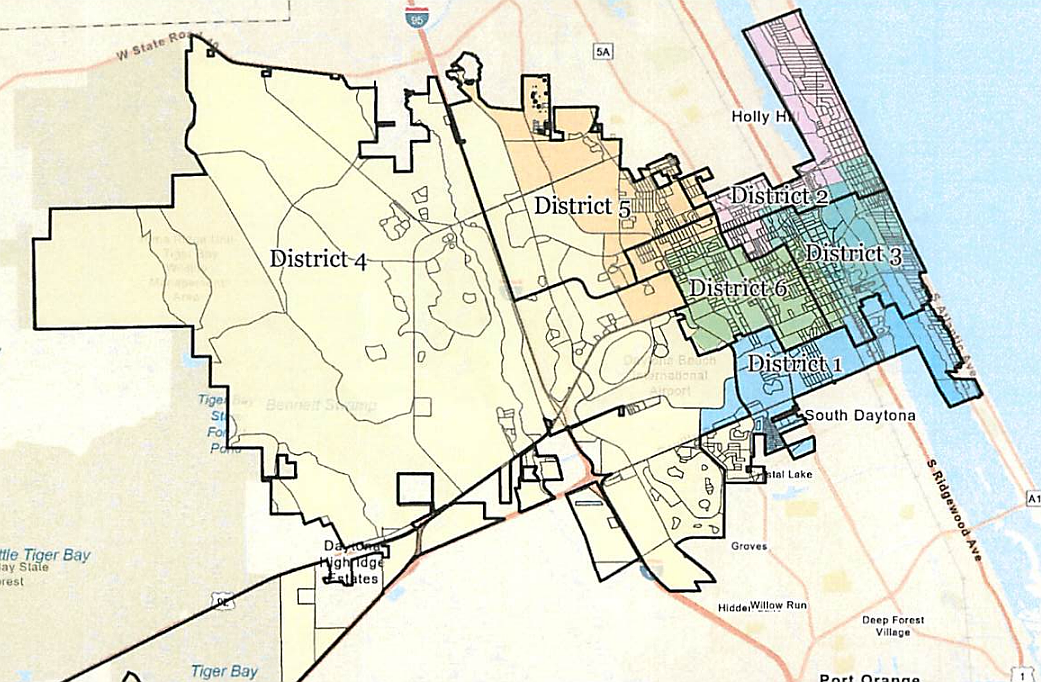
The new map redistricting the Daytona Beach City Commission’s district prioritizes equalizes the city’s population distribution.
The new district boundaries more equally divides the population, with all zones falling between 1.7% and 5.3% deviation from the ideal population standard of 11,913. Zone 6 has the largest population with 12,549 people and Zone 4 the least, with 11,557, based on 2020 Census Data.
The new district map – which goes into effect for the November 2026 municipal elections – shows the boundaries for Zones 2 and 3 shift south, and Zones 1 and 5 eastern borders taking in some of Zone 4. The Zone 6 northern border also moved north into the current Zone 5.
Redistricting Specialist Kurt Spitzer said in an August workshop the “ideal” population distribution equally divides the population among the districts. Spitzer said in August it would be impossible to create a perfectly equal distribution and balance other statutory requirements, but that generally a “10-point spread” of deviation is acceptable in court.
According to the August workshop presentation, redistricting requires districts to be almost equal in population, be contiguous and compact, not dilute minority voting strength and preserve community interests.
The redistricting also cannot favor or disfavor any candidate based on address. The ACLU lawsuit over the previously adopted map alleged the map “was driven by the desire to protect incumbents and keep each of their residences in their districts,” according to the ACLU Florida’s website. The lawsuit alleged the previous map
The city repealed its previously adopted redistricting earlier in 2025 and the ACLU in turn dropped the lawsuit.
The current deviation showed Zone 3 had a -18.5% deviation and Zone 4 a 28.44% deviation of population, with Zone 4 having a population of 15,300. Only Zones 1 and 6 had less than a 10% deviation from the “ideal” population of 11,913.
The only other change not on the map adopted on Oct. 1, was a boundary change for the common boundary of Zones 2 and 5 from the west side of Nova road to the east side, making the boundary a straight line. City Attorney Benjamin Gross said the change did not change the population in the districts.
But the new map is not without drawbacks. The city’s population has increased in the last five years since the 2020 Census, jumping from 71,400 people to over 86,000, according to a 2024 estimate. One resident pointed to Zone 4 as an example of an area that will actually have more residents than other districts, with recent growth.
Latitude Margaritaville Daytona Beach, located in Zone 4 with over 3,700 homes, opened in 2017 and sold out in May 2025 – five years ahead of its projection, according to a press release on the company’s website. The area is also home to the Mosaic neighborhood, which opened in 2018, and other development projects.
But, Gross said, the city is required by law to use the 2020 data, not current population estimates. Using other sources of data to support the redistricting could make the redistricting “increasingly difficult to defend” in a lawsuit.
“And given that we were in a lawsuit once and that most likely producing that data would have required a special study and cost and time,” he said, “I think it's fair to say it was the decision of this commission to rely on the 2020 Census.”
Zone 4 Commissioner Stacy Cantu said her district is mostly built out, excepting more recently approved developments that will take years to complete.
“I'm sure we'll be back here again,” she said. “I probably won't be up here, but we'll be back again, redistricting again.”