- March 17, 2026

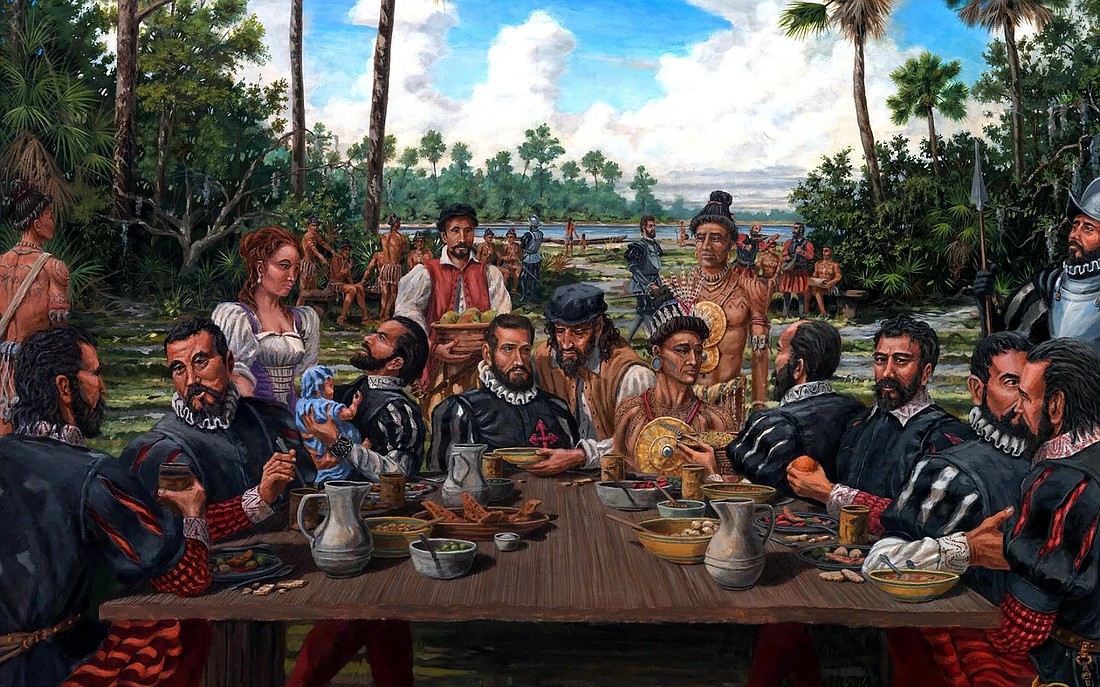
Thanksgiving celebrations, in what is now the United States, have roots as far back as Sept. 8, 1565, when Spanish explorer Pedro Menéndez de Avilés and his 800 settlers celebrated their arrival in St. Augustine, Florida with a Catholic mass followed by a feast with the local Timucua people (a once a large group of Indigenous peoples who were mostly eradicated by European introduced diseases, enslavement and warfare).
By the mid-to-late 1700s, the distinct Timucuan culture vanished and the few survivors assimilated into other tribes including the Seminoles. The food shared at this feast reportedly included cocido madrileño (a slow-cooked stew prepared with various vegetables and meats), red wine, sea biscuits, and salted pork contributed by the Spanish; and alligator, fish, turkey and venison contributed by the Timucua people.
On Dec. 4, 1619, English settlers led by Captain John Woodlief at what is now the Berkeley Plantation on the James River in Virginia held a religious ceremony to give thanks for the group’s safe arrival in the new world. This celebration is often referred to as the first English Thanksgiving in North America even though it did not include a feast.
The basis for the modern Thanksgiving holiday (which is what most people were taught in school) occurred in what is now Plymouth, Massachusetts in the autumn of 1621 (56 years after the first Thanksgiving celebration in St. Augustine). Plymouth colonists (Pilgrims) and the Wampanoag people (Indigenous people known as the “People of the First Light,” who survive today and have two federally recognized tribes and continue to maintain and teach their culture and history) shared a three-day harvest feast. This Plymouth celebration featured food shared by the English Pilgrims and the Wampanoag people which included corn, seafood, venison and wild fowl. Interestingly, the food items we typically consider to be traditional Thanksgiving dishes today which include cranberries in sauce, pumpkin pie, stuffing and turkey were not served in the Plymouth celebration.
In 1789, President George Washington proclaimed the first national day of Thanksgiving to celebrate the ratification of the U.S. Constitution. The day of the celebration was Nov. 26. For more than 70 years after 1789, the nation did not consistently observe the Thanksgiving holiday. Thanksgiving was mostly celebrated in New England, and was virtually unrecognized in the southern states.
The states that did celebrate the holiday mostly scheduled dates at different times. Some celebrations were held early in October and others in January.
The American activist, editor and writer, Sarah Josepha Hale (1788-1879), is oftentimes credited as the main person responsible for making Thanksgiving a national holiday and is known as the “Mother of Thanksgiving.” Her quest began in 1846 and spanned 17 years as she contacted five U.S. presidents advocating Thanksgiving to be celebrated as a national holiday. Finally, in 1863, she convinced President Abraham Lincoln to declare Thanksgiving a national holiday as a way to unify the nation during the American Civil War.
In Sarah Josepha Hale’s book, "Northwood: Or, a Tale of New England" (originally published in 1827), she described the many dishes and drinks that are appropriate for a Thanksgiving feast. The dishes include cakes, chicken pie, gravy and savory stuffing, pickles, pumpkin pie and roasted turkey. Drinks include cider, currant wine and ginger beer.
Florida’s Thanksgiving activities include community-focused events, such as food drives and holiday runs. Other celebrations include holiday parades, themed holiday dinners at clubs, restaurants and theme parks and various outdoor events such as holiday light displays and turkey trots.
Parades, events and festivals around the state include: The Clearwater 5K Turkey Trot. The Holiday Fantasy of Lights at Tradewinds Park & Stables in Coconut Creek, which is a large-scale holiday light display. Luminosa! Festival of Lights at the Miami Friends of the Japanese Garden, which is a festival of lights to celebrate the holiday season. Miami Beach Winternational Thanksgiving Parade, which is a large annual Thanksgiving parade in Miami Beach. Universal Orlando’s holiday parades, which are large holiday parades held throughout the Thanksgiving season.
Activities in Palm Coast include the Feet to Feast 5K Run/Walk, which is held on Thanksgiving Day at the Daytona State College Flagler/Palm Coast Campus, and is one of the city’s the largest Thanksgiving events. The Hammock Beach Golf Resort & Spa hosts a “Turkey Trot” which is followed by Thanksgiving holiday dining.
Activities in Daytona include the annual Daytona Beach Turkey Trot which will be held on Thanksgiving day and features a beautiful beach run, and the annual Daytona Turkey Run event at the speedway. Several Ormond Beach restaurants will be open for Thanksgiving dinner including Halifax Plantation Golf Club Restaurant, Iron Horse Saloon, Rose Villa Southern Table & Bar and Stonewood Grill & Tavern.
“Gobble ‘til you wobble.”
Happy Thanksgiving!
Randy Jaye has recently researched and nominated five properties that have been successfully added onto the National Register of Historic Places, and is the author of five history books. He also writes articles for historical journals, local newspapers, magazines, online publications, and has appeared on several radio shows and PBS documentaries. He earned both a master’s degree and a bachelor’s degree from California State University.