- March 18, 2026

Make budget cuts. Increase property taxes. Or, establish a new revenue stream — one that may or may not be a half-cent sales tax?
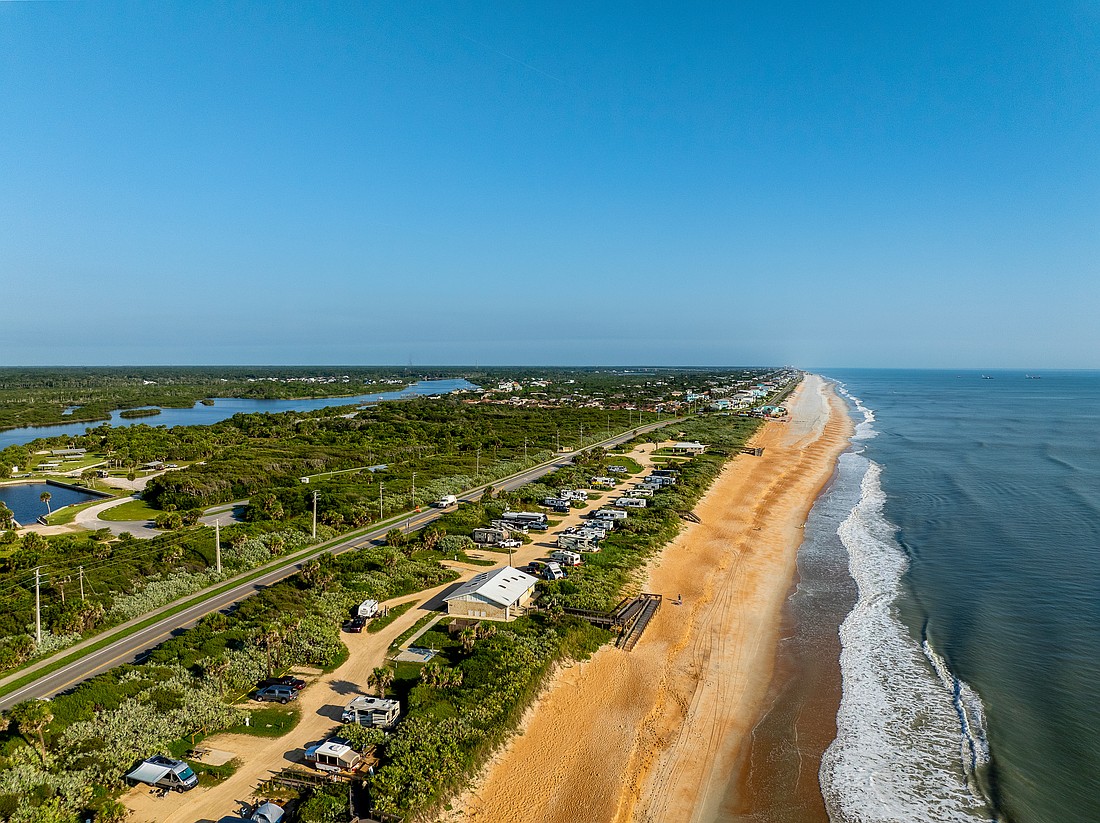
The Flagler County Commission discussed these options to fund a beach management plan during a 4-hour workshop on Monday, June 16. Officials heard presentations from county staff and coastal engineers, including the consultants who worked on the county's beach management study and ongoing nourishment projects.
The workshop was held after the board asked staff earlier this month to present them with options to fund a beach management plan that includes all 18 miles of coastline, but does not include a half-cent sales tax, as three out of the five commissioners have voiced opposition to it. For the half-cent sales tax to pass, the board needs a supermajority vote of 4-1.
The county is estimating the initial construction cost of the beach management plan at $120 million, and management at $72.1 million.
Taking into account Tourist Development Tax dollars, the utilization of special taxing districts (known as Municipal Service Benefit Units, or MSBUs), property tax dollars and grants, County Administrator Heidi Petito said the county is facing a $17.5 million shortfall for the initial construction cost — needed in 2-3 years to remain on track — and a $10 million shortfall annually for six years for maintenance.
That equates to: $15.8 million needed in 2026 and 2027; $15.9 million needed in 2028; and $10 million needed in 2029, 2030 and 2031.
"There are a lot of future variables, such as storm events, sea level rise, shifting state or federal priorities," Petito said. "We don't know what's going to happen with FEMA at the federal level ... it does make it a challenge, because I think it makes that long-term plan a little bit more complex, but we do remain committed to seeking additional grants leveraging tourist generated revenues."
If the commission opts to fund the beach management plan using property tax dollars, without raising them — and the cost was absorbed by all of the operating budgets of the county's constitutional officers, including the Flagler County Sheriff's Office — the annual budgets would need to be reduced by 10%.
If the cost was absorbed only by the county's operating budget, the annual budgets would need to be cut by 20%.
"That would be about a 40% reduction in personnel costs," Petito said.
The county is also facing a $2.9 million budget cap for its upcoming fiscal year.
TDC funds can only contribute $880,000 a year, but using the maximum funds would have "severe consequences" to the county's tourist development program, Petito said. If the county uses its current sales tax, then no funding would be available for roads and stormwater projects.
Currently, Petito said the county receives $4.7 million from its local option sales tax. Using these funds for beach management would mean abandoning the county's strategic plan, failing to establish a pavement management plan, as well as not having a local match for Florida Department of Transportation roadway grants, Petito said. The county may also lose grant funding.
The commission can also choose to raise property taxes to fund beach management or increase its proposed MSBU amount from the proposed $160 per unit.
Commissioner Kim Carney said she didn't see anything stating that the county needed to have a "100% plan in place" to call it a beach management funding plan.
"Nature is going to determine what happens on this ... coastline," Carney said. "To say that we have to have $17 million in one of these funds by the end of 2025 or 2026 ... If we can come up with the strategy that we need to get to funding, where does it say that we have to fund at a 100%?"
She suggested the county return to the sources of funding it already has and enter into an interlocal agreement with the cities of Flagler Beach, Beverly Beach and Marineland for an MSBU, and have that in place for fiscal years 2026-2027 and beyond.
"All of our municipalities should be encouraged to generate their own funding source — the local fees and that could be used to offset the MSBUs," Carney said, adding that the generated dollars could also act as more funding.
Commission Chair Andy Dance said the county doesn't want to be in a position where it has to make drastic last minute decisions to find match dollars for available grants, which he said was the most critical component of obtaining that funding.
He brought up the half-cent sales tax.
"I know we're looking at other funding options separate from the half-penny, but you can manipulate the half-penny to shorter time frames," Dance said. "There's nothing that says this has to be a 20-year timeline."
Commissioner Pam Richardson said that three months ago, she asked when a half-cent sales tax could sunset — and the answer she was given was 30 years.
"And you were adamant about it," she said. "Today, you're not adamant about it. I'm not questioning your expertise or your talent, but I'm concerned about what facts are factual and what's not, because it can't go both ways. I wanted a short-term element, and now that was nixed months ago, and this is why we're going in a circle, folks."
Dance said a month ago, the commission spoke about a shorter timeline on a half-cent sales tax. The sales tax for the schools is up for renewal every 10 years, he said, citing an example.
"They are variable," he said.
Commissioner Leann Pennington redirected the conversation away from a half-cent sales tax, mentioning the lack of consensus, and said that any plan chosen by the board will likely change as more elements come together in the future.
The board lacked numbers showing how the budget would be affected if they chose to dedicate all of the local option sales tax to the beach, as well as what raising the MSBU would look like, Pennington said.
Dance said that was an "impossible ask" because the board never reached a consensus on what it wanted to do.
"It would have helped to have seen some preliminary numbers based on the options," Pennington said.
Increasing the MSBUs by $30 per unit — which would need interlocal agreements with the coastal cities to include residences outside of the unincorporated area — would generate almost $2 million, Petito said.
With that in mind, Pennington agreed with Carney: The county should attempt to enter into interlocal agreements with the coastal cities.
But are MSBUs fair? Former Flagler County Tax Collector Suzanne Johnston said they weren't.
A commercial unit as big as Publix, a condo and a 9,000-square-foot home would all pay the same.
"Oceanside restaurant would pay less than my 1,100-square-foot-condo on the west side of A1A," Johnston said. "That's not fair."
A sales tax, she said, gives residents a choice on how much they pay.
Other speakers at the meeting agreed.
"I think the half-cent sales tax would be the least painful and the fairest method," said Dennis Clark, representing Scenic A1A Pride.
But others weren't convinced. Citizen Ron Long said he came to the meeting with hopes that there would be new ideas and new figures discussed.
"But it looks like we got the same stuff again — different font, little bit different layout, but again, we're being told this half cent tax is the only way to go," Long said. "... This isn't going to be done in 10 years. This half-cent tax will go on forever and ever and ever. No tax has ever been taken back on."
In regards to an alternate plan, county administration was placed in a tough position to come up with one, Dance said.
"Ultimately, there's got to be a plan — a defensible plan — that we come up with, no matter how we fund it, in order to alleviate the concerns of our state and federal funding partners," he said.
Their partners will see right through a non-viable funding plan, he added.
"We're already trying to make hay with a $3 million deficit for this budget," Dance said. "Lord help us if you're trying to make me go negotiate with the sheriff on a 10% budget cut, or any of the other constitutional [officers.]"
The only solid answer, Commissioner Greg Hansen said, is to create a new stream of money: A half-cent sales tax, or raising property taxes, because doing anything other than that is "irresponsible," he said.
"Because we're cutting services to the county and we're cutting — just eviscerating — our strategic plan and eviscerating our stormwater plan that we've put in place to serve the taxpayer and fix problems that we've got to fix," Hansen said. "That has to keep going. Those plans have to keep going, or we're not doing our job for the county."
Carney said the problem is that the media, and the general public, believe the half-cent sales tax is the only funding source.
"I believe this is fluid," she said. "I believe that the state will back us if we look structured, if we look well-thought-out and well-planned, and if we have momentum going forward. I do not believe that we need $20 million in the bank by 2026 in order for the state to talk to Flagler County."
She also suggested, as she has in the past, to use funds from the county's Environmentally Sensitive Lands program in the future, once it sunsets.
But Dance said that was not the board's consensus — he wants to see the program renewed via voter referendum.
So how will the county fund the beach? That remains to be determined.
"I don't know that we've come up with additional clarification on staff to be able to come up with a non half-penny funding formula," Dance said.
He asked for staff to send commissioners a working spreadsheet that will allow them to reallocate funds on the budget toward the beach to envision different scenarios.
The takeaway from the workshop, he said, is that Flagler County does need a viable funding plan for its state and federal partners.
"We can't put something together on hopes and wishes," he said. "So we have to back it up and be able to present that in order to get those additional grants and opportunities that are out there, and I know we're working on a lot of it."