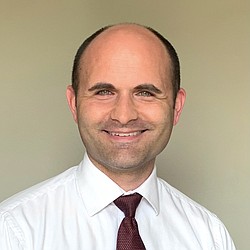
Miller answered questions on Facebook Live with the Observer on July 25.
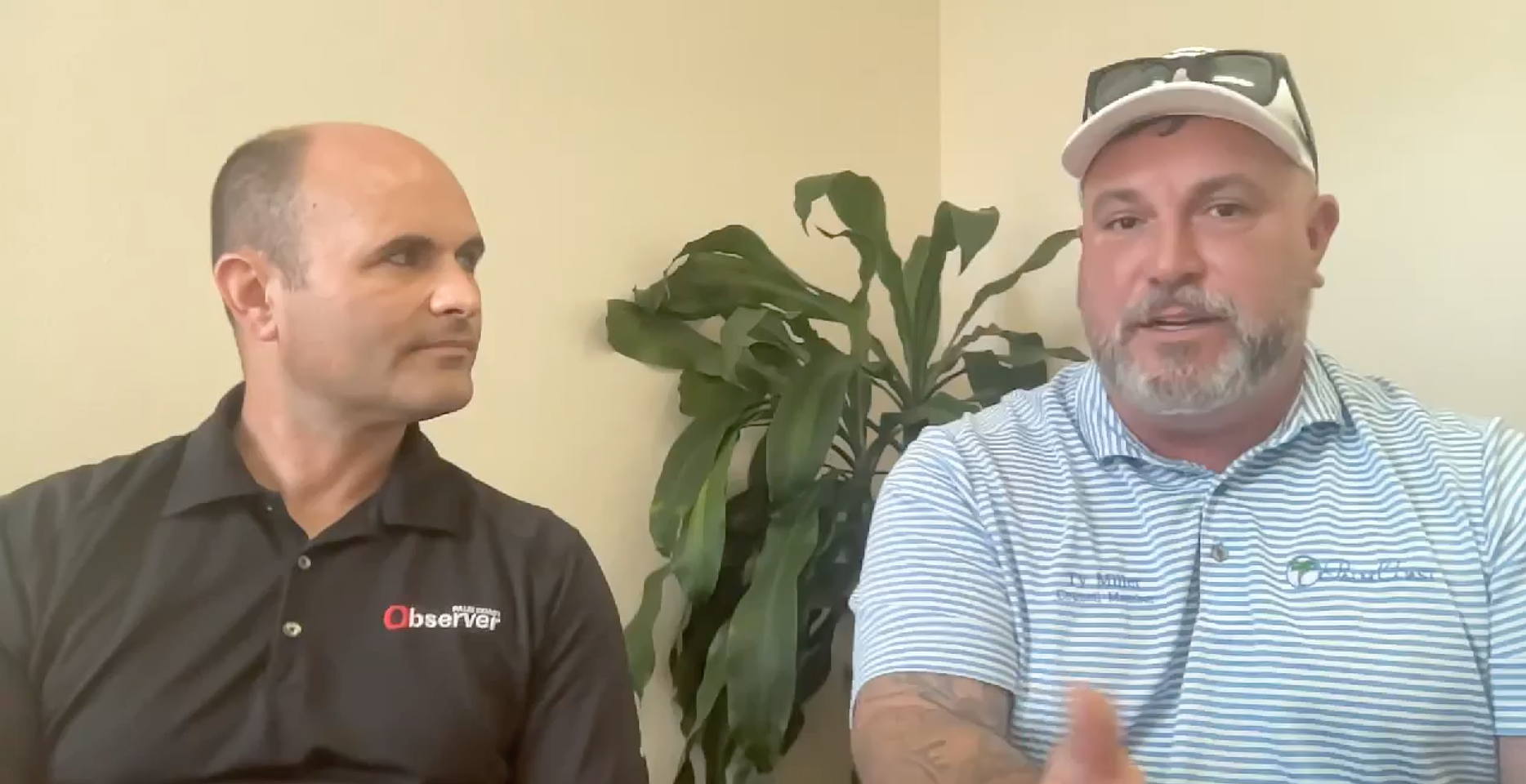
In about 24 hours, Palm Coast City Councilman Ty Miller conducted a town hall, was a guest on the “Free For All Friday” radio show on WNZF, and then gave a Facebook Live interview with the Palm Coast Observer. He was elected less than nine months ago, but it feels like he’s had a full term’s worth of action already. Although the political strife swirling around the mayor was unavoidable, Miller’s main goal was to talk about policy and the practical actions the city is taking to keep costs low for residents.
What follows is a transcript of the conversation we had on Facebook Live, edited for clarity and length.
ONE COMMENT ON FACEBOOK IS FROM ROBERT ROSANIA, ASKING ABOUT THE STATUS OF DOGE LOOKING INTO THE CITY OF PALM COAST. THE CITY ALSO JUST HIRED A NEW AUDITING FIRM, RIGHT?
The city does their annual state-required audit. And as you mentioned, we recently switched to a new firm. For me, even if they performed the exact same level of work, which I have no doubt they will, it's always good to have new eyes looking at the same process.
I also reached out and tried to get in contact with the Florida DOGE office. At that time it was kind of in its infancy. In late March they reached out and said, "Hey, these are the things that you guys need to do in order to initiate it to actively participate in it.” Because we wanted to be on the front end of this. So they gave us an ordinance to pass to say, “We want to submit ourselves to DOGE.” So, we did that as a council, and they also gave us a large spreadsheet with many tabs. Basically: “Plug in all this information.”
And so, staff worked diligently for about two weeks to get all that to them and uploaded it to the portal and everything. I'm not sure how long it takes, but I know it's a key priority for them to get through this data. About two and a half weeks ago, they sent us another spread sheet and asked for additional data, which we turned in immediately to them as well. So at this point we're just waiting for results and recommendations on how we can improve.
NOW THAT YOU’RE ELECTED, DO YOU SEE YOURSELF AS PART OF THE GOVERNMENT NOW, OR AS SOMEONE WHO’S SEPARATE FROM CITY HALL?
That's the goal is to represent the residents, right? And be the oversight for the residents. I think part of the thing that obscures that a little bit is there's just so many state statutory requirements and processes that are just mandated.
People say, “Well, you should do something different.” But a lot of those things we can't do different. Impact fees and things like that are an example. Final platting. So it makes it difficult to to try to educate and say, "Hey, I understand and I agree, but in the same sense, we can't break the law.”
ANOTHER RESIDENT, TRAVIS MATSON, ASKED, “WHAT ARE YOU DOING TO LOWER MY WATER BILL?”
In March, we had a rate study in regards to water rates and the capital improvement plan to really overhaul and expand a lot of our utility issues that we have in Palm Coast. A lot of our technology is old, created back during the original ITT days.
And that's why there's a ton of complaints about the aesthetics of the water, saying it’s slightly yellow, or maybe it smells.
The closer you are to Water Treatment Plant 1, which is using an older technology that doesn't necessarily remove some of the tannins from vegetative material that could be in the aquifer. So part of the capital improvements include some pilot programs for fixing the clarity of the water and the taste, and it's already started. They've been getting really good results from the pilot.
But in terms of the rates, there was a study for what we need to do to fix the utilities. And so some of that includes refurbishment and rehab of old stuff, right? And then some of that includes expansion.
Things like overhauling the technology or making the technology more modern, we can't use impact fees for. In other words, the growth is supposed to pay for itself. Old utilities, you can't use the impact fees to fix those.
THAT’S FRUSTRATING TO A LOT OF PEOPLE. THEY SEE THE WATER RATES ARE GOING UP, AND THEY SEE THAT MORE PEOPLE ARE LIVING HERE. IS ALL OF THAT DUE TO NEW PEOPLE?
It's a byproduct of multiple things. The utility rate study encompasses all our capital improvement needs, right? What we need to fix and what needs to expand in order to be prepared for the future.
In existing neighborhoods, some of the pipes are 50-60 years old. They're clay pipes. That was the standard of the time.
That's one of our biggest problems with wastewater during storm events is that water is actually seeping through the pipes, these clay pipes, into our wastewater pipes. Once it's in that system, it has to go through the plant and be cleaned properly. It has to be treated like wastewater. And so that's why we get 18 million gallons in one day going through there, even though we're not using that much wastewater.
I HEAR PEOPLE SAY THAT WE SHOULDN’T ALLOW NEW GROWTH BECAUSE WE DON’T HAVE THE INFRASTRUCTURE TO SUPPORT WHAT WE HAVE. IS THAT TRUE?
Daily, we operate at a fairly flat level — well below our capacity. It was like two days the entire year that we were over consumptive use permit, and that's what triggered the Florida Department of Transportation’s consent decree that said, “Hey, you went over.” It could be one day, and that’s enough to trigger it. So that's where we're at.
Once we get to the bond issuance and we start actually performing projects and doing upgrades, we can take a look at whether there's any cost savings that we found with the capital improvement projects.
When I ran for office, I went door to door, and that's what I talked about: “We need to build infrastructure because we're behind.” So, we're going to try.
SO ARE WE BEHIND, OR NOT?
When we talk about capacity, not behind. Talk about technology, behind.
I was actually advocating for the full rate increase, because now we're getting 50% of the projects for 80% of the increases. If we just increase slightly more we get the other 50% of the projects.
From a pure numbers of finance standpoint, that was the most cost effective way to do it.
ANOTHER QUESTION FROM FACEBOOK: SYLVIA GORTZ ASKED: "HOW ABOUT YOU STOP ALL THE MEGA DEVELOPERS FROM KILLING OUR BEAUTIFUL CITY?"
I get one request all the time, and that’s: Raise the impact fees. The previous council did raise the impact fees for utility, and then we just recently — this council — received transportation, fire and parks impact fees for review. Each one of these has to be spent only on that specific capacity. So transportation impact fees can only be used to expand: laning of a road, or to build a new park. For fire departments, if you have an area that's grown, and now it's a lot of residents with no fire station anywhere near that, that’s where you get that extra fire station from impact fees.
AND THE STATE SAYS YOU CAN’T RAISE IMPACT FEES MORE THAN 50%.
There's actually multiple requirements. The first requirement is that it can only happen every four or five years, depending on the fee. The second thing is that it has to be an independent rate study, from a consultant. And then the other thing is, as you said, the maximum increase is 50% of what the current number is unless there are what are considered extraordinary circumstances.
The interesting part about that is the state really hasn't defined extraordinary circumstances. So, you know, it's up to you to try to make that case. And so our staff and the review for fire impact fees, park impact fees, and for transportation impact fees came back with extraordinary circumstances for all of them.
There's a big formula to figure it out, but what we ultimately settled on was roughly 100% increases for all three of those. So, we double those impact fees. I think for a single family home, you're now talking about $30,000 in fees that are paid upfront for impact.
THIS IS A CONTROVERSIAL THING. I DON’T THINK THIS HAS HAPPENED MUCH AROUND THE STATE, WHERE CITIES HAVE SAID, “THE STATE SAYS WE CAN ONLY DO 50%, BUT WE’RE GOING TO 100%.’ THE CITY COUNCIL TOOK SOME RISK TO DO THAT.
I think the whole goal is to ensure that as much as we can, we are capturing the cost of that growth so that our current residents don't have to pay for it.
There's always going to be a cost to bear for the current residents. We use the roads as well. The goal, though, is that it doesn't become outweighed by growth. I think we did a good job of that.
DUANE TOWNSEND SAID THIS ON OUR FACEBOOK LIVE FEED: “SEEMS LIKE THE CITY COUNCIL WORKS FOR THE DEVELOPERS AND NOT THE PEOPLE.”
This council has not rezoned anything to residential since we've been seated. Final plats that have been approved are administrative, and the state law with final platting (because of property rights) means that unless we have direct evidence of specific things and criteria, we can't not approve it. We have to approve it. Otherwise we will be sued in a Bert Harris lawsuit.
SOME HAVE CRITICIZED THE OBSERVER FOR SPENDING TOO MUCH TIME TALKING ABOUT MAYOR NORRIS, BUT IS THERE ANYTHING YOU WANTED TO MENTION ABOUT THE TWO CENSURES?
I believe in what's right and wrong, and I believe I did the right thing. I don't think that people should be able to violate the City Charter even if their intentions are good. I don't believe that people should be able to belittle and berate staff in an unprofessional manner. I think those are all inappropriate things, and I think those things should be addressed.
There's been accusations that it's because he's against development, things like that. I think a lot of us are against overdevelopment in Palm Coast, in terms of the council. So, to me, those are two completely disconnected things. The reality is the censure was done for a specific reason, not for moratorium talk or you know development talk or anything like that.
I disagree with other members of the council all the time. I'm not trying to censure them because I disagree with votes.
DO YOU FEEL LIKE THE THE CITY IS RUNNING EFFICIENTLY, NOW THAT YOU’RE ELECTED AND LOOKING BEHIND THE CURTAINS?
We face some challenges with leadership, right? We've had an acting city manager for over a year. We have no utility director. We lost our community development director.
But, I'll tell you, in terms just straight numbers, what I see in the amount of services that we provide in comparison to our millage rate, and then compare that to other cities, we do a lot with a lot less money than other cities our size collect.
I pulled all the different cities that are between 100,000 and 150,000, so similar size cities to us in Florida. There's about 10 or 12 of them. We are by far the lowest millage tax rate. Some are as high as like 8 mills, so almost double.
I think the infrastructure is the main thing that we need to get back to focusing on. And it's going to be painful. Capital improvement projects don't happen in six months — they happen over the course of one, two, three, four, five years.
So, you have to be planning well in advance, advocating for it consistently.