- March 18, 2026

A regional resiliency organization is conducting a flood risk assessment on Flagler County that could help shape how municipalities address vulnerable areas.
The Northeast Florida Regional Council has been putting together data on Flagler County for a vulnerability assessment. The assessment is a study that reviews the impacts of different types of flooding on a community, said Andrew Prokopiak, a senior resiliency planner with the Northeast Florida Regional Council.
The state requires each municipality to have its own vulnerability assessment, Prokopiak said, though the county assessment fulfills the legal requirements for the cities. He presented information on the assessment to the Palm Coast City Council on July 22.
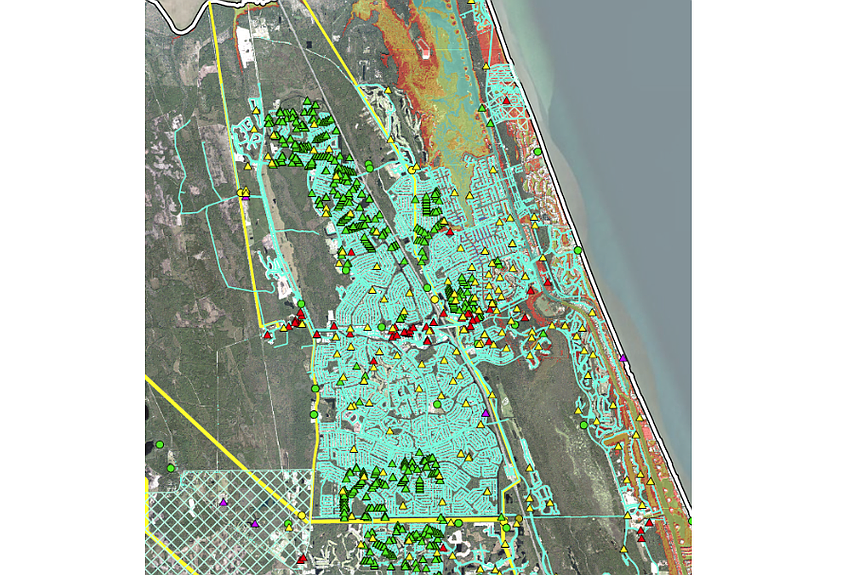
The NEFRC is working with Baker, Clay, Duval, Flagler, Nassau, Putnam, and St. Johns Counties to perform vulnerability assessments and collect data that would be free and readily accessible to use. The assessments are available to view online at www.resilientfirstcoast.com or through the NEFRC’s website at www.nefrc.org/resiliency.
For Flagler County, he said, the NEFRC is putting together a vulnerability assessment, a compound flooding assessment and an adaptation plan that prioritizes flooding impacting transportation, critical infrastructure and the beaches. While the NEFRC is still finalizing the adaptation plan, the assessments are already completed.
“Having this model really will allow our municipalities and Flagler County to prioritize implementation and grant funding and target specific things that will be needed in the future to protect against some of these flood hazards,” Prokopiak said.
These assessments show the data of where areas are prone to flooding, and how much flooding, across different storm events: rainfall-induced flooding, storm surge-induced flooding and tidal flooding.
Using predictions of different types of storm events – 100-year and 500-year – and other areas of concern, like the rise in sea levels, the data is used to generate maps that show the impact to critical assets, like wastewater treatment plants and evacuation routes. The assessments use two different types of analyses: an exposure analysis to find the depth of water areas would be exposed to and a sensitivity analysis to find how easily an asset would “bounce back” after a storm.
“For example, the sensitivity of a green space park is going to be far different than the sensitivity of a historic downtown district with old buildings that will not bounce back nearly as fast,” he said.
With these assessments, the state will have a comprehensive list of vulnerable acres for each county with completed assessments.
“This is to get hard, concrete data,” he said.
The more concerning type of flood events though are called compound flood events, he said: flooding from multiple flood events that occur simultaneously. And the data shows that compound floods are not as simple as adding the depths of two flood events together, he said.
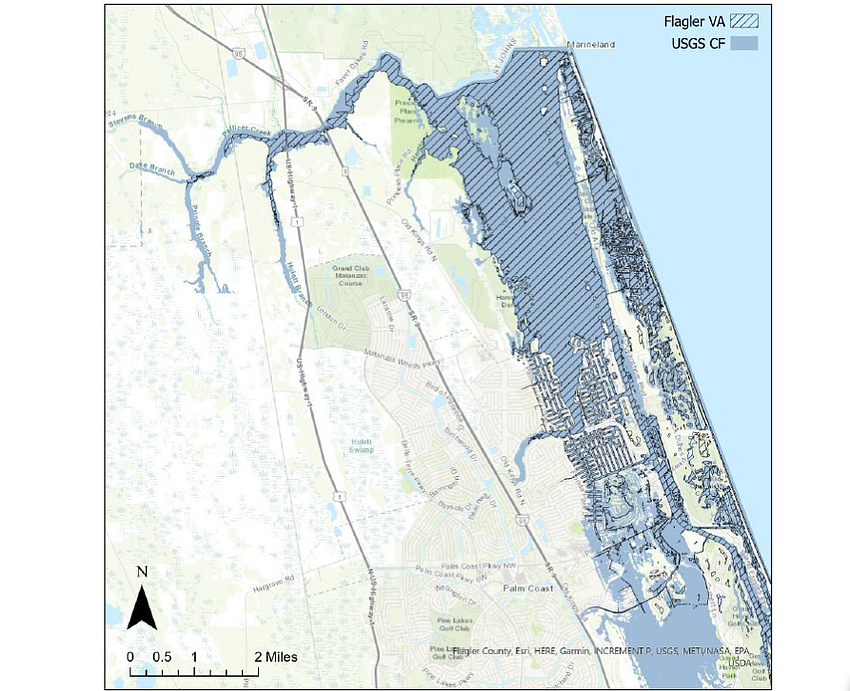
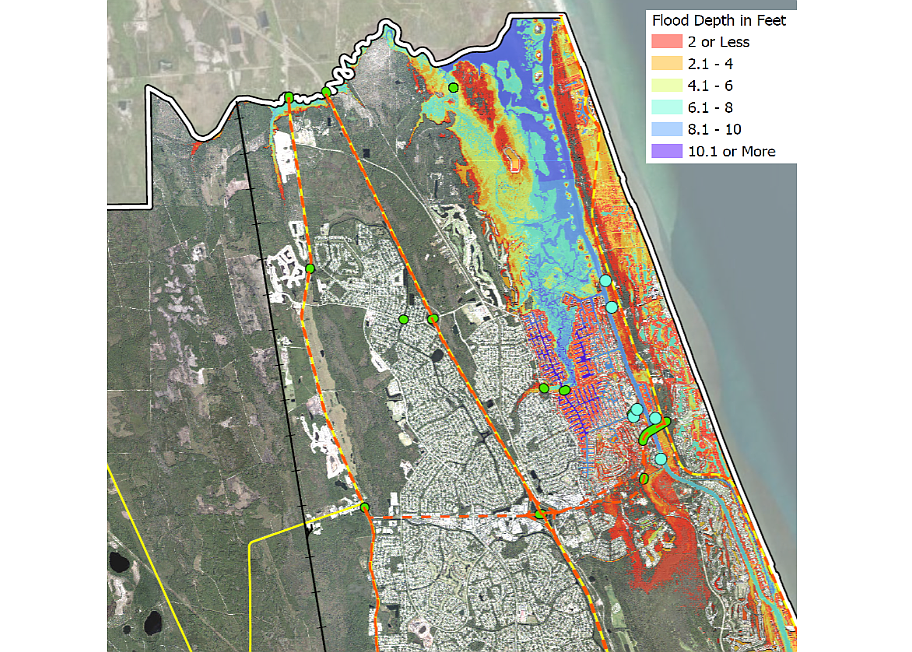
The maps of the compound flood events depict flood waters expand out and impact much larger areas than in single flood events. In some areas, he said, compound flood events add 5 feet of additional flooding.
“As you can see,” he said, “it is far more exacerbated in a compound flood event than just a single storm event.”
The assessments show, in Flagler County, that the coastal communities in Flagler, including east Palm Coast, will continue to be at risk for coastal and storm flooding.
A map specifically depicting Palm Coast flood modeling in a 100-year storm inundation shows most of the city’s critical infrastructure in areas that would be prone to 6.1-8 feet of flooding.
The adaptation plan requested by the county won’t be finalized until December, he said, but it will include a list of items targeted to address the flood vulnerabilities identified in the assessments.
The data, Prokopiak said, can be used in many ways to help protect against future flooding, including to make it easier to get funding to address problem areas.
The county and municipalities will be able to use the data to back up changes to land development codes, comprehensive plans and stormwater master plans. The data can also be used to support grant applications for funding,
Council member Ty Miller said this was a step in the right direction for gaining state funding.
“I think it'll help us to access some of those dollars,” Miller said.
Vice Mayor Theresa Carli Pontieri asked how the studies could be used in the context of controlling growth and Prokopiak said it could be used to protect vulnerable areas or to require developers to add additional storm water mitigation projects – a carrot or a stick, he said.
“That’s going to be key for us,” Pontieri said. “Particularly as we get more and more handcuffed from Tallahassee as to how we can control growth in our community.”
Pontieri asked staff to keep an eye out for ways to use the data to support initiatives and also asked staff to look into possibly purchasing open infill lots or other spaces to use as green spaces and additional stormwater runoff sites.
Adding any sort of rooted structure or greenery goes a long way in flood mitigation, Prokopiak said.
Councilman Dave Sullivan, who previously served on the Board of County Commissioners, said it is important to have city representation on the NEFRC and to ensure grant applications are supported by independent data.
“If you don't have some kind of independent analysis like this, you really get hurt when you go up against other people looking for the grants,” he said.