- March 17, 2026

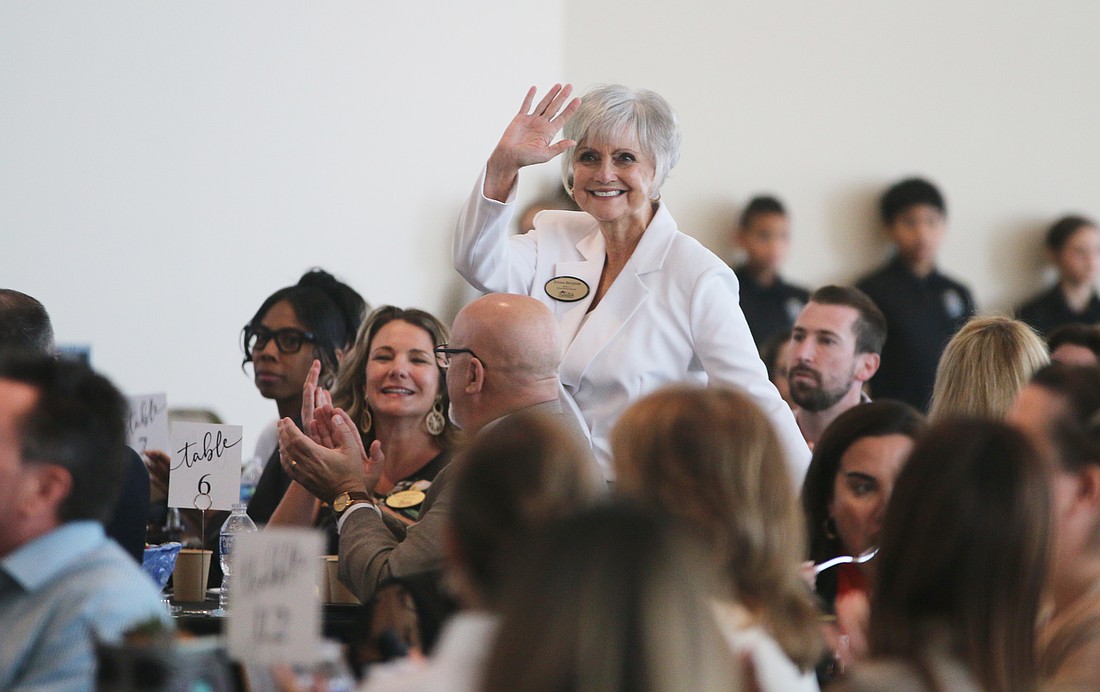
District 4 Volusia County School Board member Donna Brosemer said one of the highlights during her first six months in office were graduations.
Not only was it a chance to watch students cross the stage, but as board members and district staff spent four days together, it became a team building experience, she said.
"It was an opportunity for all of us to spend time around each other that was not in a formal setting," Brosemer said. "... I was, of course, impressed, to say the least, with the quality of the speakers. The student speakers, in particular."
The Observer recently spoke with Brosemer about priorities, challenges and goals for the upcoming school year. Here's what she had to say.
Addressing disruptive student classroom behaviors was part of your platform when you ran for School Board. What have you seen the district do to improve this, and are there other things that you would like to see done in the future?
It still is my top priority because I still see it as the critical factor in our proficiency rates. Teachers are interrupted constantly during their day by a variety of things, not the least of which is having to control a classroom.
School safety seems to be a very big topic, but classroom conditions are the first step in school safety. Safety for the students and safety for the teachers begins in the classroom. We just adopted a new student code of conduct, and much of it is clearer and more specific than the previous code, and so I'm going to be looking in this next school year for consistency of enforcement because I think that's where a lot of our gaps might be.
One of the things that I have been asked for by numerous principals in my district is in-school suspension. We don't do very much of it. and part of it is the staffing problem because there has to be somebody there. But one of the things I learned from going up to Putnam County to see what they did with a school where they were hemorrhaging students — because they had gang fights every day and it was just really dangerous — was that they established a two-tier in-school suspension system and then if the student still doesn't have his act together, then he goes to the alternative school, but that calmed everything down to the point where their seventh grade enrollment went way up, just in the first year following the implementation and and I would love to see us look more into doing something like that.
Nobody wants to send these kids home because we know that that doesn't necessarily solve the problem, but having more oversight and in-school suspension and having them get their work done while they're there, and that kind of thing, I think would be more productive.
Volusia County Schools is now an A district for the first time since the 2008-2009 school year. What were some of the strategies that the district implemented to help achieve this?
There is still a disconnect between our proficiency rates and our graduation rates.
I know that the teachers work very hard to get their kids over the finish line. There are other strategies that that the district uses that are a little harder to explain, and that includes transferring out the lower performing students who they know are not likely to graduate, so that they are in either online school or alternative schools or charter schools, and they don't count against their assigned school's graduation rate.
I'm still trying to find out exactly how that works and see what we can do to make our numbers between proficiency and graduation come closer together.
The district’s operating deficit is expected to be $8 million for the next school year, down from last year’s $25 million. Do you expect further cuts in the future, and if so, what are some areas that can be looked at?
This touches on one of my greatest priorities and concerns in the district, and that is the matter of transparency. We not only are anticipating another shortfall, but we just had federal funds frozen, as I think the whole state of Florida did.
It affected a number of our programs that are federally funded, and so that begs the question: Where do we get the money? How do we cover these programs in addition to what we're already expecting? We know that school choice has an effect on our enrollment numbers, but we are also — I can't get past this point, I made it during the campaign, and I can't get past this point — we have approximately the same number of students we had 10 years ago, but we have twice the budget.
Some of that can be accounted for additional state mandates, for instance, for school safety provisions and things like that, and of course, the higher costs, inflation — That will also affect our budget. But, not to this extent, and so my focus has been on the number of employees that we have at the district level who have no contact with students because we always cut the front line first. We always cut the teachers and the programs first, and the most we've ever done that I know of with the administration is a hiring freeze. But that doesn't reduce the actual payroll that's required in each of our departments. I would love to be able to know what those numbers are. The board's job is oversight, and it's very hard to do oversight when we can't get the information we need in order to evaluate exactly what you're asking us to do.
Volusia County Schools has an interlocal agreement with Flagler to allow students to attend schools in both districts, whichever is closest to home. Do you expect this to have a significant impact on student enrollment?
The district's initial calculation is that it will affect very few students. I think it's a wonderful idea. I'm all about the efficiency that allows to each of the districts because the transportation impacts and obligations for Volusia County, for instance, were so great from having the students who were up closer to Flagler County Schools that it just makes so much more sense to do this.
My instinct is that this may be related in some respect to some of the development plans for northern Volusia County in the Ormond area. So I think it kind of sets a precedent that might be more valuable then than its impact would be right now.
Three bills expanding school choice are now in effect, including HB 1105 which allows a majority of parents to convert a public school into a charter. Is this a good thing for families, or are there concerns about unintended consequences?
I think there are always concerns about unintended consequences. I see this as another provision by the state to enhance school choice. School Choice is a product of the desire to make public schools competitive, and so I think this is another way to push public schools into being more competitive, because obviously, parents are not going to go to that much trouble to set up their own school if their needs are being met by the public school system.
It's a tool for them to use. Whether or not it's effective or even used very much, I think, will be a reflection of whatever county they're in. I don't know what effect it might have in Volusia County, but we'll just have to wait and see how it plays out because I don't have a good sense of whether this can work and how well parents can put their own schools together.
The district is due for an impact fee study in 2026. In 2023, the School Board adopted fees that were lower than what its consultant recommended. Could this happen again?
I am not a fan of impact fees. I think too often they're used, generally speaking, as just a way to get the sign-off on the school concurrency requirements, and so my hope is that we will continue the trend that we set in the last study period.
Unfortunately, when we're under budget pressure, the tendency is to look to things like that to try to fill that gap. But I would much rather that we started looking internally first to make better use of the dollars we already have before we start raising fees to everybody else.
What are some of your goals for the upcoming school year?
When I was running for office, I talked about realigning the relationship between the board and the district administration, and that is still my top priority for non-school related policy. I think we need to be as transparent as we tell people we are and during this budget period, it's becoming more apparent that we have some work to do in that area.
For instance, when we consider the budget, we are not given a line item budget, and it's not posted on our website. There's a narrative and there are descriptions and there are some general figures, block figures, that are given, but we don't get line items, and I think that makes it difficult for us to to know what we're talking about with the budget whenever it's presented to us.
So my priorities have to do with how we function and make ourselves as transparent and efficient as possible, and how the board is allowed to exercise its oversight without micromanaging the district.
Over this next school year, I'm going to be looking at what we can do to make ourselves more efficient, and hopefully in that efficiency, address some of the needs of the principals who and teachers who are asking for better alternatives to control their classrooms. I think ultimately that raises our proficiency rates, and it can't help but make us a better school district.