
- March 16, 2026

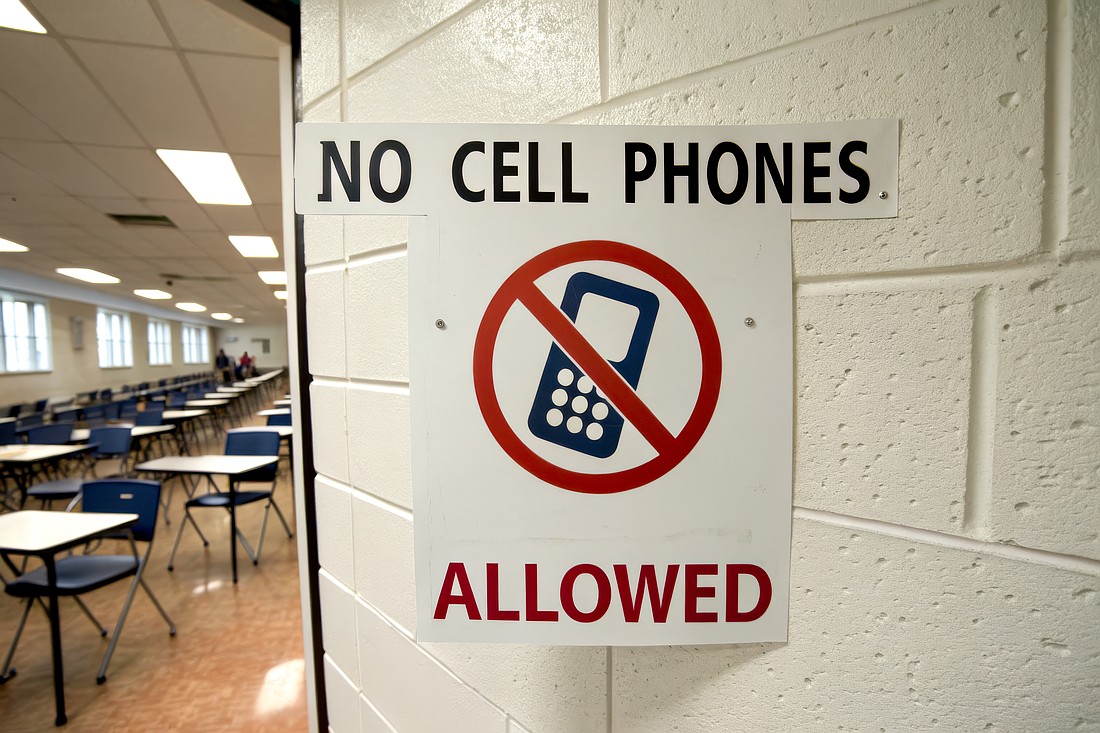
Cell phones now have further restrictions in schools, as a new law prohibits elementary and middle school students from using their devices during the entire school day.
Florida House Bill 1105 went into effect on July 1. The education bill — which contained a compilation of other unrelated measures, such as allowing parents to convert a public school to a charter and letting students in marching bands get a physical education or performing arts credit — essentially prohibits students from using any wireless devices (phones and tablets) from "bell to bell." High school students are still permitted to use their phones outside of class and during class if permitted by their teachers, but the bill also includes a pilot program to test a phone ban on six school districts during the entire school day. Flagler and Volusia County are not included in the pilot.
In Flagler County, the major impact of HB 1105 will be on the school district’s two middle schools, Flagler Schools superintendent LaShakia Moore said.
The district already had a policy in place that banned cellphone use “from bell to bell” in the elementary schools.
“Middle school is where the major change is for us,” Moore said. “The fact that those students will now have to have those devices off the entire day, will be very different.”
Mike Micallef, Volusia County School's executive director for graduation assurance and student services, echoed a similar sentiment.
"House Bill 1105 is going to be a rude awakening and eye-opening, I think, for some of our middle school students," he said.
As a district, Micallef said they will need to put a policy in place that is enforceable, holds students accountable and follows the new law.
"Ideally, phones are just going to have to be not in sight from the time they walk on campus until the time they get home," he said.
So what will that look like?
John Fanelli, Flagler Schools’ director of student services, said sixth graders entering middle school are already accustomed to the elementary school policy, so there will be no change for them.
“We’re really talking about two grade levels, seventh and eighth grade,” Fanelli said. “We may have to break some bad habits and continue to remind them to turn their phones off and put them away.”
Moore said the district has begun sharing information with families about changes for the new school year, so parents and students will know about the policy change.
Doug Glasco, the district’s coordinator of student behavior and conduct management, said enforcement policies have yet to be decided.
“We’re going to try to work with our families, making sure kids are engaged in their education and not be punitive with them,” Glasco said. “There could be a roll-out period with just warnings, calling home. It will really be a learning period for them.”
VCS will start doing announcements regarding the change in cell phone allowances on social media, Micallef said. Previously, middle school students were allowed to use their phones before or after school.
"Pretty much, it's going to be the same thing that we've been doing, normal business as usual with cell phones aren't supposed to be visible while they're in class, unless they're directed by a teacher for instructional use," Micallef said.
But, it will be up to the School Board, he explained, to set the policy.
Volusia County School Board member Donna Brosemer said the new law may impact how teachers manage their classrooms.
"One of the things that teachers tend to do is to use the devices as a way to control the class, to just keep them quiet and removing the cell phones might complicate that," she said.
History shows that it may take time for students to adjust. Two years ago, during the first year of the statute that banned the use of personal electronic devices during instructional time, Flagler Schools had almost 3,000 device referrals. This past school year, that number dropped to 1,652. Of those, 1,042 were in high schools, 596 in middle schools and 14 in elementary schools. The most serious punishments were 10 instances of full-day suspensions.
“We were able this year to reduce (the number of referrals) by 44%,” Fanelli said. “So I do expect to see out the gate, we're going to have to give a lot of reminders. We're going to have to work very closely with our families to continue to reinforce that new policy across our campuses.”
In Volusia County Schools, there were a total of 14 referrals due to cell phones in elementary schools, 914 in middle schools, 2,466 in high schools and 243 in combination schools for the 2024-2025 school year.
Students first receive a warning, and if further violations occur, then parent contact would be made. A referral is the last step.
What VCS doesn't want, Micallef said, is for students to stop learning because of classroom time is being disrupted as teachers try to enforce this new law.
"We don't want [teachers] to stop educating the students and getting into a battle with the student over a cell phone," he said. "... We're here to educate kids, and that's our number one priority, and also keeping them safe. But, if a student's got a cell phone out and they're not complying with it, they're expected to go on with normal instruction as normal for everybody in the class, and then we will deal with that as an administrative consequence."
Elizabeth Albert, president of teachers' union Volusia United Educators, said the new law is "fabulous."
"If we can limit the distractions from learning, from pulling kids attention away from the core instruction that is being provided in the classroom, that is a win every day, all day," Albert said.
But, she added, any law is only as good as the ability to enforce it. VCS already had a policy in place restricting cell phone use in elementary and middle schools, so teachers are somewhat already experienced.
"Their expectation is to just make sure that they set the standard in the classroom, and then they move to enforce the policy as much as they can," Albert said.
If a student or two continue to be non-compliant, then teachers expect the administrative team to come in and hold them accountable. Initial concerns from union members, Albert said, revolved around having support from administration and the district to enforce this new law, particularly with questions like who will be responsible for a phone should it have to be taken away from a student.
"We just want to make sure that there are some clear, defined expectations for our instructional personnel and our clerical personnel on what to do if we go beyond that initial 'Everybody put your phone away,'" Albert said.
Moore said they understand it will be difficult for some middle school students to adjust.
“We will work with them,” she said. “We will work with their families in order to ensure that all of our students are following the law, but also following what our Code of Conduct outlines are as well,” she said. “So for several of these students, they're going to get a warning, and that'll be it, and it'll be done, and they'll adjust. For some of them, they may need more than one warning.”
Flagler County School Board member Lauren Ramirez, who has children in both middle and elementary schools, said she welcomes the new statute as both a parent and board member.
“I do think this is the right direction,” she said. “There is a book, ‘The Anxious Generation,” by Jonathan Haidt. It clearly shows how the use of smartphones is linked to anxiety, depression, isolation with our children. When this law was coming forth, I thought of that that book. There are other districts that have started this before the law went into effect. And a lot of those school board members said that was one of the toughest decisions they had to make, and now that it has been a policy for over a year they said it was one of the best decisions they made as a board.”
Cell phones in the classroom is part of this day and age, Micallef said. But, he does believe this new law will promote higher academic learning.
Again, Albert said it goes back to enforcement and ensuring learning time is not disruptive.
"It's always progress, not perfection," Albert said. "So as we start to show the students that they are going to be held accountable to this expectation, and as much as our colleagues are willing to hold the line, if you will, then I believe will things will start to get exponentially better."
Orange County is one of the districts that has banned personal electronic devices in all schools, including high schools, throughout the school day. Currently, state statute allows high school students to use their devices outside of instructional time.
Ramirez said in a panel of high school students whose districts banned cellphones throughout the day, the students were angry at first and eventually accepted the policy.
“They said they were actually happy because they were having conversations at lunchtime,” she said.
Moore said some families have contacted the district to make sure that they will be able to get important information to their children. Moore reminds them that ParentSquare, previously Remind, is a way families can get information back and forth to their children’s teachers in an efficient manner.
“We always encourage our families that they can call the front desk if there's important information that they need to share with their child, such as, there's been a change in the schedule, you go home in a different way, those things that are urgent” Moore said. “And once (the student) get out of the school day, they turn their devices back on.
“What we ask the families for is that they reinforce what the expectations are at home and they do what our families do for us already, that they be great partners and just help to support us as we implement the state statute,” Moore said.
As educators, Albert said they should be able to make the new expectations aware to both students and their families.
"It's about making sure that they're aware of what the expectations are, and having conversations with them about what's allowable and what isn't," Albert said. "... I think you'll find that most parents will engage with that."