- March 17, 2026

Flagler County needs 30 more signed easements for the next phase of its beach renourishment.
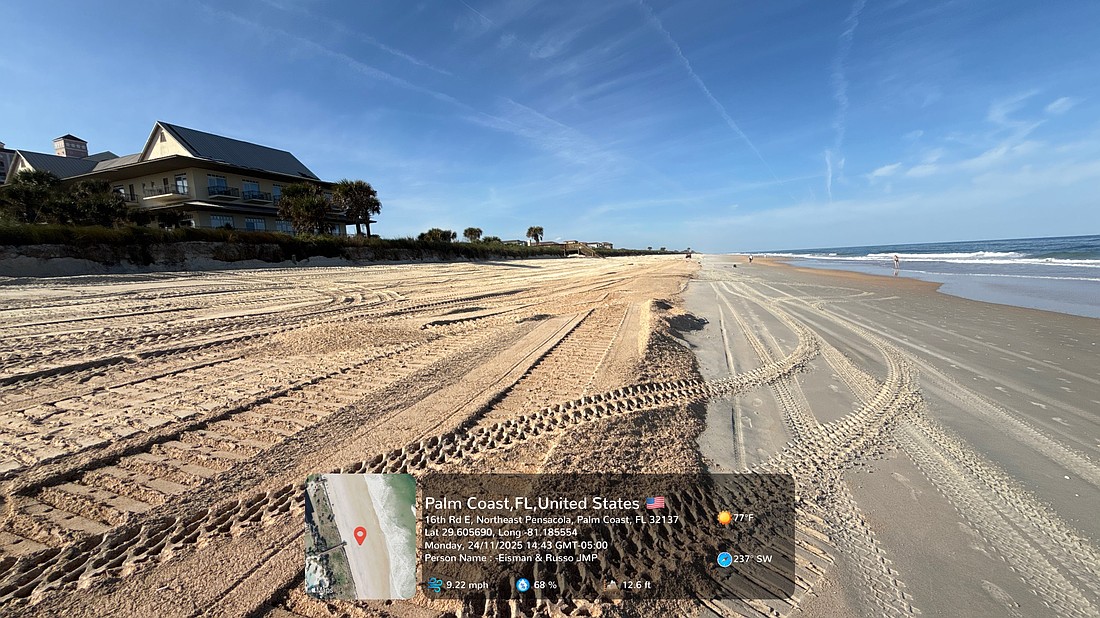
The county is preparing to begin its Reach 2 beach renourishment project, with construction planned to begin in the spring or summer of 2026. Reach 2 stretches from Flagler Beach’s North 7th Street to Painters Hill and north Varn Park. The $36 million project is fully funded, the project design completed and it is ready to go to bid in January.
In a call back to the previous issue that delayed the Flagler Beach U.S. Army Corps of Engineers renourishment project for three years, the county is having problems getting ahold of 30 property owners along the 3.3-mile stretch of shoreline.
“Thirty outstanding easements is not a small deal,” Commission Kim Carney said in the Dec. 15 Flagler County Commission meeting. “It's a big deal. Each one of those lots that are not part of the project have to be clearly marked. They have to stop at a certain point. They have to start at a certain point.”
The information came during a presentation made at the meeting to update the Flagler County Commission on the beach renourishment projects.
Carney asked the county’s legal team what other options were available for them to consider, such as offering at least temporary easement options to be able to move forward.
“This project becomes, technically – I'm going to use the word – a waste of sand if you don't have an ongoing, continuous project,” Carney said.
County Attorney Michael Rodriguez said the county would look into claiming a customary right, but while the county can try to claim a customary right it is still private property.
“I'm very weary of entering into a property dispute with private property owners,” Rodriguez said.
Rodriguez clarified in a phone call with the Observer on Dec. 16 that a customary right is a general legal term referring to the right to the public over private land, like the beach. In Florida, the beaches are public land, but beachside homeowners’ private property begins at the mean high water line.
Carney said these 30 properties were not simply people refusing to sign. She said she had been in communication with Assistant County Attorney Sean Moylan over the nature of the delays.
“People are getting divorced, and they are thinking about how they're going to split the properties so neither one of them wants to sign. Deaths, that [contacts] are not reachable,” she said. “There are several non-signatureable events going on.”
The other commissioners agreed. Commissioner Andy Dance asked the administration to provide at least weekly updates on where the county sits with the property holders.
“I see that as the critical issue to getting Reach 2, the most immediate project, fully done,” he said. “I would feel better thatI see that continuous push. I know it took a lot of effort last time.”
Commissioner Greg Hansen said the county would almost need to form a “war room with legal.”
“We need to know every day what is going on,” he said.
While the easements issue in Reach 2 is a major cause of concern, another problem awaits the county in Reach 3.
During the presentation, Casey Connor with the engineering firm Moffatt & Nichol – which contracted with Flagler County to work on the beach renourishment projects – said their teams are working on surveying how much hardbottom surface is over the 5.5-mile stretch of Reach 3.
Reach 3 spans from Hammock Dunes to Washington Oaks State Park, and is covered in places by Coquina rock. Before the county can obtain permits for the work, they need to know how much of the area is impacted by hardbottomed surface as that would impact how the work is completed and the cost.
There are regulations in place that protect the hardbottomed surface, Connor said, and areas that would be impacted by large-scale beach renourishment would legally need to be mitigated. Mitigation requires replacing the impacted areas with artificial hardbottom.
Moffatt & Nichol has completed the remote scan for the hardbottom surface, he said. Now needs to confirm those areas with diving surveys. That is underway, but only 10-15% has been completed. Because of weather concerns, the hardbottomed diving surveys won’t likely be finished until the summer of 2026.
From there, the data will be analyzed for how productive the ecological habitat is, he said, which is what is considered when it comes to mitigation.
“Basically any large-scale beach nourishment will require hard bottom coverage,” Connor said.
The more that needs to be mitigated, the higher the costs. Mitigation construction, Connor said, is $2.5-$3 million per acre, and there is a possible maximum of 225 acres that would need to be mitigated. The final number won’t be known until after the surveying is complete.
Alternatively, the county could change its renourishment plan, Connor said, to build a wider dune area with a smaller berm. The berm is the “towel space” portion of the beach.
But to avoid impacting the hardbottom, the county would not be able to dredge in sand. It would instead need to be trucked in.
“That’s the scary option,” Hansen said. “If we can’t dredge, the price goes way up.”
But building the dune could cause future problems if the dune were to wash away and cover the hardbottom during a storm. The Florida Department of Environmental Protection could come out and check for that, Connor said, but it would depend on the permit negotiations.
Worst case scenario, Dance said, the larger dune is washed out onto the hardbottom surface after a storm, and the county would still have to pay.