- March 17, 2026

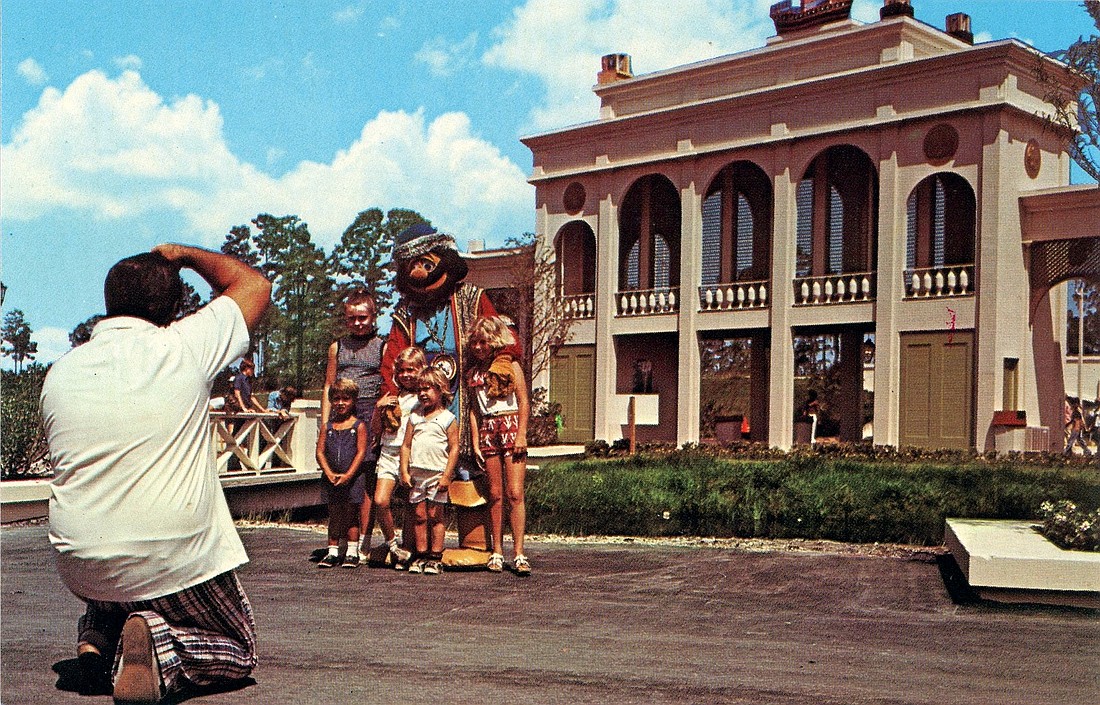
The recent announcement that Marineland (now called Marineland Dolphin Adventure), which was built in 1937 and added to the National Register of Historic Places in 1986, is for sale due to a bankruptcy process has brought to memory another local theme park: the once-enchanting and almost forgotten Marco Polo Park.
Marco Polo Park was fairly large as it occupied 5,000 acres in Bunnell near the Flagler and Volusia County border. The park featured various Asian themes based on the 13th century exotic travels of Marco Polo (1254-1324), the legendary Venetian merchant and explorer. The park featured multiple sections, beautiful gardens, canals, lagoons, dancing shows, internationally themed restaurants, live music, movies, puppet shows, various rides, and other entertainment venues designed to lure tourists.
During the time the park was operational the name of Old Dixie Highway was changed to Marco Polo Boulevard (in the park’s general vicinity). The name of that stretch of road was changed back to Old Dixie Highway many years ago.
O.L. “Jack” White (1915-2003) was a successful real estate developer in the Daytona Beach area, and president of the Daytona Regional Chamber of Commerce. In the late 1960s, White became the president of the board of directors for Marco Polo Park, Inc., and in conjunction with 28 stockholders began setting up plans to build the theme park.

The park’s visionaries believed that people traveling back and forth on I-95 to the new world-class Walt Disney World theme park, which opened in 1971, would be interested in extending their vacations or satisfying their curiosities at the nearby Marco Polo Park.
On Dec. 28, 1970, the first phase of the park, the Japanese section, opened with notable public enthusiasm. In May 1972, the second phase of the park opened and included four additional sections and a petting zoo. Television commercials stated that Marco Polo Park was to be “the greatest adventure of your life.”
There were five sections of the park: China, India, Japan, Turkey and Venice. All of the sections were connected by an overhead passenger gondola system called the Sky Ride, which provided spectacular aerial views throughout the park. A narrow gauge railroad called The Orient Express featured a steam engine with four passenger cars and traveled around the park’s perimeter.
China: Included a Chinese boat ride and a Spinning Tea Cup ride.
India: Included a Flying Elephant ride and a Log Flume (Bamboo Chute) ride.
Japan: Was the largest section, 500 acres in size, and included a lagoon, a replica of a Japanese fishing village, a Japanese botanical gardens area and a mile-long waterway with several ornately designed bridges. Rides included an 82-foot high Ferris wheel with spinning gondolas. Authentic Japanese entertainers performed at various shows. Eighteen authentic Japanese teakwood sampans (Asian boats traditionally used for transportation and fishing) transported guests around the section’s waterways. There were also souvenir shops with Japanese and Asian-themed items and two Japanese restaurants with tempura-style menu items.
Turkey: Featured multiple rides including the Flying Chairs ride, a Spinning Turban ride that rotated by centrifugal force at high speeds, and two Twin Bumper Cars rides (one for adults and the other for children).
Venice: Served as the main entrance to the park and it was highlighted by a Venetian-style entrance archway. One of the featured rides through Venice was small replica Ford Model T cars that guests could manually steer through the woods and trails along a guided track.
In February 1975, two suspicious fires, just eight days apart, resulted in significant damage to Japanese Village, the park’s major attraction. It was determined that Japanese Village was beyond economic repair and was subsequently demolished. At least one report blamed bats roosting in the electrical house and stated that they shorted out wiring which ignited the fires.

However, arson is the most likely cause since a suspect was seen fleeing from the area at the same time one of the fires began. This suspect actually fired gunshots in the direction of a security guard as he fled from the park.
Marco Polo Park closed in early 1975 to repair damage caused by the fires. On May 24, 1975, the park reopened with a new bandstand which was a replacement attraction for the Japanese Village, and a new 40-horse carousel ride. The reopened park was under new management of the Ozarks Park, Dogpatch USA organization and given a new name of Passport to Fun World. The newly reopened park featured a world travel theme very similar to that of Marco Polo Park, and was advertised as being “close to everything in central Florida” and as “The Best Day Money Can Buy.”
Not long after Passport to Fun World opened it proved to be unprofitable and unsustainable. In 1976, the park was permanently closed. In 1978, most of the park’s property was auctioned off and other assets including buildings, tracks and other structures were removed.
The Plantation Bay Golf and Country Club community was developed on the land where Marco Polo Park once stood.
In addition to the suspicious fires, there were several other factors that contributed to the closing of the park including an economic recession in the early 1970s, the lack of a nearby southbound exit off of I-95 at the time, Walt Disney World’s overpowering competition, and the OPEC oil embargo of 1973 which caused gas prices to increase.

Marco Polo Park/Passport to Fun World was not the only theme park in Florida to go out of business in the 1970s. Several other theme parks across the state went defunct as well including Wonderland Park, Titusville (closure year: 1973), Pirates World, Dania (closure year: 1975) and The Aquatarium (also known as Shark World), St. Pete Beach (closure year: 1977).
The most significant reason for the demise of these theme parks was the world-class Walt Disney World attractions who had overwhelming business advantages and were simply too much competition for these smaller theme parks to endure.
O.L. “Jack” White summed up the fate of Marco Polo Park as he said, “…I learned one important lesson - you can’t compete with the mouse [Mickey]…”
Today, no remnants or historical signs exist which would identify where Marco Polo Park once stood.
Randy Jaye currently resides in Flagler Beach. He recently researched and nominated five properties that have been successfully added onto the National Register of Historic Places. He is the author of several history books and has written articles for historical journals, local newspapers, magazines, online publications, and has appeared on several radio shows and PBS documentaries.