- March 15, 2026

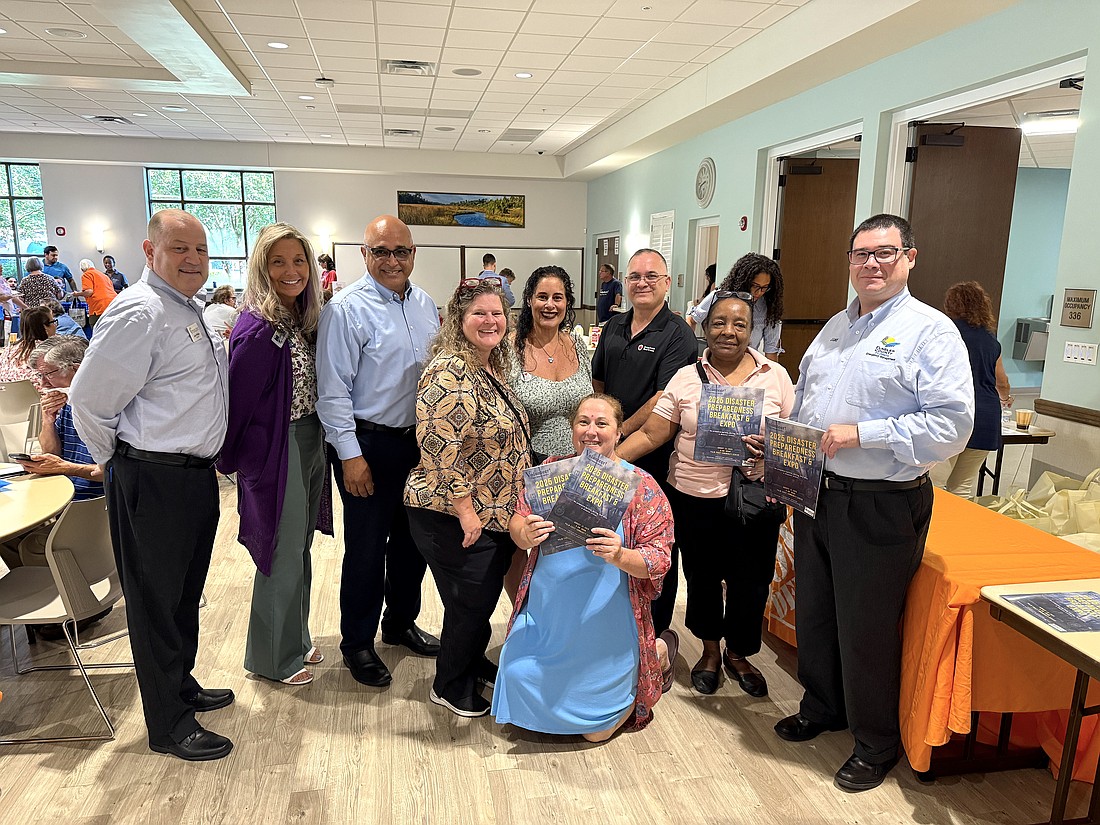
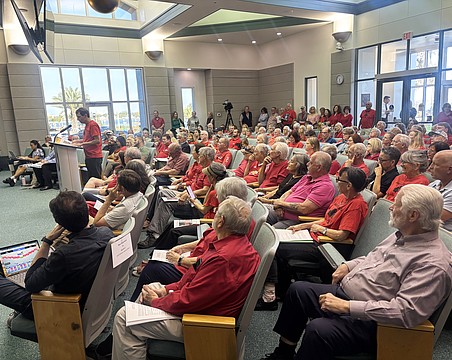
While Tropical Storm Erin is forecast to become the first major hurricane of the season, it’s not forecast to be a direct threat to Flagler County, according to Emergency Management Director Jonathan Lord. He spoke to a full room Aug. 12, at the Palm Coast Community Center, as community agencies came together, showing a unified effort for preparedness and response.
Sheriff Rick Staly was among the panel of speakers, and he praised the cooperative nature of the community agencies. Most of his career was spent in Orange County, where “all the painters didn’t always get along,” he said. “ … That’s not what happens here. This is a completely different world for public safety, and it’s really nice, because we all work together.”
Staly added: “We will get through this together if we get a hurricane.”
Lord pointed out that although the forecasts for hurricanes predict up to 18 named storms this year, it only takes one to truly matter, if it hits our community.
“We live in a community that’s at risk for hurricanes,” he reminded the crowd.
He encouraged households to put together supplies that will allow residents to live without power for a week. Generators can be bought any time without sales tax, thanks to a new state law.
EVACUATION POLICY
If evacuations are needed for a storm, Lord said, details will be broadcast through press conferences, through social media with the handle @flaglereoc, and through messages sent through a state-funded system called AlertFlagler. Sign up at flaglercounty.gov/alertflagler.
There are two zones that are identified for evacuations, one on the eastern side due to ocean and Intracoastal Waterway flooding, and one on the west due to lake flooding.
Lord said there has been a change of emphasis on evacuations.
“While evacuations are mandatory — they are legal — we can’t force you out of your home,” Lord said. Evacuations shouldn’t been as voluntary, either, he said, but households should understand the risks of staying in place during a mandatory evacuation.
When there is no story, he said, “If you fall and break a bone, you call 911, our amazing emergency people show up in minutes if not seconds.” That may not be the case during a story, if winds are too severe.
Staly added: “We’re not going to make you leave your home.” He also said the evacuations are mandatory, “but no we don’t enforce it. We encourage you to follow the warnings and heed the warnings. If you decide to stay, and your house is flooding, we can’t get to you. If the winds get to a certain miles per hour, the 911 center will give you medical advice over the phone, but we can’t get there. That’s the risk you take if you don’t take the advice [to evacuate]. Emergency response will be delayed at some point.”
The Sheriff’s Office won’t risk its employees just because “you chose to stay in some place where we advised you not to,” Staly said.
BRIDGES WON’T CLOSE
Bridges in the past have been closed to traffic when winds hit 40 mph. Staly said that is no longer the local policy.
“We don’t block bridges anymore,” he said, but, “we encourage you not to go over them.”
SHELTER SAFETY
If you live in an evacuation zone, Lord encourages residents to make arrangements ahead of time to stay with friends or family in non-evacuation zones, or hotels, or emergency shelters if needed.
Pet-friendly shelters, thanks in part to volunteers with Flagler Schools and the Flagler Humane Society, open at schools before hurricanes, with emergency medical staff available.
Staly said background checks are conducted at the shelters, and if a sex offender needs shelter, the offender is brought to the jail lobby rather than being housed with other residents.
“We check everyone,” Staly said.
LOCAL RESPONSE
Geri Scott, captain of the West Flagler CERT; Tracy Callahan, president of Flagler Strong; and Greg Peters, lead pastor of Parkview Church, spoke on a panel about disaster relief.
Scott explained that on the west side of the county, many are on wells. “So, no power, no water,” she said. She got involved because of “the right person at the right moment” who helped inspire her to serve others rather than focusing on her own struggles, even during a disaster.
Callahan has helped lead disaster recover in Flagler Beach ever since Hurricane Matthew.
Peters said he helps mobilize members of his church to respond because of the “one another” commandments in scripture, such as “love one another, service one another, forgive one another.” He said the church’s mentality is one of “mass volunteerism.”
When disasters occur, he said, “it’s the faith community that shows up.”
Flagler Cares President Carrie Baird pointed out the services she offers after a disaster. With a “no wrong door” approach, Flagler Cares connects people to services even if they don’t know exactly what to ask for. The organization offers safety net services, mental health and substance user services, as well as coordination with other nonprofits. Visit flaglercares.org or call 386-319-9483.
Crisis Cleanup is another resource for disaster relief. It’s a website that coordinates large national groups’ volunteers to respond to local needs. If you need disaster volunteers, call the hotline at
DISASTER KITS
Flagler County Emergency Management recommends storing one gallon of water per person per day for five to seven days, in addition to nonperishable food.
Diane Gee, community disaster program manager with American Red Cross, said it’s important to remember your neighbors and check in to see if they are prepared as well. In addition to water and food and light, she encouraged residents to make sure medications are part of the plan.
“Disasters start and end locally,” Gee said.