
- April 3, 2026

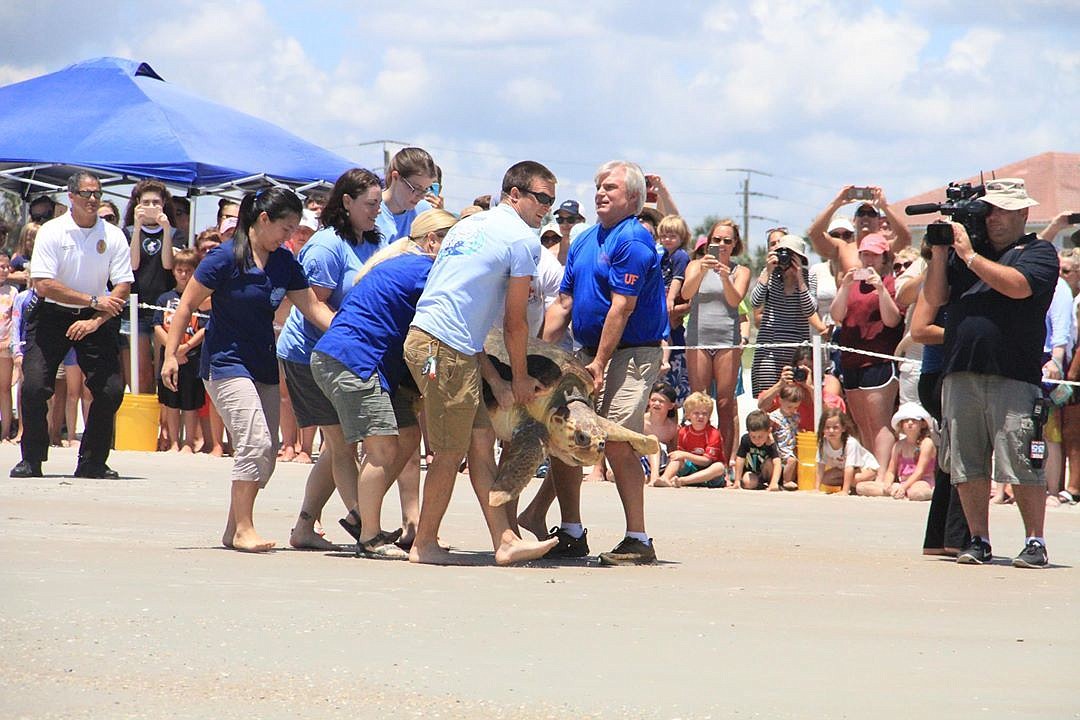
It was an exciting day at the beach as crowds gathered to watch Whitney, a roughly 280-pound loggerhead sea turtle, make her return trip home to the sea.
The turtle was released near the Beach Street ramp in Ponce Inlet around 12:30 p.m. on Friday, July 7, after her stay of almost three months at Ponce Inlet’s Marine Science Center. Whitney had washed ashore in Cocoa Beach on April 16 and was found to be anemic in addition to having a weakened immune system and being only 235 pounds—underweight for an adult sea turtle.
Crowds watch Whitney the loggerhead sea turtle return to the sea.
The turtle’s left back flipper had been amputated and her shell damaged due to what rescuers believe was the result of coming in contact with a boat propeller.
“She came in as what we call a debilitated loggerhead where she was emaciated, her red blood cell count was very, very low and she seemed to have some kind of septicemia,” Veterinarian Dr. Craig Pelton said. “It just takes a lot of antibiotics, supportive care and time to get her body to finally fight off the infection and build up those red bloods cells and strength to be able to get back out there.”
Crowds watch as Whitney the loggerhead sea turtle is given help in her return to the sea.
Pelton, along with Melissa Ranly, the turtle rehabilitation manager at the MSC, are both Port Orange residents who were part of the process to get Whitney back out into the wild. According to Pelton, an important part of releasing the sea turtle is that it provides a chance for her to breed and lay eggs in the future.
In the time Whitney spent recovering, she gained around 50 pounds and had been eating around eight pounds of food each day. She’s also a nod to the many turtle rescues that have taken place this year—52 since January.
Volunteers and beachgoers wait for the sea turtle to be released.
Ranly said they did a sonogram and found Whitney has some small undeveloped egg follicles, which means she could breed and lay fertilized eggs. Though there’s no exact way to tell, Ranly said she estimates the loggerhead is at least 30 years old but could be older.
Veterinarian Dr. Craig Pelton and Melissa Ranly, the turtle rehabilitation manager at the MSC.
“We know that means she is of breeding age so our hopes are that by getting her out there now she’ll still have time to hopefully mate and maybe reproduce,” Ranly said. “Even this season.”