- April 6, 2026

County and cities agree the half-cent sales tax should be on the primary ballot in August.
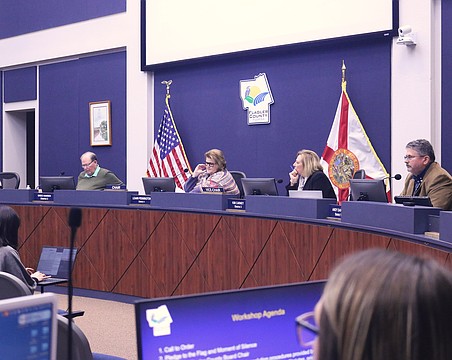
The county’s half-cent sales tax referendum may be proposed this year without a termination date, or with a duration up to 30 years, according to discussion at an intergovernmental meeting Monday, May 14.
Initially approved by voters in 2002, the sales tax will expire this year. Before June, though, officials need to decide on which elections ballot to include its renewal. For now, consent was reached that including it on the primary, along with the School Board’s half-cent referendum, was desirable.
“You’ve got to remember,” County Administrator Craig Coffey told the group, referring to the amount each government receives from the tax. “Just because the county agreed to this (disbursement formula) at one time does not mean it’s the proper formula. Out of 67 counties, we’re the only one with this strange formula.”
The state sales tax is 6 cents on every dollar. In Flagler County, it’s 7 cents, with a half cent currently going to the schools and the other half split between the county and every municipality.
The current breakdown (64% to Palm Coast, 29% to Flagler County) was originally agreed upon after Palm Coast incorporated. The tax was intended to aid in the paving of city roads and the creation of its stormwater systems.
A decade later and with a jail expansion standing as a top county priority (Coffey said that Flagler is “10 years to 20 years behind” compared to neighboring county jails), officials intend to return to the state’s default formula (closer to a 50-50 split), which would mean an annual loss of about $500,000 to Palm Coast.
“We need a jail now because the population has doubled (since 2002),” Coffey said. “We are behind on our infrastructure. We have not invested in any repaving. … We have not addressed any drainage. … We have countywide issues that no one’s willing to contribute to. … Can you see our dilemma?”
“(But) if you take money from the cities, then you are raising taxes,” Palm Coast City Manager Jim Landon said. “Don’t mess with this particular funding source. Find another funding source.”
But, to Coffey, the issue wasn’t so cut and dry.
“It’s a matter of who raises taxes and how much?” he said. “Whose is the burden, and should the burden be shared?”
No deal was reached on percentages, but officials from the county, Palm Coast, Flagler Beach, Bunnell and Beverley Beach appeared to agree to extend the duration of the tax, rather than have it sunset in another 10 years.
Palm Coast Mayor Jon Netts called an extension “the most palatable” option and even suggested removing any termination date altogether.
“I don’t think anybody realistically expects a tax to go away,” he said. “I’m paying 7% now. I expect to pay 7% forever.”
The problem for Palm Coast, according to Netts, is that the city has done all of its long-range planning according to its current budget. “Until three months ago, we had no reason to expect there would be a change in our revenue stream,” he said. “All of our (plans and projects) were based on that revenue stream.”
He favored making the tax referendum permanent.
“As far as I’m concerned, I don’t see any rationale of putting any time frame on this,” he said. “I can guarantee you that 15 years from now, the county will tell you ‘I have unfulfilled needs’ — as will the (cities).”
Flagler County Board of County Commissioners Chairwoman Barbara Revels, who pointed out that county improvements make “the cities a major beneficiary of the tax,” remained skeptical, however.
“I don’t know how the citizens would feel about a 1% that would never go away,” she said.
“As a group, we’re all going to have to either diminish our levels of service or find new ways of funding,” Netts said. “You’re either going to meet the needs or you’re not going to meet the needs. And if you’re going to meet them, you’re going to pay for it.”
Each municipality agreed to either add sales tax to their next meeting agenda or call a special session. They will then report back to the county with their final stances within the next two weeks.
According to Revels, even if the cities and counties cannot come to an agreement and the tax is not put to vote, the County Commission could still, by super majority vote, put a tax in place. If it did, it would use the 50-50 default formula.