- April 6, 2026

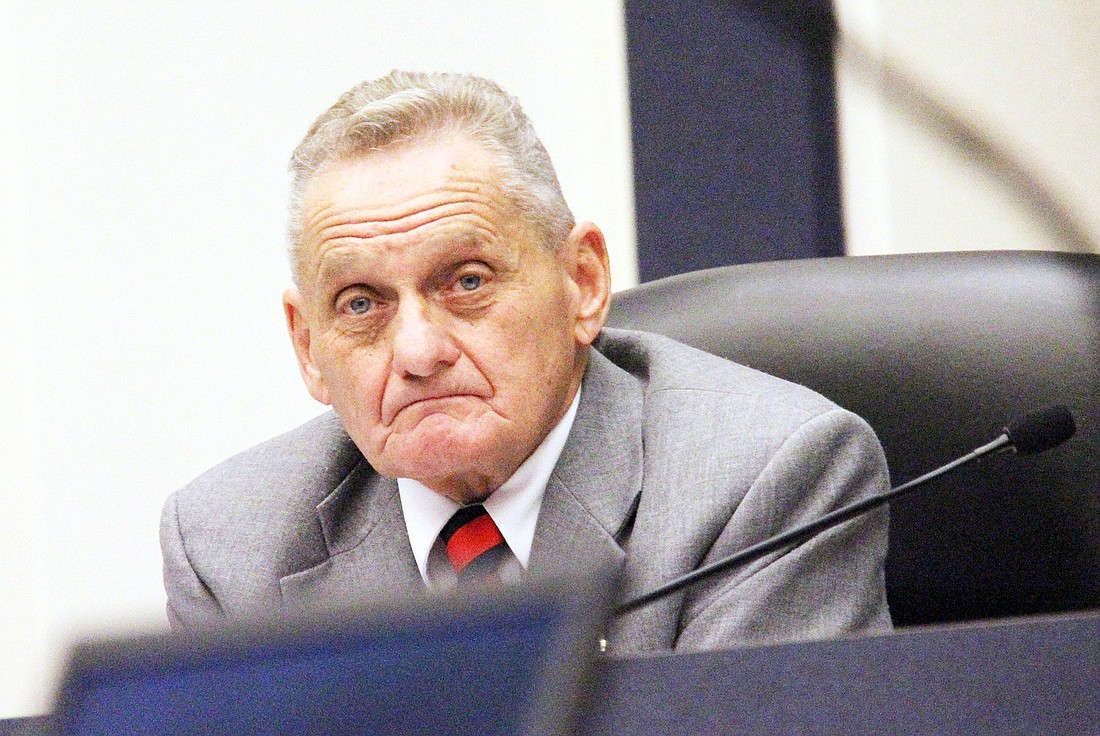
Fischer’s insurance will pay $1.25 million for wrongful death.
Three months ago today, an hour before the sun rose, School Board member John Fischer called Flagler County Sheriff Donald Fleming, at home. Whereas Fischer has been silent on the matter ever since, Fleming recently issued the following statement:
“John Fischer called me around 5:30 a.m. on Nov. 11 to tell me his wife (Jamesine Fischer) had been involved in an accident in Palm Coast where she thought she had hit an animal,” Fleming wrote.
As it turns out, Jamesine Fischer didn’t hit an animal — she hit 76-year-old Francoise Pecqueur, who died as a result, near the intersection of Colechester and Columbia lanes.
And attorney Allan Ziffra said Jamesine Fischer was identified by at least two or three individuals as being at the scene of the accident shortly after 6 p.m. One witness called 911 himself to report that he had discovered Pecqueur lying in the road. By that time, Ziffra concludes, “Ms. Fischer was aware that she struck a human being.”
And yet about 12 hours passed before Fischer had the incident reported to the Emergency Operations Center herself. That could mean trouble for her: State statute requires that in such a situation, you must report the crash to the nearest law enforcement agency as quickly as possible.
The Florida Highway Patrol is investigating the incident; Ziffra was told it could be two more weeks before the State Attorney’s Office presses any criminal charges. But the case was compelling enough for Fischer’s insurance company to settle a wrongful death case with Ziffra’s client, Catherine Vyvyan, for $1.25 million this week. Vyvyan is Pecqueur’s daughter.
Reconstruction
Debra Johnson, public information officer for the Sheriff’s Office, said Fleming won’t make further comment until the Florida Highway Patrol completes its report.
Typically, such a report is dozens of pages long and contains photographs and analysis, Ziffra said.
“How detailed (this report) will be is questionable,” he said. The Florida Highway Patrol didn’t respond to the scene until about midnight — six hours after the incident took place. With that much time passing, he said, “it’s much more difficult for them to reconstruct.”
Policy questioned
And that reveals a weakness in the Sheriff’s Office’s procedures, according to Jim Manfre, who was the sheriff from 2001 to 2005 and also lost to Fleming head-to-head in the 2008 election. He said that if a deputy had been sent to the scene immediately after the 911 call was received, much of the controversy around this case could have been avoided.
When he was sheriff, Manfre said, that was standard operating procedure in a medical emergency such as the one involving Pecqueur. That way, the deputy could monitor any traffic situation that might arise and, he said, “If it’s unclear, you investigate.”
In the 911 report from 6:08 p.m. Nov. 10, the caller stated: “I’m tapping her on her cheek, but she’s not responsive.” The caller then spoke to the victim and said, “Hello, ma’am. Are you there? We’re trying to get help for you right now.” Speaking to dispatch again, the caller said, “I think she just passed out on the street here. She’s got blood coming out of her mouth.”
As a result of that call, Johnson said, “We immediately dispatched medical personnel. There was no indication that a vehicle of any kind was involved.” Without being told a vehicle was involved, there was no reason to send a deputy, she said.
“Once the emergency personnel get to the scene,” she continued, “if they need additional help, they will call out for that. But we wait until medical asks for the help to determine what other personnel is needed.”
Palm Coast Fire Chief Mike Beadle said he doesn’t have any knowledge of the Pecqueur incident in particular, but he said it sounds consistent with his past experience with the agency; i.e., that no deputy would be sent unless requested later by medical personnel.
The Sheriff’s Office follows an internal procedure manual called the Communications Telephone Policy. Nowhere in the policy does it state that a deputy must be sent to the scene of an injured person on a roadway; therefore, on that point, there was no breach of procedure. The Sheriff’s Office procedures were checked out and approved in June 2011 by the Commission for Florida Law Enforcement Accreditation Inc.
Manfre said if that’s the current policy at the Sheriff’s Office, the policy is weak.
“If it’s not clear how the person was injured, a deputy should be dispatched, and the policy should reflect that,” he said. “The civilian who is calling it in is not a health care professional. A law enforcement official should make the determination. There’s a gap in the policy.”
By comparison, Gary Davidson, public information officer for the Volusia County Sheriff’s Office, said it’s not clear-cut in Volusia, either.
“There’s a certain amount of judgment involved,” he said, with regard to sending a deputy to what appears to be a medical emergency. “Sometimes it’s the dispatcher, sometimes they’ll consult with a supervisor.”
Investigation continues
One person who won’t be following the proceedings of any potential criminal charges later this month is Catherine Vyvyan.
Ziffra said: “Anyone out there who loses a loved one would rather have the loved one back. But we’re not the Wild West, where if you take the life of my loved one, I take the life of one of yours. So the only system we have is … monetary compensation.”
To conclude his prepared statement about the case, Fleming wrote: “It is a terrible tragedy that a woman has lost her life. It is an incident that requires a full investigation. The family of Francoise Pecqueur deserves that much.”