- April 6, 2026

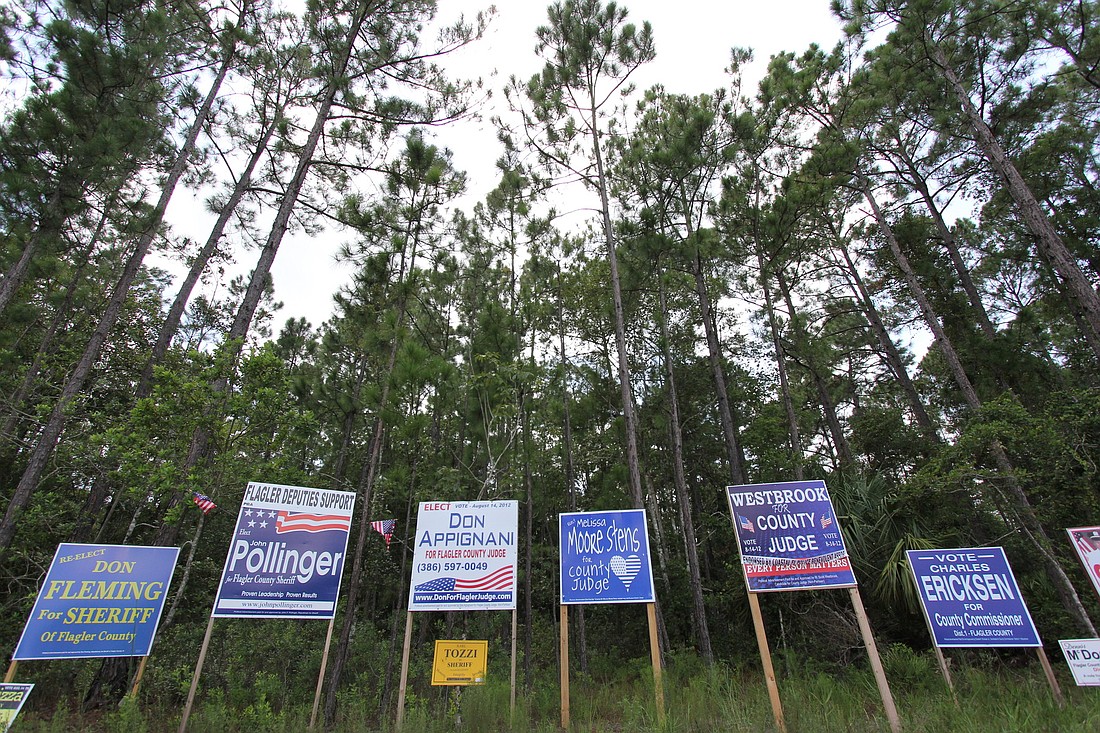
They’re everywhere.
Drive down Palm Coast Parkway or Old Kings Road or State Road 100 or U.S. 1, and there they stand: election signs, huddled together at intersections and swaying in the breeze over neighbors’ lawns. Where one crops up, others follow.
But to some candidates, sign strategy has less to do with how many signs a person can post and more, they say, with the science of being seen.
“I believe that once you post (a sign) in one location and people see it, they don’t see it anymore,” School Board Chairwoman Sue Dickinson said, noting that her theory has always been to relocate a smaller number of signs around the county every two weeks, instead of adding to an already crowded political market.
She also chose an alternative look for her signs, opting for purple font and kids’ handprints over the colors of the flag and block lettering. And, according to her, the strategy has worked. Twelve years ago, Dickinson was elected to the School Board and has since served three terms.
But this year, she says, things have changed.
Not only is money tighter (in her first campaign, Dickinson spent about $7,500, compared to $2,300 this year), but the landscape has also become more littered with signage than she ever remembers. And Palm Coast regulators are stricter, too.
So far this year, more than 100 of Dickinson’s signs have been thrown away by city code enforcers, she says — that’s compared to her having lost a total of just eight signs in her past three campaigns.
“I know that the signs are out of control this year, and I agree with some (people) that say that the city looks terrible — because it does,” Dickinson said. “But there isn’t any ordinances ... that say that you can only put up X number of signs, which to me is the answer.”
Twelve years ago, Dickinson had 75 election signs made, and opening her current campaign, she had 67 of the originals remaining. After a few weeks, however, she realized she was down to 22. So she spent $555 printing an extra 100.
Another few weeks, though, and she was down again to 42. And now she’s out of funds to buy mailers or other promotions.
“There are other ways to campaign with a $500 bill,” she added. “If I would have known this is the way things were going to go, I would have done things differently and not gotten into the signs as much.”
For Palm Coast City Manager Jim Landon, though, it’s a simple policy matter. Employees are instructed to remove any sign placed on city property or right of way, he said. And signs are only allowed on private property with the consent of the owner.
“(But) many candidates do not respect this basic courtesy and the signs are removed,” he said. “We pick up hundreds of signs — not counting political signs — and an unbelievable amount of litter each month.”
But he admits that, politically, something’s in the air this election season.
“To say the least, it is a big mess this year,” he said. “And we are doing our best to just enforce the rules consistently.”
I saw the signs
County Court Judge candidate Melissa Moore Stens also believes in avoiding sign “floods” and in the alternative-look strategy. But her budget is also far bigger than Dickinson’s — as is her inventory.
To date, Stens has contributed about $20,000-$25,000 of personal funds to her campaign, in addition to about $11,000 of outside contributions. She has 50 4-by-4-foot banner signs, to complement her stock of 500 yard signs.
“We were one of the first people to put up signs,” she said. “As more have come up, though, I think the public has stopped looking at them. ... Everybody shuts it out completely. So I think it’s useless.”
That’s why she prefers posting at quieter intersections, like the corner of Old Kings Road and Town Center Boulevard. She also has her logo displayed on car windows and in parking lots.
It’s the same type of thinking that went into her sign’s heart-flag design and casual lettering, a look she has been told by some doesn’t feel “judicial enough.”
“But I’m a scrapbooker,” she said. “That (sign) is completely me. I’m staying true to who I am. I am who I am.”
Even if the font is a bit harder to make out, she’s OK with that. It means people really have to read it, which means they’ll remember it.
Supervisor of Elections candidate Trey Corbett also tries to avoid what he calls “sign alleys,” by focusing his locations on more private lands than public. He also displays his face on his sign — which he believes gives him another edge.
“Having a background in psychology, I understand that some people are left-brain and some people are right-brain,” he said. “A lot of people recognize my face and might not recognize my name, and vice versa.”
And then there there is County Commissioner Milissa Holland, who is running for Florida House 24: She hasn’t posted a single sign in the county.
“I have chosen to spend my time meeting with small groups and organizations,” she said, citing past advocacy for county beautification. “I decided early on that due to the fact there were so many candidates in the primary, and so many signs going up and changing the landscape of our community, that I would utilize a different approach in my campaign.”
And the list of diverging strategies goes on.
Supervisor of Elections Kimberle Weeks won’t be running for re-election until November, but she already has signs planted and larger ones in parked truck beds around Flagler.
County court judge candidate Don Appignani utilizes a billboard-style sign on the side of a moving truck.
School Board candidate Bill Corkran has bought ad space before matinees at EPIC Theatres. And some of his bigger signs are homemade, constructed out of used lumber and some yellow paint, made to look like school buses.
Opposing Sue Dickinson, Corkran has also bought shirts for his campaigners to wear. He has printed 2,500 info cards, a banner for events, bumper stickers, cozies, postcard mailers and a total of 450 yard signs.
Look, location, wording — every aspect of a campaign sign has been analyzed and strategized by its creator. But some kinks can only be worked out after trial and error. Judge candidate Craig Atack, for example, says the “Atack for Judge” tagline on his signs has been confused by some residents as saying, “Attack the Judge.”
Still, following the Aug. 14 primary, most of the sign war will be over. A judge will be chosen. We’ll know our state attorney. Two School Board seats will be set. And whether you’re John Pollinger, who spent $40,547 on his campaign, or Dickinson, who spent $2,300, when it comes to small town politics, it’s really all a simple matter of who shows up to the polls.
“I know it’s an eyesore now,” Stens said of the election debris. “But a week after Aug. 14, three-quarters of the signs will be gone.”
And then it’s off to November.
Sign me up
According to Flagler County Public Information Officer Carl Laundrie, all political candidates must sign an agreement stating they understand all regulations before posting a single campaign sign. For the city of Palm Coast, the rules are the same, according to policies distributed by Virginia Smith, city clerk and supervisor of elections. Neither the city nor county charges a permit deposit. Bunnell charges $50.
The rules are as follows:
-Political campaign signs must be set back 2 feet from public rights of way and 15 feet from side property lines.
-The maximum height of signs is 5 feet in residential districts and 10 feet in commercial/industrial districts.
-The maximum size of signs in residential districts is 6 square feet, or 12 square feet per parcel; in agricultural, commercial or industrial districts, it is 16 square feet, or 32 square feet per parcel.
-Candidates or property owners must remove signs within 15 days after an election — failure to do so could result in fines up to $450.
$ign $tats
The county’s latest financial reports show active political candidates having spent anywhere from $25 (Ed Caroe, East Flagler Mosquito Control District) to $40,000 on campaign expenditures to date. A list of the top 10 spenders is as follows:
John Pollinger, sheriff $40,547.81
Melissa Moore Stens, judge $21,798.43
Craig Atack, judge $21,369.25
Gail Wadsworth, clerk of court $17,704.64
Donald Fleming, sheriff 13,899.93
Ray Stevens, sheriff $11,691.37
Ken Mazzie, clerk of court $9,055.86
Marc Dwyer, county judge $8,483.22
Jim Manfre, sheriff $8,030.11
Karl Tozzi, sheriff $7,772.72