- April 6, 2026

The Flagler Beach City Commission’s unanimous April 23 vote to use Holmberg Technologies' Undercurrent Stabilizer Systems is the latest attempt to making this small sea-side town the first on the Atlantic seaboard to have a naturally restored and permanently sustainable beach.
Flagler Beach boasts nearly seven miles of oceanfront along scenic highway A1A, now buttressed with rock revetments and a short sea wall. For years there has been lively controversy over whether to wall the entire seven miles and forfeit the beach, wait for the Army Corps of Engineers to complete its multi-year $3 million-plus feasibility study in preparation for an expected dredge-and-fill project, or turn to other methods of restoring the natural beach and protecting the road and the town.
The 5-0 decision came after years of research and advocacy by Save Flagler’s Beach, which had led the fight against beach renourishment and in favor of the adoption of a plan to restore the beach naturally.
“We did a lot of research on available options,” says Patty Brown, a founding member of Save Flagler’s Beach. “We determined early on that Undercurrent Stabilizer Systems was the only method that would give us back our natural beach in a permanent, sustainable way.”
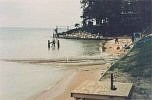
The Englewood-based HTI technology — consisting of sets of long slurry-filled tubes installed at calculated angles to the shore — has many decades-old installations to its credit that are continuing to build and protect once-eroded beaches along Great Lakes and Middle Eastern shorelines.
According to HTI President Dick Holmberg, Undercurrent Stabilizers work passively to reduce the energy of waves and currents. Slowed currents are induced to release the sand they carry. As a result, the beach widens and grows in elevation — an important attribute as sea levels rise. As the beach grows, the stabilizers disappear under the accumulating sand, and dunes develop, further protecting the shoreline and the road.
City Commissioner Kim Carney, a leader in the push to investigate and assess the various alternatives and, ultimately, a supporter of the Holmberg method, said the next steps for Flagler Beach officials will be to consolidate supporters among county and state officials and line up funding for the project, “which could be a small ‘demonstration’ project or an inlet-to-inlet project involving three counties.”