- April 8, 2026

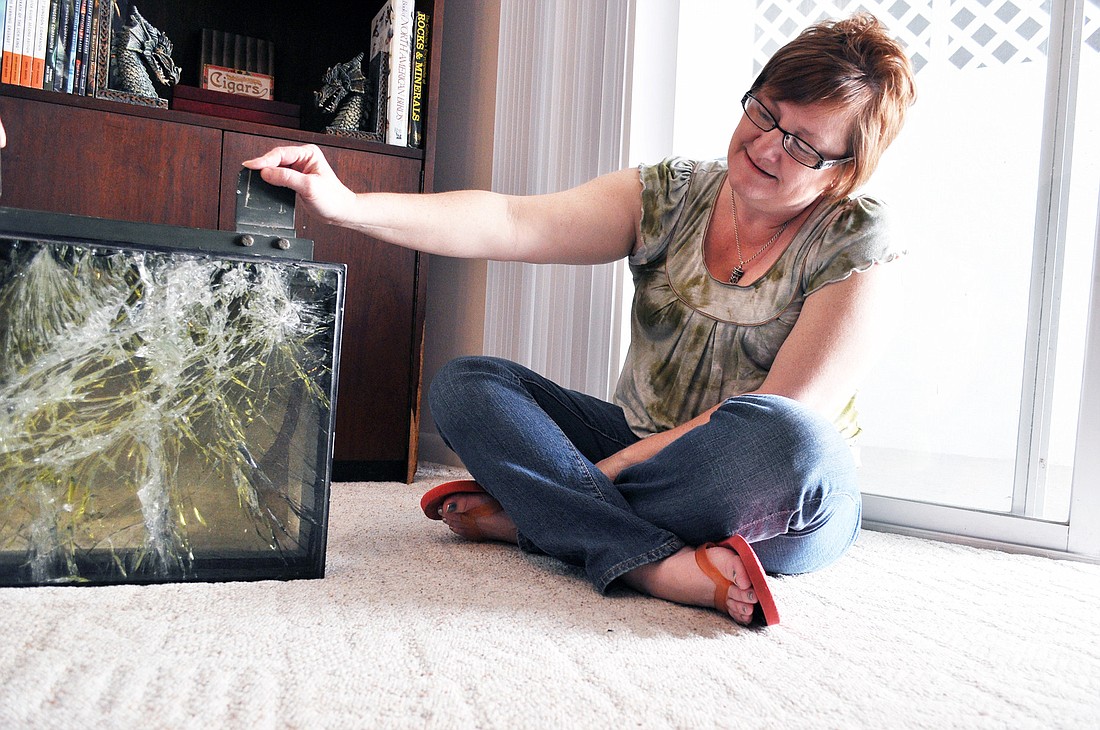
Memory Nichols spent the past five years dedicated to helping her husband, Corey Nichols, fight through post traumatic stress disorder before his death.
At 47 years old, Memory Nichols didn’t really know how to ride a bicycle. That’s until she met her husband, Corey. From him, she learned how to ride last summer and after that, the couple often hit the trails throughout Palm Coast.
Occasionally, Corey went for bike rides alone; Memory knew he enjoyed the adrenaline rush of riding fast.
On Friday, Feb. 25, Corey set off on his ride at about 5 p.m. Memory recalls a phone call from Corey around 5:45 p.m., when he told his wife that he was about 30 minutes away and that he was headed home.
“I said, ‘OK, see you in 30 minutes,’ and that was the last conversation we had,” Memory said.
Corey was reported missing around 8:35 a.m. Saturday, Feb. 26. Nearly 45 minutes later, Flagler County Sheriff’s deputies found Corey’s body in the woods near Walmart. According to the medical examiner’s report, the cause of death was asphyxiation due to ingestion of chemicals. Corey was 34 years old.
Sniper to Purple Heart
Corey enlisted in the U.S. Army fresh out of high school as an 18-year-old. He slowly worked his way up, and in 2004, he earned the rank of sergeant. He was a sniper in the Army.
But on Dec. 11, 2003, in Afghanistan, Corey’s life changed.
Corey was traveling in a Humvee with a convoy when word came over the radio that the convoy was passing through a hostile environment — some referred to the stretch as “IED alley.” The convoy was ordered to be careful and stay alert. Not long after, the Humvee was blasted by a roadside bomb, and three of the five occupants were killed. Corey and one other soldier survived. Corey suffered leg injuries and would eventually suffer from post traumatic stress disorder. On March 2, 2004, Corey was awarded with the Purple Heart for his injuries.
After 10 years in the Army, Corey retired following a medical discharge in 2005.
Military family
Corey and Memory met in January 2006, at a bar in Newnan, Ga.
“We had a lot in common, and it just clicked from there,” Memory recalled Tuesday at her home, sitting in front of a scrapbook with pictures of Corey.
Memory is from a military family. She served in the U.S. Army, and her father also was in the military.
In July 2006, Memory and Corey moved to Roanoke, Ala., to help care for Memory’s father, who died one month later. In September 2006, Memory and Corey got married — just seventh months after meeting.
In 2008, the Nichols moved to Palm Coast — the fourth time in five years the couple had moved.
Following the death of Memory’s father, she noticed Corey’s post traumatic stress disorder was getting worse.
“He was withdrawing from people and just wanted to be alone,” Memory said. “His nightmares got worse. He would want to be alone for the entire day and he would do anything to stay away from people.”
Corey was experiencing the affects of PTSD, and Memory knew it. Corey got treatment, but Memory recalls the uncertainty of the type of person Corey would be at any moment because of the PTSD.
“It’s a lifetime of constantly not knowing,” she said. “It caused a lot of heaviness all the time.”
PTSD isn’t curable, Memory said, and it’s a lifelong struggle to live with it on a daily basis.
Corey also had two children, Brendon and Emma, from his first marriage. They both live in Minnesota.
“He loved them dearly,” Memory said. “But he was scared to be around them too much because he didn’t want to expose them to (the PTSD) side of him. He had to balance being away from them and wanting to be with them at the same time.”
But because “he woke up a different person every day,” Memory said it was difficult to know when he would flip like a light switch.
Self-medication
Like many with PTSD, Memory said, Corey fell into “self-medication,” misusing his prescribed drugs. Then he got involved in more dangerous substances.
In May 2010, Corey was arrested on inhalation-of-dangerous-chemical charges for a second time in five months.
“He had his run-ins with the police, obviously,” Memory said.
Memory knew any drug problem was related to Corey’s PTSD, and she admits that at times, she felt like she needed out. But she had committed her life to Corey, and she wasn’t going to leave.
“One minute I would want to hit him and the next minute I’d want to squeeze him,” Memory said.
Memory said that in order for Corey to get high, he would inhale easily accessible chemicals that would literally freeze his brain cells.
“It gave him an instant high,” Memory said. “He would relieve his brain from thinking in any way he could. He just wanted the bad thoughts out.”
Memory recalls Corey’s visit to his therapist about a week before he died. He told the therapist that his memories of being a sniper didn’t bother him. In fact, in a strange way, he missed his military life — even the sniping.
“He would ask, ‘What’s wrong with me that I don’t feel guilty about that?’” Memory said.
Still, Corey was showing signs of improvement in the last month of his life. Memory said he was calmer for longer periods of time. But despite all the attention she gave him, he was unable, in the end, to withstand the draw of self-medication.
To ride a bike
Memory said she wants the families of soldiers who return with PTSD to know there is help — “that the emotions that you go through of hating them one minute and loving them the next is normal.”
She said she plans to become an advocate for the families, but she’ll take it slowly.
Each morning, Memory wakes up and greets the family pets — the two dogs, the cat, the fish, the snake and the bird — one by one, just as Corey did. Then, she said, her day feels empty.
Her purple Schwinn leans against the side of the house by her front door, parked next to Corey’s. Some things take time.